Full-Mouth Dental Implants in Mexico: Costs & Process
May 9, 2026

Back to Blog
.png)
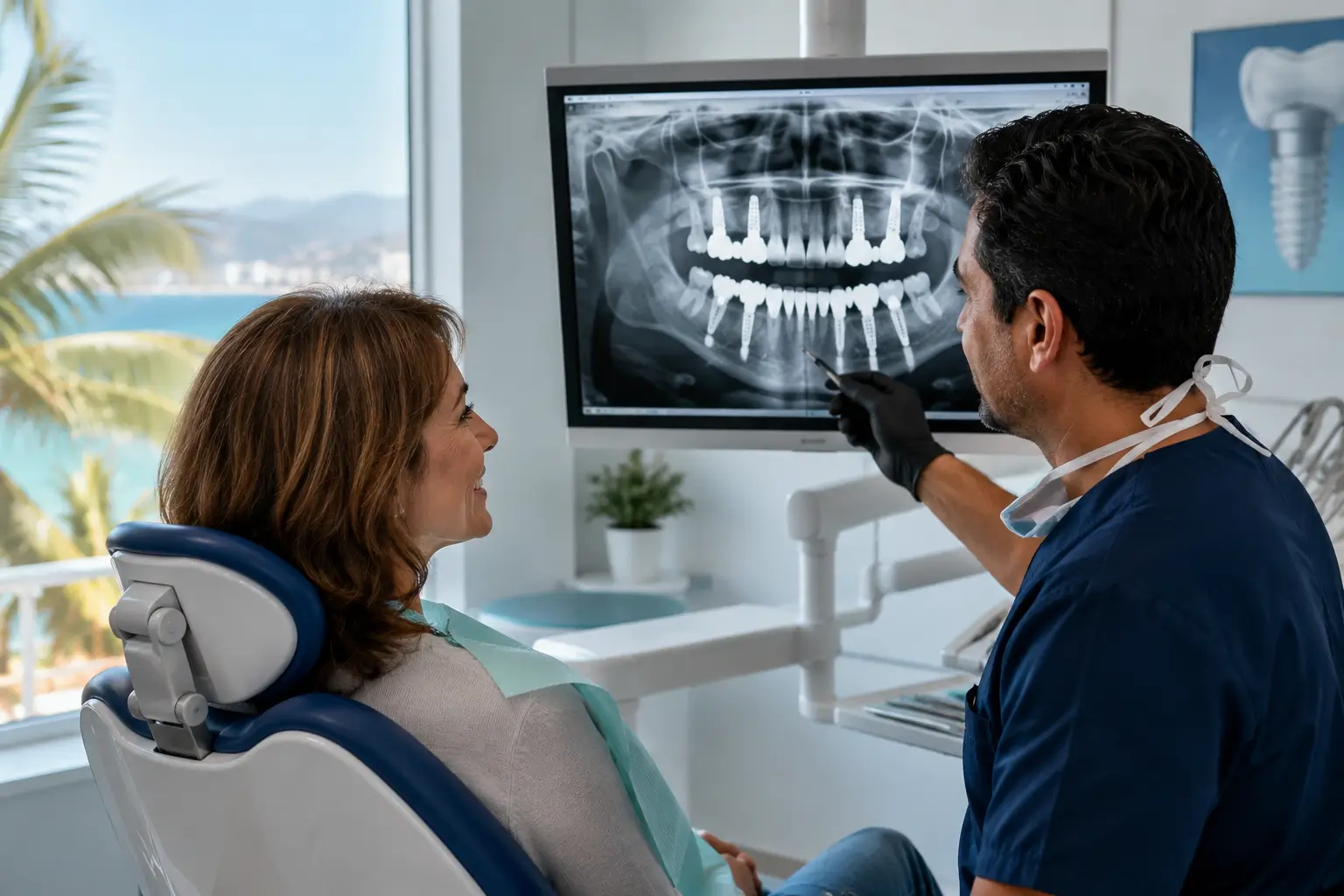
If you take away nothing else from this guide, remember these three principles: full-mouth dental implants aren't just another dental procedure. They reshape your oral health, your confidence, your finances, and your daily life for decades to come. When you pursue dental treatment across an international border, the line between a smooth outcome and a stressful one almost never comes down to luck. It comes down to documentation and planning.
Know your actual total cost—not the marketing price. The phrase "all-in" is meaningless until it's itemized on a dated PDF you can reference. You should be able to identify exactly where your quote addresses imaging (CBCT scans and X-rays), extractions, anesthesia or IV sedation, temporary teeth, your final bridge material (whether that's PMMA or zirconia), and contingency pricing if bone grafting becomes necessary mid-treatment. Any number that stays vague can shift dramatically once you've already arrived at the dental clinic.
Know your realistic timeline and trip count. The majority of patients require at least two trips: one for surgery and temporary teeth, then another four to six months later for the final prosthesis. If your case involves bone grafting or sinus lifts, you may be looking at three trips and a longer overall timeline. If you can't realistically take that time off work or return for adjustments, you need a treatment plan that aligns with how you actually live.
Know exactly who will treat you and what materials will go into your mouth. This means obtaining your surgeon's full name and cédula profesional (Mexico's professional license number), along with the precise implant system—a brand name like Nobel Biocare or Straumann, not vague references to "German implants." Request packaging photos and lot numbers for your personal records. This documentation protects you if you ever need service, replacement parts, or warranty support years down the road. A dental clinic that won't provide these basics in writing? That's not a cultural difference or communication hiccup—that's unnecessary risk.
This guide is written for U.S. and Canadian adults who are seriously weighing full dental implants in Mexico—people who want genuine savings without compromising safety, materials quality, or long-term support.
You're probably a strong candidate for dental tourism if significantly higher U.S. pricing pushed you to explore alternatives in the first place. You likely need a full-arch or full-mouth solution after years of struggling with bridges, traditional dentures, or progressive dental breakdown. And you're probably the type of person who wants a concrete method to verify clinic credibility rather than relying on slick marketing and glowing testimonials.
Be honest with yourself about some practical realities too: Do you have the schedule flexibility for multiple international trips? Are you comfortable traveling and recovering away from your usual support network? Can you commit to maintaining dental implants long-term through regular professional cleanings and check-ups—and possibly wearing a night guard?
Here's something important to understand: not everyone is a candidate for dental implants, regardless of where they get them. Certain medical conditions, specific medications (bisphosphonates used for osteoporosis, for example), severe bone loss, or uncontrolled systemic diseases can affect your eligibility or require a modified treatment approach. A thorough evaluation by a qualified clinician—ideally including a CBCT scan or CT scans—is non-negotiable before you commit to any treatment plan.
By the time you finish this guide, you'll understand how to validate credentials, compare itemized quotes without being misled, plan travel and healing realistically, and protect yourself if issues arise after you return home. This isn't personal medical advice—your final plan must be confirmed by a qualified implant clinician who has reviewed your imaging and health history firsthand.
Before you start comparing clinics, booking flights, or wiring deposits, take the single step that cuts through uncertainty fastest: ask for a dated, downloadable PDF quote that names your specific surgeon.
When everything stays vague—"starting at," "all included," "our expert team"—you're essentially being asked to make a life-changing decision on blind trust. A dated PDF with a named surgeon replaces that fog with something you can actually verify. Request the surgeon's full name and license number (the cédula profesional), along with the exact implant brand and model (Nobel Biocare, Straumann, BioHorizons, MIS, or MegaGen, for instance).
Here's language you can use—and there's no need to apologize for asking:
If the dental clinic hesitates, keeps the surgeon anonymous, or simply won't commit details to writing, treat that as a serious red flag. Working with multiple quotes? Keep everything organized in one place so you can compare surgeon names, implant systems, timelines, and warranty language side by side. The Globalcare app is designed to help you collect and compare exactly this type of documentation.
For any comparison to mean anything, you need apples-to-apples totals—not promotional "starting at" figures. The ranges below represent a 2026 pricing snapshot compiled from commonly advertised self-pay prices across Mexican clinics and dental tourism platforms, combined with typical U.S. patient quotes that include major components like surgery and prosthetics. Real pricing varies considerably based on grafting needs, anesthesia type, brand and material selections, case complexity, and geographic location.
Think of the low end as a straightforward case with standard materials. The middle represents a typical real-world case. The high end reflects more complex planning, premium materials, and deeper sedation options. If a clinic's quote falls significantly below the low end, your job is to figure out what's been left out—often the final bridge material, anesthesia, extractions, grafting, or meaningful warranty support. Individual quotes may land outside these ranges depending on your specific situation.
Curious about single-implant pricing? You'll encounter a wide range depending on brand, grafting requirements, and dental crowns material. Just don't make the mistake of comparing a single-implant price to an all-in full-arch package—those represent entirely different bundles of services. And remember: if imaging, anesthesia, temporaries, final prosthetics, warranty terms, and follow-up visits aren't clearly itemized, you don't have a meaningful comparison. You have marketing.
All-on-4[11] pricing in Mexico is often advertised around $8,500–$13,000 per arch, while U.S. quotes commonly land closer to $24,000–$32,000 / $48,000–$65,000[12] depending on what's included.
For larger full-arch cases, U.S. pricing for $28,000–$40,000 / $56,000–$80,000[10] is a common self-pay range cited for All-on-6 and similar configurations, while full-mouth totals can reach $48,000–$80,000+[8] depending on materials and complexity.
For removable options, U.S. pricing for $5,000 to $12,000 / $10,000 to $24,000+[9] is a more typical range for snap-in dentures than many headline quotes suggest.
Price ranges only become genuinely useful once you customize them for your specific situation. Whether you're using an online estimator or simply building a spreadsheet, it should accomplish one essential job: transform broad ranges into a documented, adjustable plan you can stack up against competing clinics.
Full-arch treatment isn't one-size-fits-all. Your jawbone density, bite force, medical history, and willingness to maintain implants all factor in—not just your budget. The right approach should ultimately be determined with a qualified implant dentistry specialist who has assessed your individual anatomy and health profile.
If minimizing future travel is a priority for you, choosing a plan with widely supported implant components can save significant headaches down the road. If you have poorly controlled diabetes, smoke, or have a history of periodontal disease, you'll likely need a more thorough evaluation—and possibly a staged approach—since healing and osseointegration can be more complicated. While implant success rates are generally quite high[2] (often reported above 95% in studies of well-selected patients), your personal outcome depends on factors including bone quality, oral hygiene habits, overall health, and smoking status.
All-on-4 supports a complete arch of teeth using just four strategically placed implants, frequently with angled positioning in the back to maximize whatever jawbone you have available. Many patients are drawn to it because it can reduce the need for grafting and, when bone quality allows, support an immediate temporary bridge placed the same day as surgery.
Living with All-on-4 can dramatically improve your quality of life—replacing missing teeth with a permanent solution that functions like natural teeth—but it's not a "set it and forget it" situation. You'll need meticulous daily cleaning under the bridge using special floss or threaders, a water flosser, and regular professional cleanings. With proper care, your full-arch implant restoration can last decades. Expect bite adjustments in the early months as your muscles and bite pattern adapt.
Temporaries are inherently more prone to chipping or needing minor tweaks than your permanent bridge, and that doesn't signal treatment failure—it simply means you should build buffer days into your trips for adjustments. Some patients opt for All-on-4 with a temporary or mid-term prosthesis first, then upgrade to zirconia once healing has fully stabilized. If that's your plan, document it now: materials, timing, and precise upgrade pricing. Keep in mind that not all patients are candidates for immediate loading—your surgeon will determine eligibility based on bone quality and implant stability at the time of implant placement.
All-on-6 or All-on-8 simply uses additional implants to support your bridge. The theoretical advantage is improved force distribution—which may be particularly meaningful if you have a powerful bite, grind your teeth at night, or simply want the sturdiest possible foundation for your full arch restoration. That said, long-term comparative studies between All-on-4 and All-on-6/8 approaches demonstrate generally comparable success rates when cases are appropriately selected.
The trade-off is practical: more implants typically mean more surgical time, more complex planning, and higher overall cost. Whether additional implants would provide clinically meaningful benefit for your particular case is a conversation best had with your surgeon based on your anatomy and needs.
Questions worth raising: "Based on my scan, what specific problem would 6 or 8 implants solve that 4 wouldn't?" "If one implant fails to integrate, what's the backup plan, and what would that cost?" "Do you recommend a night guard given my bite pattern, and is wearing one required to maintain my warranty coverage?"
Snap-on overdentures are removable dentures that clip onto implants using locator-style attachment components. Unlike traditional dentures that rely solely on adhesives and suction, implant-supported overdentures offer significantly improved stability and chewing function. They're generally less expensive upfront than fixed bridges and can be simpler to clean since you remove the entire denture to do so.
The daily experience differs meaningfully from fixed bridges: you'll take out the denture to clean it thoroughly, clean around each implant attachment, then snap everything back into place. Many patients find the comfort level excellent, though it's a distinctly different sensation—some notice more bulk on the palate and more movement than a fixed option, while others adapt without issue.
The "wear parts"—the attachment inserts—will need periodic replacement, and that's completely normal. Budget accordingly, and confirm how the clinic handles parts and follow-up support once you've returned to the U.S. or Canada. Ask specifically: What's covered when attachments wear out? What do replacement parts cost? Are the components standard and easily sourced by dentists near my home?
Not everyone can—or should—complete full-mouth restoration in a single concentrated push. A staged approach may be the most appropriate option when health factors, significant grafting requirements, or budget realities make single-stage dental implant treatment risky or impractical.
You might choose staging for complex grafting or sinus lifts that require months of healing before implant placement can proceed, for medical considerations that favor shorter procedures with conservative timing, or simply to distribute treatment costs across a longer period.
The trade-off is coordination complexity: you'll need a clear plan for interim teeth, plus explicit clarity on who handles maintenance between visits—the Mexican dental clinic or a local U.S. dentist. Going the staged route? Insist on a written timeline with defined checkpoints and clear "if healing is delayed, then..." contingency instructions.
Before you finalize anything, run through the CARE check. It keeps you focused on the four areas where patients most commonly get hurt—medically or financially—and bridges the gap between surface-level research and a confident decision grounded in real evidence.
A trustworthy quote isn't a single number—it's a comprehensive list of what you're paying for and what might become an extra charge once you're already in the chair.
Ask the dental clinic to itemize everything in a dated PDF: consultation and treatment planning, CBCT scan and X-rays, extractions (and sedation for extractions if applicable), bone grafts or sinus lifts (or clear per-site pricing if "only performed if needed"), implants, abutments, and multi-unit components, temporary teeth (specifying materials and whether repairs are covered), final bridge (with material clearly stated: acrylic, PMMA, or zirconia), anesthesia or IV sedation fees, lab fees, follow-up visits during your trip and post-operative check-ins, and any taxes or administrative fees.
Without these elements explicitly addressed, you can't accurately answer the question most people start with: "How much do dental implants cost in Mexico?" You're simply missing too much of the picture.
You're not being difficult or paranoid by requesting proof—you're being appropriately careful for a procedure you'll live with for the rest of your life. At minimum, seek verifiable evidence of your surgeon's identity and licensing (full name plus cédula profesional, with clear instructions on how to verify it through Mexico's Registro Nacional de Profesionistas), their training and relevant experience in implant dentistry (who performs the actual surgery, who designs the prosthesis, and whether any dental specialists are involved), and confirmation of implant brand and model authenticity—the exact system name, not just "premium" or "German implants," plus packaging photos and lot numbers for your records.
Marketing claims aren't evidence. A legitimate clinic providing high-quality care can provide documentation without acting insulted by the request.
A recovery plan isn't simply "come back in 4 months." It's a written timeline that translates clinical steps into the realities of your life: work commitments, caregiving responsibilities, travel logistics, and the biological process of osseointegration—when your jawbone fuses with the implants.
Your written plan should specify how many trips are anticipated and how long you should stay each time, whether you're a candidate for immediate loading (temporary teeth placed right away) or a staged approach, healing windows and what specific milestones must be achieved before finals can be placed, what circumstances might trigger additional visits (bite complications, healing delays, temporary repairs), and who to contact and what steps to take if swelling or pain doesn't follow the expected pattern. Remember that healing timelines are estimates—individual variation is normal, and factors like age, overall health status, and smoking can meaningfully affect how quickly you heal.
The key isn't the number of years emblazoned on a warranty—it's whether you can realistically use that warranty once you're back home in the States. Get the following in writing: the clinic's emergency contact method (including a phone number and expected response time), the warranty scope (what's covered: implants, abutments, bridge, attachments), clear exclusions (smoking, poorly controlled diabetes, missed cleanings, bruxism without a night guard, trauma, etc.), the claim process (what documentation you must provide and the timeline for evaluation), and who bears responsibility for travel, imaging, shipping, and out-of-network repairs if required.
Keep in mind that cross-border warranties have inherent limitations: pursuing legal recourse against a Mexican clinic from the U.S. or Canada is substantially more difficult than with a domestic provider. This makes thorough upfront documentation and realistic expectations about warranty enforcement even more important.
If any of these elements are missing, you're being asked to accept risk you may not fully understand until it's already too late to negotiate.
Many Mexican dental packages sound wonderfully comprehensive because the headline price is so attractive. The safest way to compare clinics is to force a transparent breakdown of what's genuinely included versus what mysteriously becomes an extra charge once you've already committed.
Once you've gathered two to four quotes, arrange them in a simple comparison grid so you can evaluate value clearly without getting swept up in sales conversations. Track each clinic's package tier, high-level inclusions, probable extras, warranty documentation quality, materials (brand and final prosthetic type), and any notes on red flags or unverified promises. Require source documents—actual quote PDFs, warranty PDFs, material identifiers. If it's not documented, operate as though it's not included.
Hidden costs are rarely genuinely hidden—they're simply left vague until you're already committed. Watch carefully for "graft as needed" with no price per site defined, unclear final-teeth materials (the difference between temporary acrylic and final zirconia represents a major gap in both cost and durability), no mention of anesthesia or sedation options like local anesthesia versus IV sedation, an unclear number of required trips (a "great deal" changes rapidly if you need an unplanned third visit), warranty language that sounds impressive but proves difficult to actually use, and outsourced labs with no turnaround commitments—which could unexpectedly extend your stay.
Mexico's lower prices often stem from the lower cost of living and reduced labor and laboratory expenses—not from mystery shortcuts or inferior materials. The primary trade-off is usually follow-up logistics: getting a quick in-person adjustment can be significantly harder once you're back home. Direct comparative outcome data between U.S. and Mexican dental implants is limited, and quality varies by clinic in both countries, which makes individual clinic verification absolutely essential.
The right choice depends entirely on your priorities: maximum cost savings, easiest follow-up access, premium materials, or minimizing the number of trips. The "best deal" is ultimately the one that still works when something small goes wrong.
For most full-arch and full mouth dental implants cases, you should plan on multiple trips. The exact schedule depends on your bone quality, whether grafting is required, and whether the clinic determines you're a candidate for immediate loading of temporary teeth.
For immediate loading cases, Trip 1 covers any necessary extractions and dental implant surgery, with placement of a provisional restoration typically within 24 to 72 hours. You then heal at home for approximately four to six months before Trip 2 (5–7 days), when your permanent bridge is fitted and delivered. These timelines are general estimates—your surgeon will provide a more specific schedule based on your healing progress.
When grafting is required due to bone loss or complex support needs, the timeline expands significantly. Trip 1 addresses grafting procedures, followed by four to six months of healing. Trip 2 places the implants, then another four to six months of healing. Trip 3 delivers your final bridge. So when people ask "how much do full dental implants cost in Mexico?"—the honest answer often includes: "It depends on how many trips and healing phases your case requires." Your clinic should estimate both scenarios in writing.
Delays don't automatically signal that something went wrong. Common reasons for extended timelines include slower-than-expected bone integration, bite adjustments requiring extra chair time, or laboratory remakes needed to achieve optimal fit and aesthetics for your restoration. To protect both your schedule and your budget, build buffer time into each trip—especially your final-bridge trip—to accommodate swelling, bite refinements, and potential lab delays.
Ask for a written contingency plan: "If my final bridge needs a remake, what happens to my schedule and what additional costs would I face?" Book flexible travel arrangements wherever possible (refundable hotel nights, changeable flight tickets)—that flexibility costs far less than being forced into last-minute extensions. And plan your life logistics early: align trips with work deadlines, arrange caregiving coverage, and schedule around any major events where you'll need to speak publicly or travel.
Travel goes more smoothly when you approach it as a medical tourism trip rather than a vacation with dental work tacked on. Bring your documentation in both printed and digital formats: dated quote PDF, warranty PDF, appointment confirmations, scan files if the clinic provided them, and post-operative instructions.
Create a critical information sheet covering your medications, allergies, medical conditions, emergency contacts, and your clinic's emergency phone number. Have a clear payment and receipts plan with a U.S.-compatible payment method and a dedicated folder for all receipts. Handle prescription refills before departure since regulations differ between countries.
Choose lodging close enough to avoid long drives immediately after surgery—and confirm clinic directions plus any airport pickup options in advance.
Mexico's dental market varies significantly by location—your experience can differ dramatically depending on where you go. Before you fall in love with a clinic's website photography, choose a geography that matches your comfort level and follow-up realities.
Border cities like Tijuana and Los Algodones are typically the easiest and least expensive to reach from the U.S., making return trips for adjustments far more practical. These areas host many high-volume dental clinics catering to international patients.
A travel cost estimator is the simplest tool to ensure that "amazing dental pricing" doesn't get erased by flights and unplanned extra nights. The most useful estimators let you input your departure city, number of trips anticipated, nights per trip, and local transport needs—then output an itemized, dated summary you can combine with your medical quote for a true all-in picture. Because travel costs fluctuate seasonally, a helpful estimator also allows adjustments for timing (high season versus shoulder season), lodging tier, and whether a support person will accompany you.
Once you've selected a few destinations and narrowed down your procedure options, the task becomes straightforward: collect the same proof from each clinic in a consistent format so you can compare fairly without getting pulled off track by marketing.
Request these essentials from every dental clinic on your shortlist: a current, dated quote PDF with inclusions and exclusions clearly stated; the named surgeon plus license number and verification instructions; clinic location and clarification of who performs which roles (surgeon vs. prosthetic dentist vs. laboratory); explicit identification of the package tier (basic, mid-range, full-featured); a warranty PDF (not a copy-pasted email message); and before-and-after cases matching your procedure and starting condition, complete with dates.
When asking questions, seek answers that can be independently verified: "Please send the PDF." "Please specify the exact implant system name." "Please confirm the final bridge material in writing." If a clinic can't provide documentation for a claim, don't accept "trust us" as a substitute.
Use a spreadsheet or table for consistent evaluation. At minimum, track clinic name, quote date, package type, surgeon name, warranty link or PDF, implant brand and materials, documented timeline, and emergency contact method. The example row below shows the format—replace with actual clinic data as you collect it:
Flag missing fields—an undated quote, missing warranty PDF, unnamed surgeon, unverifiable credentials—before you send any payments. Save files using a simple naming convention so nothing gets lost: [ClinicName]_[YYYY-MM-DD]_[DocumentType].pdf. If a clinic refuses to provide basic documentation, pushes you to pay before sending it, or becomes evasive when you ask for written clarity, that's your signal to walk away—no matter how attractive the price appears.
Compare pre-screened dental clinics in Mexico
Reputable clinics can typically provide patient case documentation that includes sequential images (before treatment, temporary phase, final result, and sometimes immediate post-operative photos), the procedure type and approximate date, clear views of fit, bite alignment, and gumline transitions, and confirmation that patient consent was obtained for sharing.
Look for visual markers of high-quality dental work: a consistent midline and overall symmetry, natural-looking tooth proportions and shade that resemble natural teeth, clean transitions where the prosthesis meets the gum tissue, and photographs that aren't heavily filtered or shot exclusively from one flattering angle. Be skeptical of galleries filled with generic, undated, stock-style imagery. Request cases that match your specific procedure and starting condition, and ask for dates so you can distinguish immediate post-op results from fully healed outcomes. A complete full-mouth restoration portfolio should demonstrate consistent results across multiple patients.
When comparing warranties across clinics, focus on three elements: coverage scope, specific exclusions, and how you would realistically file a claim once you're back in the United States or Canada. Warranty terms can change over time, so always verify current policies directly with the clinic before making any commitment.
The table below shows illustrative examples of how warranty terms may be structured. These are based on publicly available information and may not reflect current policies—always confirm directly with any clinic before committing:
A simple clarity rating helps during comparison: Strong means the warranty PDF is readable, exclusions are specific, claim steps are spelled out clearly, and emergency contact information is provided. Medium means duration is stated but exclusions or claim procedures are vague. Weak means "we stand behind our work" with no PDF, no defined exclusions, and no real claim process. A warranty is only as good as your ability to meet its requirements—get those requirements documented in writing before you commit.
Quality clinics won't be offended by verification requests—they'll be fully prepared for them.
Request the exact implant brand and system name (not vague descriptors like "premium" or "German"), packaging photos showing the model and lot numbers for your permanent records, manufacturer datasheets or certificates if available, and distributor or lab documentation when packaging isn't available. Nobel Biocare and Straumann are examples of globally recognized implant systems with established track records for durability and parts availability. If you ever need service in the future, having the precise implant system documented can mean the difference between a straightforward fix and a frustrating, expensive dead end.
Request written infection-control protocols. If the clinic is willing, ask for autoclave monitoring details and how they track sterilization cycles. Confirm whether they use CBCT imaging and CT scans for treatment planning, and whether scans are included in your quote and shareable with you. Ask where your final prosthesis is fabricated—in-house digital lab versus outsourced—since this directly affects turnaround times, remake speed, and how efficiently adjustments can be completed during your trip. If key items are "not available" or you feel pressured to stop asking questions, take that seriously.
Even with excellent dentistry, implant cases sometimes need adjustments—particularly with temporary prosthetics, bite changes during the healing process, or occasional unexpected complications. Protect yourself by locking in support systems upfront and knowing exactly what to do if something feels off.
Before you travel home, obtain written post-operative instructions covering normal healing milestones and red-flag symptoms that require attention, urgent access details (a 24/7 contact method, how to securely share photos, and typical response times), and your complete documentation package: quotes, receipts, scan files, and implant details including lot numbers.
If a problem emerges, follow a straightforward decision tree. For same-day urgent situations—uncontrolled bleeding, fever, spreading swelling, difficulty swallowing or breathing, severe allergic reactions—seek in-person medical care immediately. For issues warranting quick clinic contact with photos, think worsening pain after initial improvement, persistent discharge or bad taste, a loose temporary, sudden bite changes, or a crack or chip you can feel. When visiting a U.S. dentist for short-term relief, share your implant system details and records so they're not working blind. Keep all receipts and notes in case your warranty requires documentation. Thorough records reduce confusion, help a local dentist support you safely, and protect your warranty position.
Globalcare doesn't replace your personal due diligence or your clinician's medical judgment, but it can streamline the process significantly when you're juggling multiple quotes, organizing records, coordinating travel timing, and navigating language barriers.
The service provides clinic introductions with baseline requirements—access to clinics throughout Mexico that have provided documentation of credentials, equipment, and English-friendly communication. It helps with paperwork and proof organization so you're actively collecting and comparing key documents (quotes, timelines, warranty terms, materials) rather than depending on verbal promises. Comparison tools offer side-by-side views of pricing, patient reviews, and before-and-after case documentation to accelerate your shortlisting. Coordination support provides bilingual communication assistance and records transfer help, plus planning support to minimize friction throughout the process.
What Globalcare doesn't do: provide medical diagnoses, override a surgeon's clinical judgment, independently verify all clinic claims, or eliminate the need for your own verification work. The goal is simply to reduce preventable errors—missed details, lost paperwork, cross-cultural misunderstandings—so your final decision rests on solid evidence, not pressure.
Start by requesting two to four formal, dated PDF quotes, each clearly naming the surgeon and listing all included services and materials. Create one comparison entry per clinic with links to the quote PDF, warranty PDF, surgeon and license information, and written timeline. Schedule consultation calls with your comparison table in front of you, and ask for any missing documents before you send any money. Flag unknowns immediately: grafting or sinus-lift pricing, number and timing of trips, and exactly what's covered by warranty once you're back in the U.S.
If you want your shortlist to begin with clinics that meet certain baseline documentation requirements—and you want to request multiple quotes with a clear record of what each includes—the Globalcare app is a practical next step.
One final word: Don't move forward with booking until every major promise has been confirmed in writing, in English, with documentation you can save for your records.
Clinical review: Clinical content in this guide has been reviewed by a dental professional with implant experience. This guide is for informational purposes only and does not constitute medical advice. Readers should consult with their own dental provider before making treatment decisions.
Editorial independence: Clinics cannot purchase rankings or editorial coverage. Any affiliate, referral, or sponsorship relationship is disclosed clearly near calls to action and in the footer so readers can evaluate potential bias for themselves.
When evaluating clinics and planning your treatment, look for resources that display their source and "last updated" dates: cost comparison tables showing Mexico vs. U.S. pricing, warranty comparison indexes with links to actual PDFs where available, interactive estimators with exportable reports (PDF or CSV), clinic directories with clear documentation requirements, and verified before-and-after galleries with dates and procedure types.
Quality tools display their source, last updated date, and clear inclusions and exclusions. Exports should include timestamps, assumptions, and warnings when required documentation is missing. Look for automatic gap flags (undated quote, missing warranty PDF, unnamed surgeon, unverifiable credentials) before data displays as "comparable." This level of transparency isn't optional—it's what keeps patients safer when decisions are high-stakes and cross-border.
The best savings are the ones you can defend with documentation. Every figure, credential, material choice, and promise should be verified—because with full-mouth dental implants abroad, what you don't confirm upfront can cost you dearly later. Whether you're considering Tijuana, Los Algodones, Cancún, or another destination in Mexico, the principles remain the same: prioritize high-quality dental care, verify everything in writing, and ensure your implant restoration will serve you well for decades to come.
Get in touch to get started!
Our team of experts will ensure your all-on-4 dental implants journey is safe and easy. We're dedicated to guiding you to your new smile every step of the way!
ConnectConcierge Services

Trusted Dentists

Safe Locations

Concierge Services
Trusted Dentists
Safe Locations

Disclaimer: Dental Cost Estimation Calculator
This Dental Cost Estimation Calculator is designed to provide users with estimates of potential savings when seeking dental treatments abroad compared to the cost of similar procedures in the United States. However, please be aware of the following important information before using this tool:
1. Estimations Based on Publicly Available Data:
The estimates provided in this calculator are derived from publicly available data sources, including average procedure costs, exchange rates, and other relevant information. These figures may not reflect the exact costs of your specific treatment or location. Estimations include non-dynamic assumptions for travel and lodging costs that may not reflect the actual costs at the time of your research.
2. Quantitative Model Assumptions:
The calculations are based on assumptions and data inputs that may not account for all factors influencing dental treatment costs. Variations in individual treatment needs, dentist fees, and other variables can significantly affect the final expenses.
3. No Substitute for Professional Advice:
This tool is not a substitute for professional dental advice. Before making any decisions about your dental treatment, it is crucial to consult with a qualified dental professional who can provide you with a personalized assessment of your needs and potential costs.
4. Currency Exchange Rates:
Estimates involving foreign treatment costs rely on currency exchange rates, which can fluctuate. The rates used in this calculator may not accurately represent the current market rates at the time of your treatment.
5. Geographic and Facility Variations:
Dental costs can vary significantly based on geographic location, dental facility, and the complexity of the procedure. The estimates provided are general in nature and may not reflect the specific conditions in your chosen destination or dental clinic.
6. Non-Inclusive Costs:
This calculator may not account for additional expenses such as per diem costs in destination or unforeseen complications during or after the procedure. These costs can substantially impact your overall expenses.
7. Liability Waiver:
By using this calculator, you acknowledge that the estimates provided are for informational purposes only, and Globalcare Network Inc or any of its representatives bear no responsibility for the accuracy of the estimates or any decisions made based on them.
8. Independent Research Recommended:
It is strongly recommended that you conduct independent research, obtain quotes from dental professionals, and consider all relevant factors when making decisions about dental treatment abroad.
In summary, while this Dental Cost Estimation Calculator aims to provide helpful information, it should not be the sole basis for your decision-making process. Your individual circumstances and dental needs may differ, and it is essential to seek professional advice and conduct thorough research before pursuing dental treatment abroad

