Dental Implants in Tijuana: How to Find a Good Clinic
April 27, 2026

Back to Blog
.png)
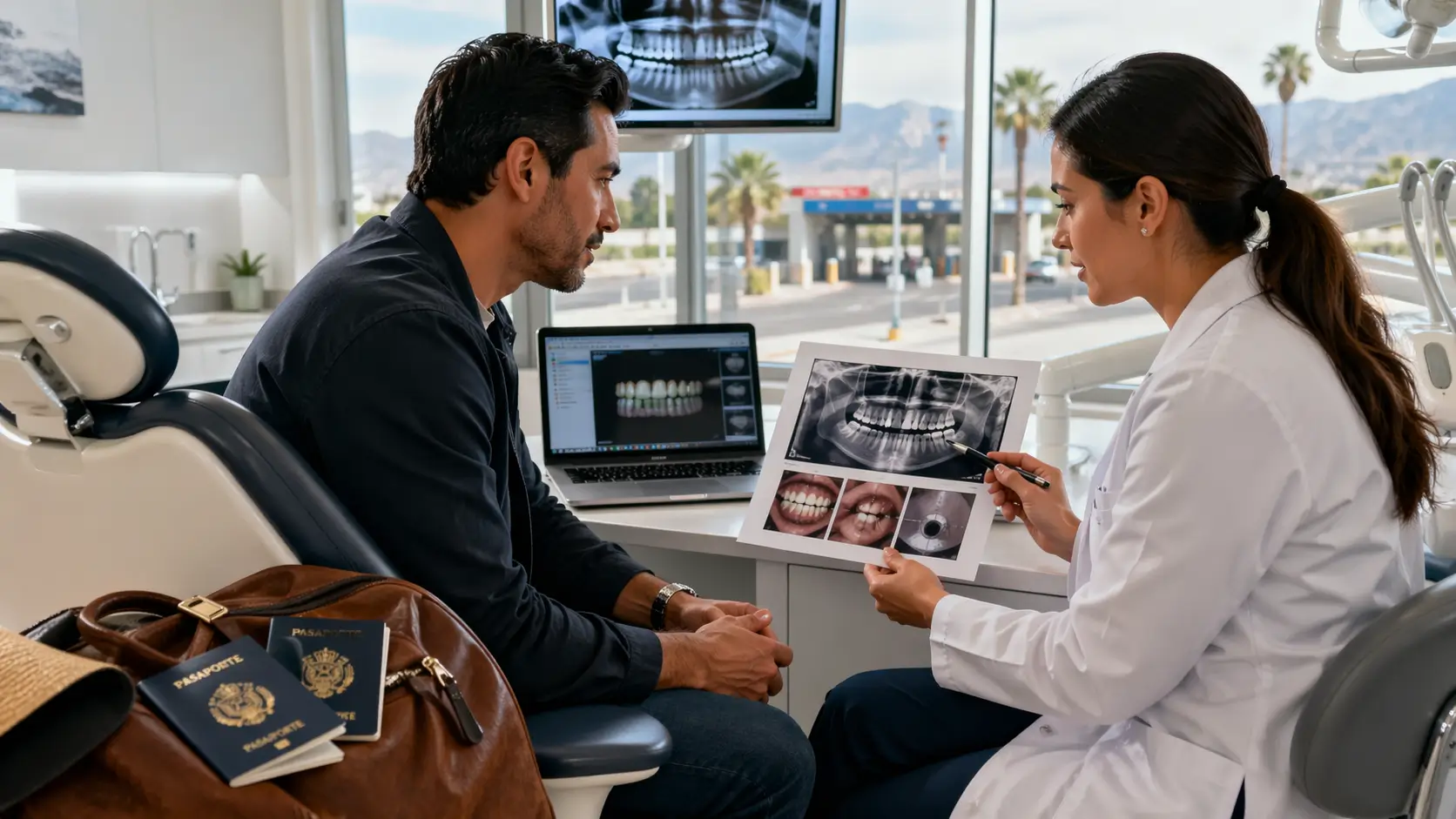
Dental implants are surgery. They need healing time, follow-up visits, and a real financial commitment. Most people turn to dental tourism in Tijuana because the savings are real—and they can be significant. To protect both your health and your budget, three things need to be in order from the start.
First, understand your total cost—not just the per-implant price. The number that matters is your complete treatment plan: the imaging (usually a CBCT or CT scan), the surgery itself, whether you'll get temporary teeth while you heal, how many trips you'll need, and what happens if something needs adjusting. A good clinic will send you a dated, line-by-line quote in U.S. dollars. It should show exactly what's covered—and what costs extra, like extractions, bone grafting, sedation, or switching to a zirconia crown.
Second, check credentials—and get them in writing. Whether you're looking for the best dentist in Tijuana or simply a reliable one, a "top clinic" isn't a feeling—it's documentation you can verify yourself. You need the surgeon's full legal name and their Mexican professional license number (called a cédula profesional), which you can look up on Mexico's official SEP registry. You also need written confirmation that this specific surgeon—not just "someone on staff"—will handle your case. Ask for the implant brand by name (common ones include Straumann, Nobel Biocare, BioHorizons, and MIS), and request traceability proof—a photo of the implant kit label showing the lot and batch numbers.
Third, get the aftercare plan in writing before you pay anything. Even great dental work sometimes needs small fixes—a bite adjustment, a loose screw, a chipped temporary. If the clinic can't give you a written policy on complications and remakes, a real 24/7 contact number with a backup, and a clear follow-up schedule, you're not booking care. You're booking hope. Get the policy first, then worry about deposits and travel.
If dental costs in the U.S. feel out of reach, Tijuana can be a real option. Many patients dealing with missing teeth—whether one or many—find that Tijuana makes treatment genuinely accessible. But the right question isn't "Is Tijuana safe?" It's more specific: "Is this clinic transparent, properly credentialed, and set up to support me after I go home?"
Tijuana makes the most sense if you're uninsured or underinsured, facing high out-of-pocket costs in the U.S., dealing with long wait times, or comfortable managing a cross-border trip. It's especially popular with San Diego and Southern California residents who can drive across the border for a weekend—as long as the clinic's plan is realistic. Many patients find the savings still hold up even after adding travel costs.
Here's something important: Plan on at least one return trip. Most implant cases are not one-and-done. Even when clinics advertise "teeth-in-a-day," what you usually get right away is a temporary set while your implants heal and fuse with the bone. Your permanent teeth come later. That's not a warning sign—it's just how implant dentistry works.
The right mindset: treat travel and documentation as part of your total cost and timeline. Credentials, clear pricing, material traceability, and written aftercare aren't extras—they're the baseline. If a clinic hesitates to provide any of these in writing, that's useful information. Move on.
It's also worth noting that not everyone qualifies for implants. You need enough bone density, healthy gums, and reasonably controlled overall health. Conditions like uncontrolled diabetes, gum disease, heavy smoking, or certain bone medications (such as those prescribed for osteoporosis) can affect whether you're a good candidate Any reputable clinic will check your oral health before confirming implants are right for you—some patients do better with alternatives like dentures, a dental bridge, or dental crowns, while purely cosmetic concerns may be addressed with veneers.
You'll see "50–70% savings" advertised everywhere—and that range is often accurate. Tijuana's affordable prices are one of the main draws for dental tourism, but your real savings depend on the procedure, how complex your case is, and which clinic you pick. The only fair comparison uses the same scope of work: same implant brand, same materials, similar imaging, and matching aftercare terms.
Where surprise charges come from: Extra fees that show up after you arrive often include bone grafting, extractions, material upgrades, added visits, and imaging. The simplest protection? A line-by-line quote in USD that says what's in, what's out, and what triggers a new charge.
For multi-implant and full-arch cases, the price gap can be large enough to change what's actually possible for you financially. Clinics in Tijuana offer affordable prices without sacrificing high-quality dental treatments—and many can schedule you faster. Some specialize almost entirely in implants, doing them every single day, which builds real, concentrated experience. For people in San Diego or Southern California, crossing the border adds real convenience.
The downside: you're far from your care team. Implants require multiple visits—even when everything goes perfectly, you'll need at least one return trip. If something needs adjusting, distance can turn a small issue into a real headache unless the clinic has a concrete support plan in writing.
Other things to consider: language can matter when you're reviewing consent forms and aftercare instructions, border delays can disrupt your schedule, and you'll need a local dentist for regular check-ups and long-term maintenance. Keep in mind that some U.S. dentists won't take on follow-up care for work done abroad—confirm you have local support lined up before you book travel. Note too that cosmetic dentistry options like veneers or dental crowns are widely available in Tijuana, so it’s worth asking about the full range of dental treatments if implants aren’t your only consideration.
Most people searching for a top dentist in Tijuana are really asking one question: Which clinics give predictable results and stand behind their work? Online lists are a starting point, but for dental implants, the signals that actually matter are the ones you can verify on paper.
A clinic earns a spot on your list when they provide—without pressure—the surgeon's verifiable license, a dated itemized quote in USD, the implant brand with traceability proof, a written aftercare and return policy, and clear logistics like confirmed appointment times and emergency contacts. When a clinic hands all of that over without asking for payment first, that's a good sign.
This is not a paid ranking or a quality guarantee. It's a list of names patients often come across online—through Google reviews, forums, and directories—so you're not starting from zero. Run the same verification steps on each one.
How to use this list: Ask each clinic for (a) the operating clinician's full name and cédula profesional, (b) the implant system (brand and model), and (c) a written complication and remake policy. If they can't—or won't—provide those, they don't belong on your shortlist, no matter how polished their website looks.
Want a more organized way to compare? Platforms like WhatClinic and Dental Departures can help you find clinics and read reviews. If you'd rather compare clinics by what they can actually document, the Globalcare app keeps quotes, credentials, photos, and policies in one place. Clinics go through a screening process to join the network, and bilingual support is usually available during the planning stage.
Most clinic websites look polished. The real differences only show up when you ask for proof. Use this checklist to test any clinic before you commit to booking.
Before sending any deposit, ask the clinic to confirm in writing which clinician will place your implants and who will deliver your final restoration—these are sometimes two different people.
At minimum, you need their full legal name as it appears on their license, their license number (cédula profesional) along with directions to verify it on the SEP registry, and their specific role in your case—surgery, prosthetics, or both.
For full-arch cases especially, also ask for details about their implant or prosthetic training, any specialty certifications and who issued them, a rough count of implants or full-mouth cases they've completed, and a named contact who can confirm the surgeon will personally handle your procedure.
A trustworthy quote doesn't just give you a total—it shows exactly what you're getting, what's included, and what could change the price. If something is supposedly "included," it should appear as a line item—even if it's listed at $0—so there's no confusion when you arrive.
Your quote should cover: the exam and imaging (X-rays and/or CT scan), extractions and surgical fees, bone grafting or sinus lift if needed, the implant fixture plus abutment plus crown (with brand and material listed), whether temporary teeth are included, lab fees and the lab warranty, sedation type and whether it's covered, any medications you'll need to buy yourself, how many follow-up visits are included and when, and the full payment schedule with the quote's expiration date and cancellation terms.
Why "dated, in USD" matters: It eliminates currency confusion, shows whether you're looking at current or outdated pricing, and gives you something solid to reference if the total changes after you arrive.
If you ever need a part replaced, remade, or verified by another dentist down the road, this documentation is your safety net. Traceability also confirms you got the real thing—counterfeit and grey-market medical devices are a documented problem in medical tourism. Ask for the implant brand and model, and request traceability proof—a photo of the box label or manufacturer card showing the lot and batch numbers.
Also ask for lab details: which lab made your restoration, where it's located, what materials were used (acrylic/PMMA vs. zirconia for crowns), and what the lab warranty covers.
Two more things worth checking: First, 3D imaging (CBCT/CT scan)—most implant cases benefit from this kind of detailed scan, especially when multiple implants are involved, bone is limited, or the sinuses are nearby. Clinics with this equipment can plan placement much more accurately. If a clinic recommends complex work without a CT scan, or can't explain their imaging protocol, dig deeper. Second, sterilization—a trustworthy clinic can describe exactly how instruments are sterilized (typically autoclave-based) and how they manage sterile packaging between patients.
Implant treatment happens in stages. Even when a clinic advertises "teeth-in-a-day," what you get right away is a temporary restoration while your implants heal and bond with the bone. The permanent solution comes later—and that immediate option isn't the right choice for every patient.
Replacing a single tooth typically moves through four stages. The first is diagnostics and planning—often on the same day as your first appointment—which includes an exam, X-rays, usually a CT scan, and finalizing your treatment plan and quote. Surgery day covers the extraction (if needed), implant placement into the jawbone, and post-op instructions with medications; some cases also require bone grafting. Then comes the healing phase—called osseointegration—usually 3 to 6 months. During this time, the implant bonds with your jawbone. How long depends on your health, bone quality, and whether grafting was done. The last stage is the restoration visit: the abutment and crown are placed, impressions are taken, and your bite is adjusted. Some clinics do this in one trip; others split scanning and delivery into separate appointments.
Full-arch cases (All-on-4 or All-on-6) follow a similar pattern with more moving parts. Visit one is the surgical phase: extractions if needed, implant placement, and a temporary bridge—what most clinics call "teeth-in-a-day." During the healing period, you'll have check-ups and bite adjustments; your clinic should spell out which are included and whether remote check-ins count. Visit two is the final phase: scans or impressions, delivery of your permanent restoration (with the material confirmed in writing), and bite refinement. Some patients need a short third visit for fine-tuning, especially if the bite shifts or the temporary required multiple adjustments.
What can extend your timeline: Bone grafting, sinus lifts, individual healing variation, and lab remakes. These are normal parts of real-world dentistry. What you're looking for is a clinic that plans for them openly and tells you upfront.
Booking dental implants in Tijuana should follow one rule: collect proof first, then commit money and travel.
Start by building your shortlist. Use a couple of directories—Google reviews, WhatClinic, or Dental Departures—plus any referrals you trust. Then narrow fast by asking each clinic one question: "Can you provide all CLEAR items in writing before I pay a deposit?" Any clinic that dodges that question has already ruled itself out.
Request comparable quotes. Ask each clinic for the same format so you can compare line by line. The goal is to eliminate mismatched comparisons—like when one quote includes CT imaging and sedation while another doesn't.
Verify credentials and components. Before sending any deposit, save a screenshot of the surgeon's cédula verification from the SEP registry, plus at least one traceability document (a kit label photo or manufacturer card with lot and batch details).
Get the aftercare policy in writing. Ask for a dated document that covers response times, who pays for what, whether you have to return to Tijuana for repairs, and what voids the warranty—like missed follow-ups or poor hygiene. If it's not written down, it doesn't exist.
Confirm travel and consent details. Before booking flights or a hotel, make sure you have: bilingual consent forms to review in advance, confirmed appointment times with a policy for border delays, the clinic address with arrival and parking instructions, an emergency plan with an after-hours contact and a backup phone number, and your own prep checklist—passport or ID, medication list, health conditions, allergies, and a rest plan. Many patients do better with a companion for the first 24 hours after surgery.
Plan for the border crossing. Most U.S. patients cross through San Ysidro or Otay Mesa and build in buffer time for delays. Many patients stay near Zona Río—a central neighborhood—because it's close to most dental offices and easy to reach by rideshare. Your clinic should tell you what neighborhood they're in and what arrival timing works best.
Use the "verified" column as your baseline. Vague offers are where hidden costs and post-treatment stress usually come from.
Treat implant and lab documentation like medical records you may need years from now. Save both digital and printed copies of: your implant brand and model with lot/batch proof, lab material details and warranty, invoices and your treatment plan, and your imaging (CT scan and X-rays) with clinical notes if available.
About registration and manufacturer warranties: Some implant manufacturers run warranty or product-registration programs through their participating clinics. Others don't register directly with patients. Requirements vary by brand and region.
If "registration" is promised, ask three things in writing: (1) what exactly is being registered (implant fixture, prosthesis, or both), (2) who submits it (the clinic or you), and (3) what confirmation you'll receive (email, card, certificate, or a manufacturer reference number).
Who to contact if something goes wrong: Start with your clinic—they have your records, X-rays, and component details. From there, they'll coordinate with the manufacturer for any defective parts, or with the lab for crown and bridge remakes. Replacement parts can take time to ship, so written traceability and a clear service plan aren't nice-to-haves. They're your leverage.
Dental implants have strong long-term outcomes when placed in the right patients and properly maintained. Studies commonly report success rates above 90–95% over 5 to 10 years. Results vary based on follow-up length, patient health factors (smoking, diabetes control, bone quality), implant location, and how each study defines "success." That said, complications can still happen: infection, slow healing, loose screws, bite issues, or a chipped prosthesis. What matters is whether the clinic is ready to handle them responsibly.
One important reality: if something goes seriously wrong, getting legal help across international borders is much harder than it would be at home. Any dispute would fall under Mexican law, and cross-border malpractice claims are rarely practical. That's exactly why vetting your clinic thoroughly before treatment—not after—matters so much.
Good disclosures sound like planning—not a marketing pitch. They spell out what can go wrong, when to call, who handles it, how fast they'll respond, and what's covered versus what's on you.
Ask for a dated document that answers these questions directly: What's covered and what isn't? Who pays, and within what timeframe? Do you have to come back to Tijuana for service? How fast will they respond to an urgent issue?
Use this script: "Please email your written return-care and complication policy for implant issues and prosthesis remakes—including who covers what, the timeframe, and whether service requires coming back in person. We can't confirm travel or a deposit without that document."
After surgery, problems don't always come up during office hours. A trustworthy clinic gives you a direct way to reach a clinician or care coordinator—and tells you exactly what to do if you can't get through.
Before you travel: Test the number, save it under a name you'll recognize (not just "Clinic TJ"), confirm the backup contact, and ask what counts as "urgent" versus "normal post-op" in their instructions.
Ask for the written warranty on implant hardware (terms vary by clinic and manufacturer) and on the prosthesis (crown, bridge, or full-arch restoration—often a separate warranty). Also confirm what voids it—missed follow-ups, poor hygiene, trauma—and whether repairs are clinic-only or whether any reimbursement is possible if you can't travel back. Many clinics require in-person service; that's not a dealbreaker by itself, but it needs to be clear from the start.
Another script to use: "Please list the included follow-up schedule and the warranty periods for both the implant hardware and the prosthesis. Include start dates and what's required—appointments, hygiene visits, etc.—to keep the warranty valid."
Many well-known implant systems are used internationally. What matters to you is traceability—being able to identify exactly what was placed—and having documentation you can keep and reference later.
Mexico's health regulator is COFEPRIS (the U.S. equivalent is the FDA). You'll often see clinics advertise "FDA/CE cleared" brands—meaning those brands are approved in the U.S. or Europe. That's a useful quality signal, but it does not mean the FDA or CE has oversight of what's used in Mexico. COFEPRIS is the regulator there.
Turn this into an email: "Please confirm the implant brand and model, and provide a photo of the kit label or manufacturer card showing lot/batch information for my records." Save the reply with the date.
Regulatory Processes that Help Dental Patients[6]
Quality management according to ISO standards[7]
Don't pay a deposit or book travel until you have at minimum: a dated itemized quote in USD, verified clinician license info with saved proof of your registry check, implant system and lab material details plus warranty terms, a written aftercare and emergency plan, and consent forms you can review before your appointment.
When possible, use staged payments tied to clear milestones—diagnostics, surgery, final delivery. This keeps everyone on the same page and reduces your risk if timelines or lab turnarounds shift.
The safest approach is simple: collect documentation first, then book. Globalcare is built to help you filter and compare clinics by actual proof—not just marketing copy.
Globalcare's role isn't to steer everyone toward one clinic. It's to help you find the right fit for your situation—whether that means the lowest total cost, shortest travel time, English-speaking staff, modern equipment, or a clinic with real experience in complex full-arch cases.
Build a shortlist of 2 to 3 clinics using the same criteria for each: verifiable clinician identity, clear pricing, documented implant brands, and written aftercare policies. Focus your deeper verification on clinics that consistently provide dated, exportable documents—without pressuring you to pay first.
Only after your five critical items are complete and saved: surgeon proof, itemized USD quote, manufacturer traceability, written aftercare and return-care policy, and bilingual consents provided in advance. If anything is missing, ask for it in writing and wait. That's not being difficult—that's being smart.
Here's what it comes down to: Tijuana can deliver real savings and high-quality dental care—but only when a clinic is willing to prove what it promises. Collect the documents, verify them, and book once everything checks out. Proof beats promises. Your records are your long-term protection.
If you're ready to move from research to real quotes, the most practical next step is to compare vetted options side by side and request written quotes you can actually review.
Explore the Globalcare app to compare clinics by treatment type and location, view transparent pricing with verified details, chat directly with clinics to request quotes and clarify treatment plans, and book your appointment once you've found the right fit.
Get in touch to get started!
Our team of experts will ensure your all-on-4 dental implants journey is safe and easy. We're dedicated to guiding you to your new smile every step of the way!
ConnectConcierge Services

Trusted Dentists

Safe Locations

Concierge Services
Trusted Dentists
Safe Locations

Disclaimer: Dental Cost Estimation Calculator
This Dental Cost Estimation Calculator is designed to provide users with estimates of potential savings when seeking dental treatments abroad compared to the cost of similar procedures in the United States. However, please be aware of the following important information before using this tool:
1. Estimations Based on Publicly Available Data:
The estimates provided in this calculator are derived from publicly available data sources, including average procedure costs, exchange rates, and other relevant information. These figures may not reflect the exact costs of your specific treatment or location. Estimations include non-dynamic assumptions for travel and lodging costs that may not reflect the actual costs at the time of your research.
2. Quantitative Model Assumptions:
The calculations are based on assumptions and data inputs that may not account for all factors influencing dental treatment costs. Variations in individual treatment needs, dentist fees, and other variables can significantly affect the final expenses.
3. No Substitute for Professional Advice:
This tool is not a substitute for professional dental advice. Before making any decisions about your dental treatment, it is crucial to consult with a qualified dental professional who can provide you with a personalized assessment of your needs and potential costs.
4. Currency Exchange Rates:
Estimates involving foreign treatment costs rely on currency exchange rates, which can fluctuate. The rates used in this calculator may not accurately represent the current market rates at the time of your treatment.
5. Geographic and Facility Variations:
Dental costs can vary significantly based on geographic location, dental facility, and the complexity of the procedure. The estimates provided are general in nature and may not reflect the specific conditions in your chosen destination or dental clinic.
6. Non-Inclusive Costs:
This calculator may not account for additional expenses such as per diem costs in destination or unforeseen complications during or after the procedure. These costs can substantially impact your overall expenses.
7. Liability Waiver:
By using this calculator, you acknowledge that the estimates provided are for informational purposes only, and Globalcare Network Inc or any of its representatives bear no responsibility for the accuracy of the estimates or any decisions made based on them.
8. Independent Research Recommended:
It is strongly recommended that you conduct independent research, obtain quotes from dental professionals, and consider all relevant factors when making decisions about dental treatment abroad.
In summary, while this Dental Cost Estimation Calculator aims to provide helpful information, it should not be the sole basis for your decision-making process. Your individual circumstances and dental needs may differ, and it is essential to seek professional advice and conduct thorough research before pursuing dental treatment abroad

