Dental Financing in Mexico: How International Patients Pay
May 4, 2026

Back to Blog
.png)
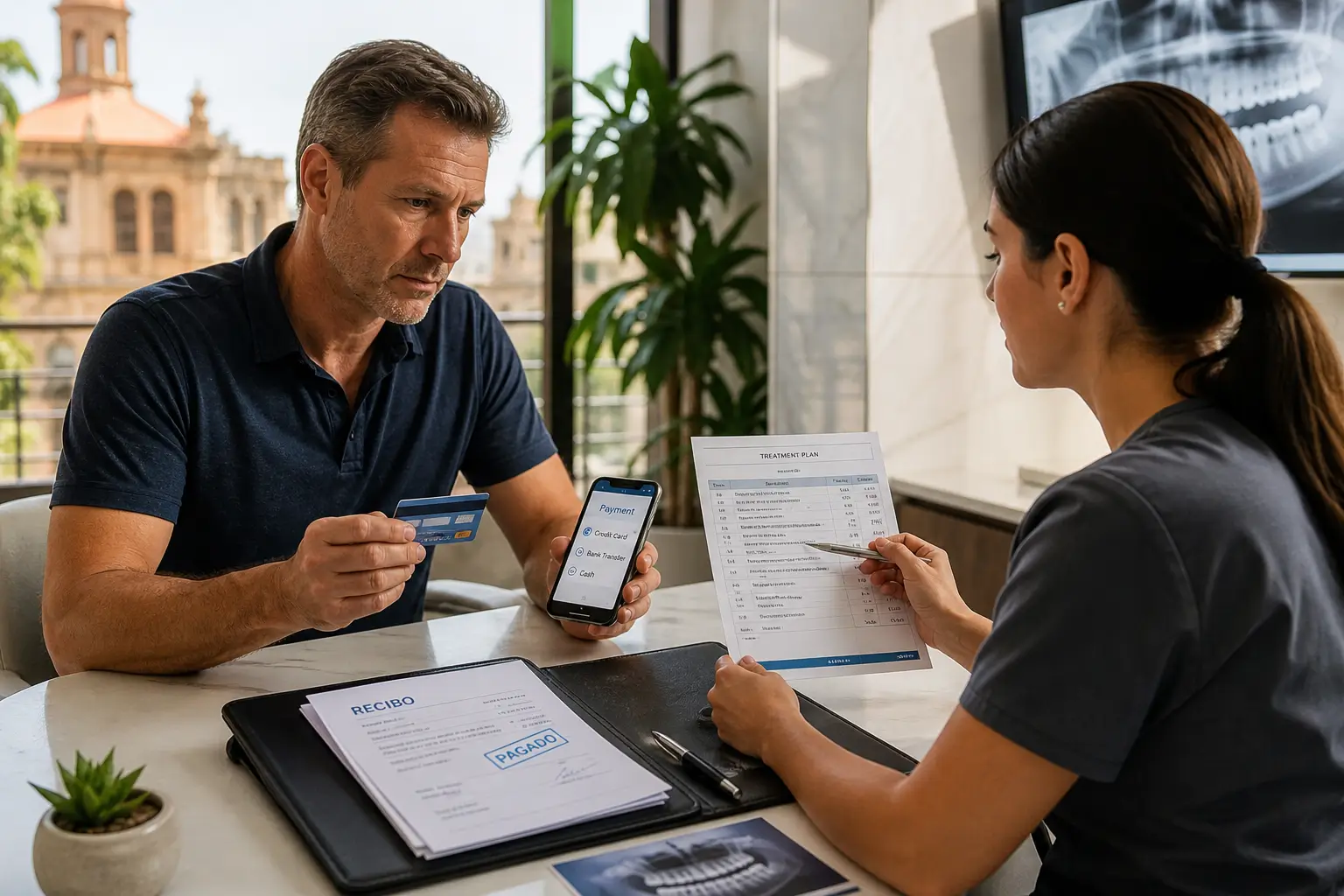
A pattern emerges from dozens of cross-border dental trips: the difference between a smooth experience and a stressful one usually isn't the dentistry. It's the money process wrapped around it. If you remember nothing else from this article, walk away with these three decisions made—and documented—before you pay anything.
First, figure out how you'll structure your payments, not just which payment method you'll use. For anything beyond a simple filling, think in stages. A reasonable deposit locks in your dates. A mid-treatment payment keeps both sides accountable. A final balance is paid after delivery. This approach tends to be safer than handing over 100% upfront—even when you're using a credit card with dispute protections. Most clinics will work with a staged structure if you simply ask.
Second, choose the payment route that gives you the best paper trail for your situation. Cash works perfectly well if you're diligent about getting receipts (dated, itemized, signed, and stamped). Cards—whether Visa, Mastercard, or Amex—generally create the cleanest proof of payment and may offer dispute options through your issuer. Bank and wire transfers are standard for larger deposits, but they're notoriously difficult to reverse if something goes wrong. Digital services like Wise or PayPal can handle smaller deposits if the clinic's account is verified and you save your transaction IDs.
Third, verify names and policies the way you'd verify a passport. The clinic's legal business name, the merchant name that appears on your card statement, and the beneficiary name on a wire transfer should all line up. If the clinic uses a payment processor (Mercado Pago, Clip, Stripe, or PayPal), that's completely normal—just know about it before you pay. And don't move any money until you have written terms covering refunds, remakes, and what happens if your treatment plan changes.
When the paperwork is solid, everything else gets easier. Scheduling runs smoother. Your trip becomes more predictable. And you keep your options open if you ever need a refund, remake, or warranty repair down the road.
You've got enough on your mind without payment chaos complicating things before you've even sat in the chair. Most international patients choose between four main options, each with trade-offs worth understanding.
Cash can keep costs down and sometimes unlocks an on-the-spot discount—but collecting proper receipts is entirely your responsibility. Credit and debit cards are fast, convenient, and create solid proof of payment; depending on your card network, you may also have dispute pathways available, though you might face a processing surcharge. Bank or wire transfers work well for larger deposits, especially for multi-visit treatment, but small errors (a misspelled beneficiary name, a missing reference number) take time to sort out, and wires are nearly impossible to reverse. Clinic or partner financing can make bigger treatment plans manageable by spreading payments out—but only if you truly understand the APR, fees, and total amount you'll repay.
Here's a quick way to think about which option might suit you. If you're paying in person and want maximum flexibility, bring cash in the clinic's preferred currency and insist on a signed, stamped receipt—ask for any discount to be written directly on the quote and receipt. If you want formal proof and potential dispute options, or you'd rather not carry cash across the border, pay by card after confirming the merchant name, currency, and any surcharge. If you need to send a larger deposit for multi-visit work, use a bank or wire transfer—but only after verifying beneficiary details through an official clinic channel and understanding when the clinic considers the payment "received." And if you can't or don't want to pay the full amount upfront for a bigger plan, explore payment plans—but only after you've seen the complete repayment schedule tied to your exact quote.
No method is perfect. The goal is picking the trade-off you're comfortable with, then making sure the clinic can support that choice with clear policies, written proof, and a predictable process.
One practical note: your payment method and clinic choice are connected. The ideal clinic for an All-on-4 case spanning multiple visits might not be the best fit for a single crown on a tight timeline. If you want to compare vetted clinics in Mexico side by side—including pricing, credentials, photos, and reviews—so you can confirm which payment routes they actually support, you can start with the Globalcare app and filter by treatment type and location.
When you're paying for care outside the U.S., your payment method affects far more than how money moves from your account to theirs. It determines whether your appointment is truly secured. It shapes how easy—or hard—it will be to address problems like refunds, remakes, warranty work, or disputes. It affects how usable your paperwork will be if you submit for dental plan reimbursement back home. And honestly, it influences how stressful the entire trip feels. Uncertainty around money has a way of bleeding into everything else.
The common cross-border payment problems usually aren't dramatic scams. They're avoidable "small" issues that become expensive because of timing. Unexpected fees appear at checkout—a card surcharge or third-party processor fee that wasn't mentioned in your quote. Treatment gets delayed because a deposit hasn't cleared or can't be matched to your case. Insurance submissions get held up or denied because the invoice is missing provider details, dates, codes, or proof of payment. Your leverage for a refund or remake evaporates when there's no signed treatment plan or written policy to point to.
Consider these three "tiny mistake, big headache" patterns that come up more often than you'd expect. A patient wires a deposit using bank details from an email thread, only to discover the beneficiary name doesn't match the clinic's legal business name. Another patient pays by card but doesn't confirm the merchant name—then struggles to connect the charge on their statement to the clinic invoice during a reimbursement submission. A third patient pays in full before signing a treatment plan, leaving limited options when the plan changes mid-visit.
Payment safety usually comes down to two things: what you verify before you pay, and what you keep after you pay. Before sending money, make sure you have a full, itemized treatment quote; written payment terms covering due dates, deposit rules, and refund or remake policies; a clear receipt plan; and provider or clinic details that will appear on your invoice. If any of these pieces are missing, pause. A short delay now prevents a much bigger problem later.
PRICES is a simple framework for pressure-testing any clinic's payment process—no expertise required. Use it during your calls, emails, or WhatsApp chats, and save the answers in one place so you can compare clinics without losing track of critical details.
P: Price — What's the full, itemized cost?
R: Route — How exactly does your payment move, and when is your appointment officially confirmed?
I: Insurance — Will your paperwork work if you file for reimbursement?
C: Credit — If financing is involved, what's the true cost of borrowing?
E: Escrow or staged payments — Can you reduce risk by tying payments to clear milestones?
S: Support documents — What written proof will you have before and after you pay?
The sections below unpack each part with the specific steps most international patients need before paying a deposit or balance.
Ask for a dated quote that spells out exactly what you're paying for and when. For complex cases—implants, full-arch work, anything spanning multiple visits—this clarity prevents disputes later.
Your quote should include each procedure listed by tooth and service (not just "implants"), lab work and materials (including brand names when relevant), imaging like CBCT or panoramic X-rays, anesthesia or sedation if used, temporaries, and any standard add-ons for your case type. It should also specify how many visits are expected and what's due at each one, warranty or remake terms (what's covered, for how long, and what isn't), and the deposit amount plus balance due dates.
Convert totals to USD for your own comparison, but keep the clinic's billing currency on the invoice so your documentation matches what you actually paid. If you're comparing multiple clinics, create an all-in number for each quote: procedure total + expected payment fees + any financing total repayment.
Don't stop at "How do I pay?" Ask how the clinic processes payments, who actually receives the money, and when your appointment becomes official.
For cash, confirm whether USD and/or MXN is accepted, whether there are per-visit limits, and what the receipt will include. For cards, ask about any surcharge, the merchant name that will appear on your statement, and whether you'll be charged in MXN or USD. For wire or bank transfers, get the beneficiary's legal name, account details, expected timing, and what reference information to include so the clinic can match the payment to your case. For digital platforms, confirm which platform account you're paying (and under what name), any platform limits, and how the clinic will confirm receipt.
The key question: "Is my appointment confirmed when I send payment, or when you receive and post it?" A solid confirmation routine looks like this: you receive written payment instructions and terms, you save your transaction reference (receipt number, authorization code, or wire reference), and the clinic replies in writing that your deposit is posted and your appointment is confirmed.
If you're planning to submit to a U.S. dental plan, your invoice typically needs specific fields—though requirements vary by insurer, and reimbursement is never guaranteed. Most insurers look for the provider's legal business name and address, provider credentials or license information (or at least the treating dentist's name), treatment dates, itemized procedures (often using CDT codes—the standard coding system for dental billing—when available), charges listed by service (not lumped together), currency clearly stated (and if your insurer requests it, a USD equivalent total), and proof of payment tied to the invoice.
Ask your insurer for their preferred format—many can provide a sample. Then check with the clinic: can they produce invoices with CDT codes and the other fields your insurer requires? Not all international clinics routinely use these codes, so you may need to request them specifically. When your invoice aligns with insurer requirements from day one, submissions tend to process more smoothly, and you're less likely to face those frustrating "request for more information" delays.
Keep in mind that even with perfect documentation, reimbursement amounts depend on your plan's out-of-network rules, allowed amounts, deductibles, and annual limits.
Financing can help with complex work or when you need treatment sooner than your cash flow allows. Clinics may offer in-house payment plans or refer you to a third-party lender, and availability varies for non-residents. Understanding your options for dental financing in Mexico before you travel prevents surprises at checkout.
Before agreeing to any financing, get these details in writing: who the lender is (in-house versus third party) and who you're legally paying; approval requirements for non-residents (common asks include passport, basic income verification, a down payment, and a billing method); APR (fixed versus variable) and the full fee schedule (origination, late fees, prepayment rules); a repayment schedule tied to your quote (not a generic example); the total repayment amount over the life of the loan; and who to contact after you return home for billing questions.
APR ranges vary widely based on eligibility, lender, and market conditions. Don't evaluate financing based on "from $___ per month." Evaluate it based on total cost—and whether it's meaningfully better than paying upfront or using a lower-interest option you already have access to.
A common question from U.S. patients: "Can I use CareCredit at a dentist in Mexico?" Generally, no—CareCredit and similar U.S.-based medical financing cards are designed for domestic healthcare providers and typically cannot be used directly at Mexican clinics. If you're accustomed to using CareCredit for dental work at home, you'll need to explore other options when seeking treatment abroad, such as clinic-offered payment plans or third-party lenders that work with international patients.
For higher-value treatment plans—implants, full-arch work, complex cosmetic cases—one of the simplest ways to protect yourself isn't a fancy new payment method. It's a safer payment structure.
Many clinics don't offer formal escrow, but most can support staged payments: a deposit to reserve your dates (after you've received the itemized quote and written terms), a midpoint payment after a defined milestone (such as after diagnostics and final treatment plan sign-off, or after surgery is completed), and a final payment after delivery or fit check of the prosthetic work and receipt of your final documents.
If a clinic or facilitator does offer escrow, treat it like any other contract: confirm who holds the funds, what triggers release, and how disputes are handled. If escrow isn't available, a staged schedule tied to clear milestones still reduces pressure and preserves your options if the plan changes.
For multi-visit treatments spanning weeks or months, also clarify whether your quoted amounts are locked or could change with exchange rate fluctuations. If the clinic bills in pesos but quoted you in dollars, ask whether each staged payment will be converted at the rate on the day of payment or held at the original quoted rate.
A simple script that tends to work well: "I'm happy to pay a deposit now. Can we document a staged payment plan tied to milestones and attach it to the treatment plan?"
Before you pay anything substantial, make sure you can prove what you agreed to and what you paid for. This is what makes chargebacks, refund requests, warranty claims, and insurance submissions realistic—not stressful guesswork.
You need a signed treatment plan with every service listed (and a dated version number if updates happen), a written refund or remake policy (including what triggers a refund versus a remake), any staged payment schedule or milestone agreement in writing, signed and stamped receipts for your deposit and final balance, and documentation that ties each payment to the invoice or plan (dates, amounts, what it covered).
Quick evidence-capture tips: Ask the clinic to email PDFs (so dates are preserved), take timestamped photos of physical receipts before leaving the front desk, and back everything up to the cloud (Google Drive, Dropbox, whatever you use). If you ever need reimbursement help, warranty support, or a dispute process, this folder becomes your safety net.
In Mexican dental tourism markets—especially border regions—prices are frequently lower than in many U.S. cities for major procedures. That said, exact costs depend on the city, the clinic, the materials used, case complexity, number of visits required, and what's included in the quote. Individual quotes can vary significantly even for the same procedure.
The ranges below reflect commonly advertised cash-pay pricing in 2026, but they're estimates—not guarantees. Your quote may fall outside these ranges depending on your specific circumstances. Always confirm brands, imaging, temporaries, sedation, remakes, and payment staging so you're comparing apples to apples.
When comparing quotes, ask the clinic these questions and get answers in writing: Which dental implant, crown, or veneer brands and lab materials will be used? Is imaging (CBCT, panoramic X-ray) included? Are temporaries, remakes, and required follow-up visits included? Are sedation or anesthesia fees included? Are there third-party "facilitator" or processing fees? Is the payment schedule staged, and what milestone triggers each payment?
If a price is dramatically lower (or higher) than comparable quotes, dig into what's included before sending a deposit.
It's also worth remembering that "Mexico" isn't one dental market. Different destinations have different rhythms and trade-offs. Patients often compare clinics across Cancún, Los Cabos, Los Algodones, Puerto Vallarta, Playa del Carmen, Guadalajara, Mexico City, Querétaro, Monterrey, Ciudad Juárez, and Mérida. Your best-fit location matches your treatment plan (single visit versus multiple visits), your comfort with travel, and how much support you want coordinating logistics. Border towns like Los Algodones are ideal for quick day trips; resort cities like Cancún or Puerto Vallarta let you recover somewhere comfortable with vacation-style amenities.
Use this table to narrow down your options, then apply the PRICES checklist to stress-test your choice—especially for higher-value procedures like implants or full-arch work.
Even a "good" payment method can cause headaches if the steps happen in the wrong order or the paperwork is weak. A smoother process follows the same foundation regardless of method: get written terms before paying (deposit rules, refunds/remakes, and what counts as "confirmed"), confirm timing (when the clinic marks payment as received and when your appointment is officially held), capture proof immediately (photos of receipts, screenshots, emails, transaction IDs), match every receipt to your quote (date, amount, and what it covered), and escalate early if something feels unclear—your leverage is highest before money moves.
Cash is straightforward, but your documentation discipline has to be airtight. Confirm in advance whether the clinic accepts USD, MXN, or both—border clinics often accept both; other regions may vary. If you plan to ask for a cash discount, do it before you pay: "If I pay today in cash, can you confirm the cash price in writing and reflect it on the receipt?"
For larger sums, think about safe transport and timing. Don't carry more than you need for that day's payment. If you're uncomfortable, ask about staged payments or paying part by card. When you pay, request a dated, itemized, signed, and stamped receipt—review it before leaving the desk. Photograph it immediately and back it up to the cloud. For high-value treatment, consider splitting payments (part cash, part card) so you also have card documentation.
Cards are popular because they're fast, create solid proof of payment, and may offer dispute or chargeback pathways depending on your issuer and circumstances. Before you pay, ask three questions: "Is there a card surcharge?" "What name will appear on my statement?" "Will you charge me in MXN or USD?"
If you're offered a choice of currencies at checkout, ask to pay in the clinic's local currency unless you clearly understand the alternative—this helps you avoid surprise exchange markups from dynamic currency conversion. Request the itemized invoice and the card receipt or authorization record (printed or emailed). If possible, snap a quick photo of the approval screen for your records. Also ask whether any part of the payment is a pre-authorization versus a final charge, which matters if you're watching available credit while traveling.
If you ever need to dispute a charge, the best first move is keeping everything in one folder—invoice, receipts, written clinic terms, and messages about any changes or issues—and contacting your card issuer promptly. Solid documentation makes disputes and reimbursement submissions much easier. Patients paying several thousand dollars by card often do it for speed, clear records, and the ability to show proof of payment. Just keep in mind that chargeback outcomes aren't guaranteed—they depend on your card issuer's policies, the nature of the dispute, and your documentation.
Wires are common for larger deposits—especially to reserve multi-visit work—but verification is critical because they're hard to reverse once sent. Get wire instructions from an official clinic channel and confirm they match the clinic's legal identity. Treat any last-minute change to bank instructions as a red flag until you've verified it by calling the clinic at a known phone number.
For larger deposits, consider a small test transfer first if timing allows. Include your invoice number and name in the transfer reference so the clinic can match it quickly. Ask for written confirmation when the payment is received and posted, and clarify whether your appointment is held after posting or after clearance.
If something feels off before you send the wire, pause. If you've already sent it and discover a mismatch, contact your bank immediately to ask about a recall or trace—and keep every reference number. Alert the clinic through a known official channel so they can flag the issue on their end.
Digital platforms work well for smaller deposits—often a few hundred dollars—to hold a first appointment before you fly in. Confirm the clinic's official account details directly with the office, ideally matching the clinic website or a known contact. If the platform has payment limits, ask whether the clinic accepts split payments and how they want them labeled so they're matched correctly.
Put your invoice or treatment reference in the payment notes. Save transaction records immediately (transaction ID, screenshots, confirmation emails) and reconcile them with the clinic's receipt or invoice. Also ask how refunds work on that platform and how long they typically take if plans change.
Financing can make bigger treatment plans doable—but only if you fully understand the terms. Clarify who the lender is and who you're legally paying (clinic versus third party). Ask how long approval typically takes and what documents non-residents usually need, so financing doesn't delay your scheduling. Request the full APR, all fees, and the total repayment amount in writing.
Ask for a repayment schedule based on your exact treatment quote—an amortization schedule, not a "starting at" monthly figure. Check prepayment rules and late fees so you understand the real downside if plans change, and get a direct billing contact you can reach after you're back home.
A patient quoted $7,000 for veneers was offered financing that sounded reasonable monthly. When she requested the full schedule, she realized the total repayment would be significantly higher—so she chose a mix of upfront payment and card instead.
The takeaway:Always evaluate financing by total cost, not the monthly number.
Before paying, request an invoice format that includes the fields your insurer requires—often including CDT codes when available, though not all international clinics routinely provide these. Ask for a claim-ready packet plan: "At the end, can you provide my signed treatment plan, itemized invoice, proof of payment, and materials or brand details?" Keep all documentation and written communication in one place. Confirm your claim filing deadline and submission method with your insurer.
When a patient confirms invoice requirements with both the insurer and the clinic before paying, and the invoice is itemized with complete provider details and proof of payment, submissions tend to process smoothly. Whether and how much the insurer reimburses depends on the plan's out-of-network rules, allowed amounts, deductibles, and annual limits—proper documentation improves your chances but doesn't guarantee a specific outcome.
Crypto can work for patients who already understand volatility and are comfortable managing documentation carefully. Agree on the exchange rate source and the exact time used to calculate the payment value, and record it. Get the refund policy in writing (refund in crypto versus cash, how value is calculated), including whether refunds require conversion back to fiat and typical timelines.
Save the transaction ID, explorer link, and screenshots as your proof. If you plan to file for reimbursement, make sure you can produce documentation showing the value in USD or MXN at the time of payment.
Cross-border treatment involves travel logistics, medical decisions, and payment steps—all under time pressure. A simple set of visual tools can prevent confusion and reduce back-and-forth with the clinic.
Consider using a payment flowchart to keep the sequence clear: quote → terms → deposit → confirmation → balance → final documentation. A receipt checklist ensures every payment is matched to a dated, itemized, signed, and stamped receipt. A lender comparison template helps you compare financing options apples-to-apples (APR, fees, total repayment, flexibility).
Use whatever format matches real life: a single-page printout you hand the front desk, a screenshot you pull up during checkout, or an email you send ahead of your visit so expectations are clear before you arrive. For many patients, the biggest organizational win is simply keeping everything consistent: one written treatment plan, one paper trail, and a clear way to compare clinics before sending a deposit. That's also where services like Globalcare can reduce friction—you can review verified clinics and request quotes with consistent checklist standards.
Most payment problems aren't obvious scams—they're small details missed at the wrong time. These scenarios highlight what tends to matter most.
Maria from California paid $5,200 for an implant case with a Visa card at a Tijuana clinic. Before authorizing payment, she asked for an insurance-friendly invoice template and confirmed what merchant name would appear on her statement. Because her documentation was solid from day one, her reimbursement submission went smoothly—though her actual reimbursement amount depended on her plan's out-of-network terms.
The lesson: If you want to file for reimbursement, secure a submission-ready invoice format before you pay, and keep the card authorization or receipt with the invoice in the same folder.
Steve was traveling for full-arch work and received wire instructions by email for a deposit. He noticed the beneficiary name didn't quite match the clinic's name. Instead of sending the money, he called the clinic using a known number and learned the email was likely a phishing attempt. He verified the correct instructions and avoided a costly mistake.
The lesson: For large wires, verify beneficiary details by calling the clinic through a trusted contact path—not through the same thread that delivered the instructions.
Karen was quoted $8,400 for cosmetic crowns and was offered financing that sounded manageable monthly. Once she requested the full amortization schedule, the total repayment was far higher than she expected. She chose a combination of cash and a U.S. credit card instead.
The lesson: Ask for an amortization schedule tied to your quote. Then compare total repayment versus paying upfront or using a lower-cost option.
Think of these red flags as a signal to slow down, ask better questions, and get terms in writing. Spotting them is only half the job—knowing what to do next is what actually protects you.
Highest-severity red flags (pause immediately): last-minute changes to wire instructions, refusal to provide written terms, or pressure to pay in full before you receive and sign a treatment plan.
Medium-severity red flags (slow down and fix the paperwork): vague invoices or receipts, unclear refund or remake terms, or surprise fees that weren't disclosed on the quote.
A simple escalation plan: First, request written proof and corrected documents. Second, verify through a second, trusted channel (phone number from the clinic website, your bank, or the payment platform). Third, delay payment until the clinic can document terms clearly.
Weak receipt language looks like "Payment received," "Dental work," or "Deposit" with no service detail, no patient name, and no signature or stamp. Try this script at the desk: "Can you please reissue this as a dated, itemized receipt with my name, the services covered, and a signature and clinic stamp?" Then photograph the corrected receipt immediately and back it up.
If a clinic can't provide a clear, written record of who you're paying—or asks you to wire to an unrelated name without documentation—pause. A practical verification script: "Please send official wire instructions on clinic letterhead (or from your official email domain) showing the beneficiary legal name, and a phone number I can call to confirm. I'll send payment once I can verify those details." If that request is met with pressure instead of clarity, don't wire.
Deposits are common. Full prepayment is higher risk unless you already have a signed plan and written refund or remake terms, or a staged payment schedule tied to milestones. You can say: "I'm ready to pay a deposit now. I'll complete the balance after we sign the treatment plan and confirm the milestone and payment schedule in writing." If a clinic refuses any reasonable staging and won't document refund or remake terms, walking away is often the safest option.
Be direct: "Please send your written refund/remake policy and attach it to my treatment plan." If it can't be provided in writing, treat that as a serious warning sign. Save a signed and stamped copy for your records before paying a substantial amount.
Tools that make it easier to compare clinics, organize documentation, and prepare for reimbursement are available in the Globalcare app:
This content was reviewed by Dr. Carolina Meza, DDS, MS, an international dental consultant and practicing dentist with cross-border case experience. Price and process information was last updated April 2026.
These steps help protect your appointment, your budget, and your ability to request reimbursement or warranty service later.
Get in touch to get started!
Our team of experts will ensure your all-on-4 dental implants journey is safe and easy. We're dedicated to guiding you to your new smile every step of the way!
ConnectConcierge Services

Trusted Dentists

Safe Locations

Concierge Services
Trusted Dentists
Safe Locations

Disclaimer: Dental Cost Estimation Calculator
This Dental Cost Estimation Calculator is designed to provide users with estimates of potential savings when seeking dental treatments abroad compared to the cost of similar procedures in the United States. However, please be aware of the following important information before using this tool:
1. Estimations Based on Publicly Available Data:
The estimates provided in this calculator are derived from publicly available data sources, including average procedure costs, exchange rates, and other relevant information. These figures may not reflect the exact costs of your specific treatment or location. Estimations include non-dynamic assumptions for travel and lodging costs that may not reflect the actual costs at the time of your research.
2. Quantitative Model Assumptions:
The calculations are based on assumptions and data inputs that may not account for all factors influencing dental treatment costs. Variations in individual treatment needs, dentist fees, and other variables can significantly affect the final expenses.
3. No Substitute for Professional Advice:
This tool is not a substitute for professional dental advice. Before making any decisions about your dental treatment, it is crucial to consult with a qualified dental professional who can provide you with a personalized assessment of your needs and potential costs.
4. Currency Exchange Rates:
Estimates involving foreign treatment costs rely on currency exchange rates, which can fluctuate. The rates used in this calculator may not accurately represent the current market rates at the time of your treatment.
5. Geographic and Facility Variations:
Dental costs can vary significantly based on geographic location, dental facility, and the complexity of the procedure. The estimates provided are general in nature and may not reflect the specific conditions in your chosen destination or dental clinic.
6. Non-Inclusive Costs:
This calculator may not account for additional expenses such as per diem costs in destination or unforeseen complications during or after the procedure. These costs can substantially impact your overall expenses.
7. Liability Waiver:
By using this calculator, you acknowledge that the estimates provided are for informational purposes only, and Globalcare Network Inc or any of its representatives bear no responsibility for the accuracy of the estimates or any decisions made based on them.
8. Independent Research Recommended:
It is strongly recommended that you conduct independent research, obtain quotes from dental professionals, and consider all relevant factors when making decisions about dental treatment abroad.
In summary, while this Dental Cost Estimation Calculator aims to provide helpful information, it should not be the sole basis for your decision-making process. Your individual circumstances and dental needs may differ, and it is essential to seek professional advice and conduct thorough research before pursuing dental treatment abroad

