Dental Prosthesis Costs in 2026: Your Complete Guide
May 22, 2026

Back to Blog
.png)
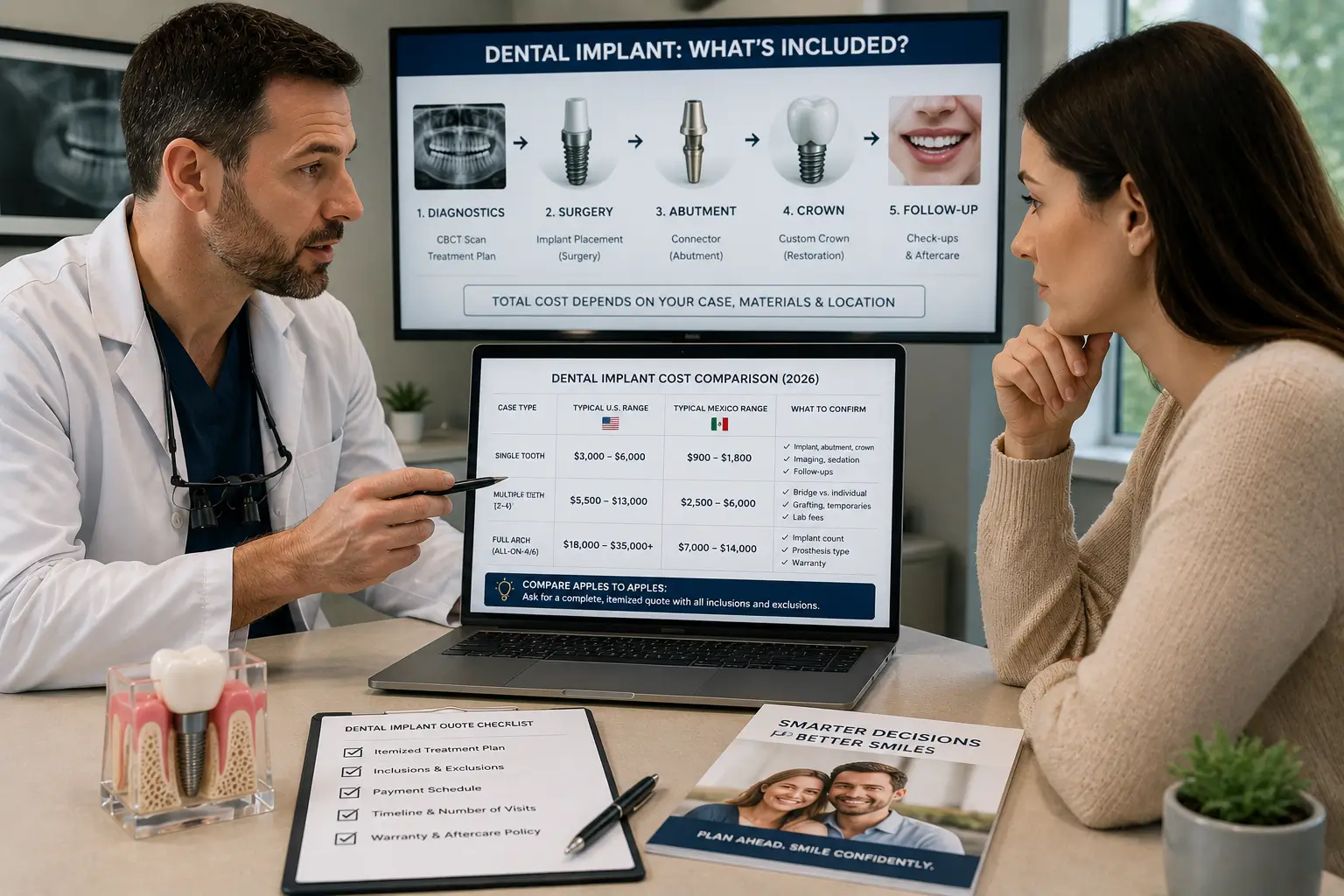
If you walk away with nothing else from this guide, keep these three truths in mind. Smart, careful people make expensive mistakes simply because dental implant cost information is presented as though it's straightforward. It's not.
First, "the price of an implant" really means the price of an entire process—not a single part. A real, functional tooth involves diagnostics (typically a CBCT scan), oral surgery (placing the implant itself), and restoration (the abutment and crown, or a bridge, or a full-arch prosthesis). When a quote doesn't clearly spell out these pieces, you're not comparing the same thing—even if both clinics throw around the word "implant."
Second, your anatomy drives a significant chunk of the total. Tooth extraction, infection control, bone grafting, and sinus lifts aren't tricks or upsells. They're clinical realities, especially for teeth that have been missing a while or for upper back teeth near the sinus cavity. The right question isn't "Are you trying to sell me grafting?" It's "Based on my imaging, what prep work is likely, what's optional, and what does each option cost?"
Third, the cheapest clinic fee can turn into the most expensive plan if follow-up becomes difficult. Whether you stay local or travel to Mexico—Tijuana, Los Algodones, or Cancún—you need a clear plan for adjustments, repairs, and remakes. That means understanding the warranty in plain language, knowing who covers lab fees and shipping, and knowing what happens if you need help once you're back home. The best "deal" is usually the quote with the fewest unknowns and the clearest path to aftercare.
Sticker shock is real. So is the frustration of discovering later that the number you saw upfront only covered one phase. Dental implants typically involve multi-stage treatment, and many clinics price each stage separately. That can be perfectly fair—but it dramatically increases the odds that critical costs surface late unless you push for a complete plan from the beginning.
When you're comparing a $5,000 U.S. quote with a $1,400 Mexico quote, you're not just comparing countries. You're comparing scope, follow-up logistics, what happens if timelines shift, and how you'll handle something needing adjustment months down the road.
Before requesting quotes, get honest with yourself about the practical constraints that shape a good decision. What's your true budget once you account for scans, sedation, travel (if applicable), grafting, and follow-up? How urgent is your timeline? Are you comfortable managing complications from a distance? Can you realistically return if healing takes longer than expected? And how do you plan to pay—cash, financing options, insurance reimbursement, or some combination?
To compare providers fairly, ask every clinic for a dated, itemized quote with clearly stated inclusions and exclusions, a payment schedule with deposit amounts and refund terms, an estimated timeline with the number of visits you should expect, and a copy of their warranty and aftercare policy. Many dental offices don't offer this upfront. The ones worth serious consideration can usually provide it without pushback.
"Starting at" pricing is marketing language. The number that actually matters is the one covering every likely phase of your dental care. The biggest real-world budget overruns come from items that were never truly included—CBCT imaging, grafting, sedation, temporary teeth, and vague remake policies.
In the U.S., single tooth implant treatment typically lands between $3,000 and $6,000, with major metros often running higher. In Mexico's high-volume dental hubs like Tijuana and Los Algodones, you're more likely to see $900–$1,800.
A genuine single-tooth plan includes the implant fixture (the titanium or zirconia "root"), the abutment (the connector piece), the crown (the visible tooth), diagnostics (usually a CBCT scan plus X-rays), and post-op visits with basic adjustments. The factors that shift your total most often: whether imaging is bundled, whether sedation is included (local anesthesia versus oral sedation versus IV), and whether you'll need a temporary tooth while healing.
If you're traveling for treatment, request the quote in the clinic's local currency with a date stamp. That reduces exchange-rate confusion and discourages last-minute add-ons.
Replacing two to four missing teeth rarely scales in a neat "per implant" line. U.S. bundled ranges commonly run $5,500–$13,000; Mexico often falls between $2,500 and $6,000. The variability comes down to prosthetic design (multiple individual crowns versus an implant-supported bridge), prep work (extractions, infection control, bone grafting), whether temporaries are included (especially critical for visible areas), and lab choices.
When you see a suspiciously low "per implant" number, treat it as a prompt to request a line-item breakdown that includes restoration and lab work. That's where "low" quotes often become normal-priced totals.
Full mouth implant restorations are complex and heavily marketed. In the U.S., $18,000–$35,000+ per arch is common across many practice types. In Mexico, established clinics often quote packages in the $7,000–$14,000 per arch range.
That spread reflects implant count and positioning (All-on-4 versus "All-on-6" or more), prosthesis material (acrylic hybrids versus high-quality zirconia, with different wear and repair profiles), whether both temporary and final teeth are included, and how adjustments and remakes are handled. Confirm the quote date—full mouth pricing shifts faster than most patients expect due to lab and material costs.
Where you get treated can affect dental implants cost nearly as much as the treatment itself. In the U.S., high-overhead metros price above average. In Mexico, border hubs price differently than resort destinations.
The bottom line: If you're local and replacing one tooth, U.S. treatment may cost only slightly more once you factor in travel and follow-up convenience. But if you need full mouth restoration, the all-in difference can reach five figures—making Mexico a real contender if you verify aftercare and plan for the possibility of additional visits.
If you're exploring Mexico, search for terms that surface real patient experiences and current pricing—not just "from $X" ads. Try "dental implant cost Mexico 2026," "All-on-4 package Cancún," "Los Algodones dental implant pricing," "Tijuana dental implants all-inclusive," and "Mexico dental implant warranty terms."
When you're ready to compare real clinics with transparent details in one place—pricing, verified reviews, credentials, photos, and treatment-specific filtering—use a structured directory instead of piecing things together from social media. The Globalcare app is built specifically for comparing pre-screened dental clinics in Mexico side by side.
When the variables start blurring together, use PRICE as your filter. The goal isn't to catch a clinic in wrongdoing—it's to turn fuzzy promises into written, comparable facts before you commit money or time off work.
You want a quote that can survive a spreadsheet comparison, with each phase clearly named. Here's a message you can copy and send to any clinic:
"Can you send me a dated, itemized implant quote that lists each line item separately: exam/consult, CBCT or imaging, extraction if needed, bone graft or sinus lift if needed, implant placement, abutment, crown/bridge, temporary teeth, anesthesia/sedation type and cost, follow-up visits, and any lab fees? Please also note what is not included."
If you're comparing across countries, ask for pricing in local currency and the clinic's policy if exchange rates change or treatment takes longer than planned.
Credentials don't guarantee a perfect outcome, but they strongly predict whether you'll get clear planning, safe protocols, and a straightforward response if something needs correction. Ask for the license information for the treating dentist or oral surgeon (not just the clinic brand), clarification on who does what (surgeon placing implants versus restorative dentist delivering crowns), the complication protocol in writing, and the implant system used (brand and system family) so parts remain available long-term.
A telling question to ask: "What's your protocol if an implant fails to integrate, and what costs are covered versus billed again?"
Dental implants are one of the easiest places to get blindsided by coverage assumptions. The fix is simple: use procedure codes and get responses in writing.
For dental insurance plans, ask the clinic for procedure codes on your treatment plan, then call your insurer and request a written coverage estimate, annual maximum details, exclusions, and any pre-authorization requirements. Many PPO plans have annual maximums that won't cover the full cost of implants, so understanding your out-of-pocket responsibility is essential. For financing, many dental practices offer payment plans through CareCredit or similar programs—compare offers by total repayment (APR plus term length plus fees), not just the monthly payments. For HSA/FSA, confirm what documentation your administrator requires, typically an itemized treatment plan and receipts. Also ask whether the provider can supply receipts in the format your insurer or HSA administrator expects, especially if you're paying abroad and submitting for reimbursement.
A clean comparison requires a "net cost" view. Clinic fees are only one line item, especially for multi-visit implant care.
At minimum, add the clinic fee (from a complete, itemized quote), airfare (typically $300–$600 round trip from the U.S. to Mexico), hotel ($70–$200/night near major clinics), local transportation ($10–$30/day), coordinator or translation support (sometimes included, sometimes charged), time off work, a return-trip buffer for healing or remakes, and potential aftercare costs back home if you need a local dentist to help.
The decision isn't "Mexico versus the U.S." It's whether your projected savings hold up against the extra logistics for your specific situation.
Even when everything goes smoothly, dental implants take time. A timeline you can plan your life around is part of the value. Ask for a written plan stating how many visits you'll need and what happens at each, expected healing windows and what could extend them (grafting, infection, stability issues), what aftercare is included (and what triggers extra fees), and warranty terms specifying parts versus labor coverage, plus what "repairs" and "remakes" mean in practice.
If a warranty is vague, verbal, or "case by case," budget as if coverage is limited.
A complete implant quote often includes some or all of these items. Seeing them listed doesn't mean you'll need everything—but you should understand what each represents and whether it's included.
You'll typically encounter an exam or consultation (sometimes free, sometimes credited toward treatment), imaging like CBCT and panoramic X-rays (ask if existing scans can be reused), extractions (simple versus surgical differ in cost and recovery), bone grafting (common enough to budget for the possibility), sinus lift (sometimes needed for upper back teeth), the implant fixture itself (brand matters for long-term parts availability—ask which system they use), the surgical placement fee (may be separate from hardware), abutment (stock versus custom affects cost and fit), lab fees (sometimes bundled, sometimes separate), crown or bridge or full-arch prosthesis (material choice affects cost and repair patterns), temporary teeth (provisional crown or bridge while healing), anesthesia or sedation (local versus oral versus IV—confirm what's included), post-op visits and adjustments (confirm how many and what triggers extra charges), and repair/remake policies.
Two questions that help prevent expensive surprises: "Which implant brand/system is this, and will you register it with the manufacturer and provide documentation?" and "Are the abutment and all lab fees included in the total, or billed separately?"
Bundled pricing can reduce surprises, but a "bundle" only helps if it's clearly defined. Many clinics bill surgery and prosthetics separately; others use package pricing. Either approach can be perfectly fair—the only problem is vagueness.
Use this question to force clarity: "If anything needs to be adjusted, repaired, or remade in the first year, what's covered—and does that include lab fees, parts, and shipping?"
For full mouth cases especially, dig deeper. Ask how many adjustment visits are included and what happens after that limit. Ask whether temporary teeth are included or what options and costs apply. Ask what fees apply if you develop an infection or need an unexpected visit. Ask who pays for a remake if the bite is off or the prosthesis doesn't fit.
If the answers aren't in writing, budget for potential extra costs.
You don't need a fancy calculator to make a smart decision—just a simple model that stress-tests your savings against real life.
Start with two totals: Total A (U.S. all-in), which is the clinic fee plus any likely add-ons, and Total B (Mexico net), which is the clinic fee plus travel, lodging, local transport, time off work, and a return-trip buffer.
Then run three "what-if" checks. What if flights cost $200 more than expected? What if you need one additional trip for adjustments or a remake? What if you pay $300–$800 back home for an urgent visit or bite adjustment?
If you're traveling, verification matters as much as price. Use this framework to decide whether a clinic is worth deeper evaluation before paying a deposit.
Legal considerations: Malpractice claims and regulatory oversight work differently in Mexico than in the United States. Patients generally have more limited legal recourse for disputes arising from treatment abroad. This doesn't mean treatment is unsafe, but it does mean choosing a reputable clinic and getting agreements in writing is especially important.
Ask for the treating provider's full name as it appears on their license and their professional license number (cédula profesional). You can verify Mexican license records through the official SEP Registry.
Request in writing the full legal name of the treating dentist (DDS or equivalent) or surgeon, their professional license number and issuing details, and who handles surgery versus prosthetics if different people are involved. If a clinic won't share verifiable credentials before taking a deposit, that tells you something important.
Cross-border dentistry becomes dramatically easier when one person handles scheduling, instructions, documents, and follow-up communication. Confirm their name and direct contact (WhatsApp, email, phone), languages spoken, specific responsibilities (scheduling, transport guidance, post-op coordination, document support), and whether fees are included or charged per visit.
This isn't just about convenience—it reduces the risk of missed instructions, missed follow-ups, and preventable travel stress.
"We've done thousands of implants" isn't the same as reliable outcome information. If you're doing major work—especially full mouth restoration—ask for specifics that match your case.
Look for recent case examples (dated, comparable complexity) with clear before-and-after documentation, volume for your specific procedure type (how many full-arch cases per month or year), and how they define and handle complications. Be wary of vague claims, undated statistics, or "perfect success" language without definitions. The most credible clinics tend to be the most specific about process and follow-up.
Before paying, ask the clinic to send the warranty policy document—not just a marketing line. Make sure it clearly states what's covered (implant fixture, abutment, crown/prosthesis), whether parts and labor are both included, repair versus replacement rules, duration by component, geographic limits (must you return versus any reimbursement options), who pays for lab fees, shipping, and sedation during warranty work, and the claims process with expected timelines.
If anything is unclear, assume your protection is limited and price that risk into your decision.
Get a written plan that answers two questions: what happens if something goes wrong immediately, and what happens if something needs correction after you're home.
Ask for named contacts for after-hours issues, clear "if/then" instructions (swelling, bleeding, fever, bite problems, loose prosthesis), clarity on who pays if you need help in the U.S., and what documentation you should keep (photos, X-rays, visit notes) if a claim is needed. If reimbursement or U.S.-side support isn't written into your agreement, assume you'll pay out-of-pocket for local repairs or adjustments.
There's no single standard implant warranty. A "5-year warranty" at one clinic might cover only the implant component—not the crown, not labor. Another might cover the prosthesis but require you to return for all warranty work.
Before you pay, confirm coverage scope (parts only, or parts plus labor—and whether it includes adjustments and remakes), the distinction between repair and replacement (is a chipped tooth "repaired," "replaced," or excluded?), duration by component (fixture versus abutment versus crown may have different timelines), geographic limits, costs you'll still pay (lab fees, shipping, sedation, travel), common exclusions (smoking, untreated gum disease, missed cleanings, bruxism, not wearing a prescribed night guard), and the claims process.
If you must return to another city—or another country—for warranty work, treat airfare, lodging, and time off as part of the true price.
Coverage varies dramatically by plan, employer, and state. Still, some patterns are common.
Many U.S. dental insurance plans have annual maximums (often $1,000–$2,000) and may exclude implants or cover them only partially—sometimes at 30–50% of the surgical fee, with nothing for the crown. PPO plans typically offer more flexibility in choosing providers but still have significant limitations. Delta Dental and similar carriers often require pre-authorization for implant procedures.
Confirm using procedure codes and ask for written coverage details and pre-authorization requirements. When comparing financing offers, look at total repayment (principal plus interest plus fees)—the lowest monthly payment is often the most expensive loan.
Payment plans through healthcare financing programs can help spread costs, but compare the true cost of borrowing. For HSA/FSA, many dental procedures can qualify, but documentation requirements vary. Confirm eligibility for each line item if your plan is strict.
One habit that pays off: keep a folder with your treatment plan, codes, insurer responses, receipts, and warranty documents—especially if you're coordinating reimbursement for care abroad.
Dental implants cost more upfront but are designed to be long-term restorations that function like natural teeth. When successful and properly maintained, they can last many years—though individual outcomes depend on bone quality, oral health, overall health, and habits like smoking or teeth grinding. Bridges and dentures typically have lower initial costs but generally need more frequent replacement, relines, or repairs. A simple "annualized" view can help you think about long-term value, keeping in mind these are estimates that vary by individual circumstances.
*Lifespan estimates assume successful initial placement, good oral hygiene, regular dental checkups, and the absence of complicating factors. Actual longevity varies considerably based on individual health, habits, and maintenance. This comparison doesn't capture all potential costs (repairs, cleanings, complications), but it offers one way to think about relative value over time. Source for bridge lifespan: 7–15 years[12]. Traditional denture lifespan (7–10 years) is a commonly cited industry estimate.
Not everyone is a good candidate for dental implants. Your dentist or oral surgeon will evaluate your individual situation, but certain factors may complicate treatment or affect success rates. These can include uncontrolled diabetes, active periodontal (gum) disease, heavy smoking, certain autoimmune conditions, insufficient bone density without grafting, current bisphosphonate therapy (medications often used for osteoporosis), and a history of head or neck radiation therapy.
Some of these factors can be addressed or managed through additional procedures, while others may make alternative options like dentures more appropriate. A thorough evaluation—including imaging and a review of your medical history—is essential before proceeding with any dental procedures.
Most implant treatment follows a general sequence, though exact timing varies based on individual healing, anatomy, and treatment complexity. You'll typically start with a consultation and CBCT scan, then move to any needed extractions, followed by implant placement. After that comes a healing period (osseointegration) of typically 3–6 months depending on bone quality and complexity, then abutment and final crown or bridge placement, and finally adjustments as needed.
Common reasons timelines stretch: bone grafting that needs healing time before implants can be placed, infection or inflammation that must be controlled first, stability issues making immediate loading inappropriate, and scheduling bottlenecks for lab work or specialist availability.
Some clinics offer "immediate loading" (same-day teeth), which can work well in carefully selected situations—but it's not suitable for everyone and depends on factors like bone density and implant stability. If you're traveling, plan for the realistic scenario: potentially two trips with healing in between, plus a buffer if adjustments or remakes are needed.
After implant placement, expect some swelling, mild bleeding, and a few days of soreness. Recovery varies based on procedure scope, grafting, individual healing response, and sedation. Follow your clinician's specific instructions, as they're tailored to your situation.
For general planning purposes: a straightforward single-tooth case often means 2–3 days of lighter activity for many patients; multiple implants or full-arch work may require up to a week of limited activity, sometimes longer depending on healing. If you're traveling, build in a couple buffer days before flying home—especially after longer surgeries or sedation—so you're not dealing with swelling or medication changes mid-travel.
Different settings come with different costs and trade-offs. The best choice fits your case, your budget, and your ability to follow up.
If you're cost-sensitive and have timeline flexibility, dental schools can offer a cost-effective baseline option. General dentists in training work under close faculty supervision, often with specialists overseeing implant cases. Common trade-offs include more appointments, possible waitlists, and trainee involvement. When your timeline is flexible, the value can be excellent for new patients willing to invest more time.
A good quote removes uncertainty. A problematic one pushes you to commit before you understand the scope.
Watch for these warning signs: no quote date (or clearly outdated pricing), "all-inclusive" language without clear line items, warranties that are verbal, extremely short, or loaded with exclusions, evasiveness about what's included versus excluded, and no written plan for remakes or complications.
A quick scoring approach: give each clinic one point for a dated quote, line-by-line itemization, timeline with number of visits, warranty/complications policy attached, clear included/excluded list, and a named point of contact for aftercare. Clinics scoring 5–6 are usually easiest to work with; those scoring 0–3 often create expensive surprises.
Disclosure: Globalcare is a commercial platform that may receive referral compensation from clinics listed in its directory. Readers should factor this relationship into their evaluation of recommendations in this section.
When you're seriously considering Mexico for dental implants, the hardest part usually isn't finding a low price—it's finding a clinic you can trust with clear documents, clear aftercare expectations, and fewer unknowns.
Globalcare is a vetting and facilitation platform designed to reduce uncertainty for patients exploring cross-border healthcare. Through the platform, you can access clinic credential verification, organized and dated itemized quotes for side-by-side comparison, bilingual communication support, and warranty and aftercare terms collected in writing.
Worth noting: Support can reduce risk, but never eliminate it. Cross-border dentistry still requires careful planning, especially for follow-up and remakes. Globalcare helps you make better-informed decisions—it doesn't make complications disappear.
For the most useful quote, provide a simple summary of your situation: missing teeth, prior dental history, medical conditions, medications, and any existing imaging. A strong quote packet should include pricing in local currency, a written timeline, inclusions and exclusions, and aftercare expectations.
Disclosure: If you request quotes through a platform or directory, confirm whether the service receives referral compensation from clinics. If any compensation exists, transparent disclosure helps you interpret recommendations appropriately.
One practical way to protect yourself—whether you stay in the U.S. or go abroad—is requesting multiple quotes and standardizing what you ask for. The best deal is often the plan with the fewest unknowns.
Pricing guidance is only useful if it's current. This article's ranges draw from current clinic quotes and published fee schedules, publicly available market pricing references, insurer benefit structures (annual maximums, exclusions, common coverage patterns), and observed add-on patterns in implant treatment planning.
Because pricing changes quickly, this guide includes publication dating. If you're reading this long after that date, use the ranges as a starting point only—and rely on a fresh, itemized quote for actual decisions.
Clinical review status: This article provides consumer cost and planning guidance and was not medically reviewed by a licensed dentist as of May 21, 2026. It should not be used as medical advice or to make clinical decisions about your care. Always confirm treatment recommendations with a qualified dental professional who has reviewed your imaging and health history.
The biggest driver is scope—what's included versus excluded (imaging, sedation, temporaries, grafting, adjustments, warranties). Materials, lab choices, and regional overhead also play a role. Only a current, itemized quote lets you compare accurately.
Start with the clinic's complete treatment total (not "starting at"). Then add airfare, lodging, local transportation, coordinator or translation fees if needed, time off work, and a buffer for at least one extra visit. To pressure-test your estimate, run scenarios where airfare increases and you need one additional trip.
Get a written policy stating what's covered (parts and/or labor), coverage duration by component, repair versus replacement terms, how claims work, whether shipping and lab fees are included, and whether you must return to the original clinic or if any reimbursement applies.
Get the clinic's written complication protocol with named contacts and instructions. If the clinic promises reimbursement for U.S.-based care, get that in writing with clear limits. If it's not documented, assume you'll pay out-of-pocket for local repairs or adjustments.
Give your insurer the exact procedure codes from your treatment plan and request written confirmation of coverage, annual maximums, exclusions, and pre-authorization requirements. Ask whether the plan covers implants at all—or only alternative benefits like a bridge or dentures. If you plan to use HSA/FSA funds, confirm which documents they require.
Make sure both quotes are dated and cover the same scope (imaging, sedation, temporaries, abutment, lab fees, follow-ups). Add exclusions as line items so both totals reflect the same all-in reality. Then compare warranty and complications coverage—that's where a lower-priced quote can become expensive.
Only the written warranty/complications policy answers this. If remake coverage isn't explicit—including who pays lab and shipping and whether you must return—plan as if you'll be responsible for those costs.
Get in touch to get started!
Our team of experts will ensure your all-on-4 dental implants journey is safe and easy. We're dedicated to guiding you to your new smile every step of the way!
ConnectConcierge Services

Trusted Dentists

Safe Locations

Concierge Services
Trusted Dentists
Safe Locations

Disclaimer: Dental Cost Estimation Calculator
This Dental Cost Estimation Calculator is designed to provide users with estimates of potential savings when seeking dental treatments abroad compared to the cost of similar procedures in the United States. However, please be aware of the following important information before using this tool:
1. Estimations Based on Publicly Available Data:
The estimates provided in this calculator are derived from publicly available data sources, including average procedure costs, exchange rates, and other relevant information. These figures may not reflect the exact costs of your specific treatment or location. Estimations include non-dynamic assumptions for travel and lodging costs that may not reflect the actual costs at the time of your research.
2. Quantitative Model Assumptions:
The calculations are based on assumptions and data inputs that may not account for all factors influencing dental treatment costs. Variations in individual treatment needs, dentist fees, and other variables can significantly affect the final expenses.
3. No Substitute for Professional Advice:
This tool is not a substitute for professional dental advice. Before making any decisions about your dental treatment, it is crucial to consult with a qualified dental professional who can provide you with a personalized assessment of your needs and potential costs.
4. Currency Exchange Rates:
Estimates involving foreign treatment costs rely on currency exchange rates, which can fluctuate. The rates used in this calculator may not accurately represent the current market rates at the time of your treatment.
5. Geographic and Facility Variations:
Dental costs can vary significantly based on geographic location, dental facility, and the complexity of the procedure. The estimates provided are general in nature and may not reflect the specific conditions in your chosen destination or dental clinic.
6. Non-Inclusive Costs:
This calculator may not account for additional expenses such as per diem costs in destination or unforeseen complications during or after the procedure. These costs can substantially impact your overall expenses.
7. Liability Waiver:
By using this calculator, you acknowledge that the estimates provided are for informational purposes only, and Globalcare Network Inc or any of its representatives bear no responsibility for the accuracy of the estimates or any decisions made based on them.
8. Independent Research Recommended:
It is strongly recommended that you conduct independent research, obtain quotes from dental professionals, and consider all relevant factors when making decisions about dental treatment abroad.
In summary, while this Dental Cost Estimation Calculator aims to provide helpful information, it should not be the sole basis for your decision-making process. Your individual circumstances and dental needs may differ, and it is essential to seek professional advice and conduct thorough research before pursuing dental treatment abroad

