Dental Implant Cost in Mexico: Price Breakdown by City
May 8, 2026

Back to Blog
.png)
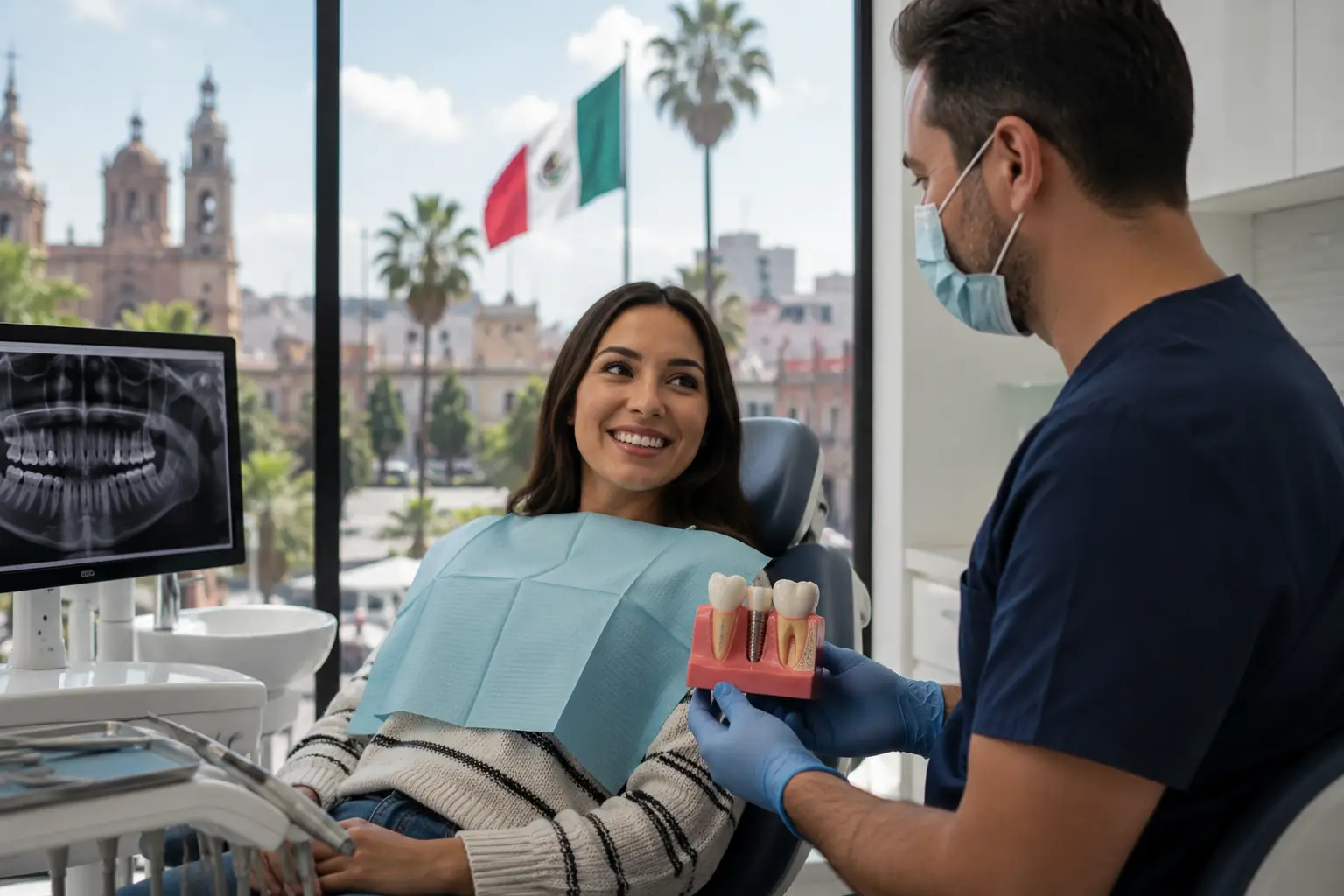
If you're researching implant costs across Mexican cities, approach it the way you would any major purchase: get clarity first, then shop. The goal isn't to find the rock-bottom price—it's to find a complete treatment plan you can actually see through to the finish line.
Before you fall in love with any city or "starting at" number, here are three things to nail down.
Compare complete outcomes, not teaser prices. When you're looking at a single tooth implant, the number that matters is implant + abutment + crown, bundled together. For full mouth dental implants like All-on-4 or All-on-6, you need the implants plus temporary teeth (if you're getting immediate load) plus the actual final bridge—and you need to know whether that's zirconia, acrylic, or something else. A quote that skips the abutment, doesn't specify temporary versus final prosthesis, or buries lab fees and imaging in the fine print isn't cheaper. It's just incomplete.
Get paperwork, not promises. Before you put down a deposit, you should have three documents saved: an itemized written quote, the full warranty PDF (not a marketing blurb), and proof of the treating dentist's license—their cédula profesional, which you can verify. For major implant brands like Straumann, Nobel Biocare, BioHorizons, Zimmer, or MIS, you also want traceability—serial or lot numbers on record—because that affects future servicing and warranty claims.
Plan for the full timeline, not just surgery day. Most implant procedures require multiple visits with a healing window in between. Even the best deal can get expensive if you need an unplanned extra trip, another week of lodging, or more time off work than you budgeted. A realistic itinerary with buffer days and written rescheduling terms prevents most surprise costs.
Get these three things right, and everything else falls into place. You'll compare cities fairly, choose a clinic that's actually accountable, and budget without nasty surprises.
The three priorities above—complete pricing, verified documentation, and realistic timelines—apply throughout your research. This section gives you a framework for deciding when you're ready to move forward versus when you need more answers.
A confident decision comes down to whether you can check these boxes. If any of them stays unclear after you ask, slow down.
Realistic pricing (apples to apples): You're only comparing fairly when the same procedure, same implant brand, and same restoration level are all on the table. A quote that says "from $999" could mean anything from an implant fixture alone to a complete restoration with the final crown included.
Trustworthy provider proof: You should be able to verify the treating dentist's cédula profesional, confirm the implant brand with traceability, and read the full warranty terms—all in writing, saved to your files.
Travel readiness: Dental implants typically require multiple visits with healing time between. Knowing the number of trips, expected days in-country, and a backup plan for delays (lab timing, swelling, added procedures) prevents most cost surprises.
Here's a framework for thinking about it. If you have two or three comparable itemized quotes in USD for the exact same scope, you've received and read the full warranty PDF, you can verify the treating provider's license, and your timeline includes healing time plus buffer days—you're ready to move forward. If pricing looks good but pieces are missing—no redacted invoice, unclear temporary-versus-final prosthesis, warranty summary only, uncertain number of trips—you're in "maybe" territory. That's not a no; it just means you're not ready to pay a deposit or book flights yet. And if a clinic won't provide itemized pricing, won't share license proof for the person doing your procedure, can't produce the full warranty document, or pushes untraceable payment methods? Those aren't small gaps—they're structural problems. Walk away.
Want to compare dental clinics side by side without chasing missing information? The Globalcare app standardizes what you see—pricing, documentation, and what's actually included—so you're not left interpreting marketing language on your own.
If you've been searching for "dental implant cost in Tijuana," "All-on-4 cost Mexico City," "Los Algodones dental implant prices," or "Cancún implant crown cost," you've probably noticed two problems: prices vary wildly, and most listings don't specify what's included.
Here's the reality. Mexico implant pricing can be substantially lower than U.S. pricing—but published rates are often misleading. A clinic's advertised starting price might be the implant fixture only (no abutment or crown), implant plus abutment (still missing the final tooth), or a true all-in package including imaging, surgery, temporaries, and final restoration. You simply can't tell from a headline number.
To compare intelligently, match both the implant brand and the full procedure scope. The table below includes a "Last Verified / Source" column so you can judge how fresh the data is. Keep in mind that individual quotes may vary depending on case complexity, bone quality, and any additional dental procedures you need.
How to use this table: Treat these ranges as a reality check. If a quote comes in far below $1,400–$1,800[4] numbers, don't assume you've stumbled onto a rare bargain—assume something is excluded until it's explicitly listed in writing. Use the matching row (same procedure + brand + restoration type) as your baseline when filling out the all-in budget worksheet below.
This section is purely about cost comparison—helping you understand potential savings when comparing the same dental treatment. It doesn't replace the credential, warranty, and timeline verification you'll do elsewhere.
Price tables show a range rather than a single number because the cost of dental implants depends on materials, lab work, imaging, and whether temporaries and finals are both included. When comparing Mexico to the USA, focus on the typical range and whether your quote is an outlier. Outliers aren't automatically bad, but they're always a reason to confirm exactly what's covered.
Budget reality check: Your true Mexico cost needs to include travel plus a buffer of 10–20% for procedures that might be added after imaging or during surgery. Savings often remain meaningful, but the gap can shrink for cases requiring multiple trips, extended stays, or substantial time off work. That's why you'll find travel planning and scenario budgeting later in this guide.
Dental tourism to Mexico tends to work best for border-city residents who can drive across, minimize lodging, and handle quick follow-ups; for full arch cases (All-on-4 dental implants or All-on-6) where even two planned trips still total far less than U.S. pricing, as long as temporaries, finals, and adjustments are clearly defined; and for snowbirds and long-stay travelers who can fold dental visits into time they're already spending in Mexico.
Sources: Dental Implants in Mexico Cost[4] | Dental Implant Cost in the USA: 2025–2026 Guide[10] | Dental Implants USA vs. Mexico: The Truth in 2025[11] | Snap-In Implant Dentures Cost[12] | The True Cost of Snap-In Dentures[13] | All on 4 Full Mouth Permanent Implant Teeth[14]
A trustworthy implant quote should leave little to interpretation. You want a document specific enough that a third party could understand exactly what you're buying—and that you could use later if there's a warranty claim.
Helpful downloads: Use our redacted, annotated sample invoice to see what complete billing looks like—and where dental clinics often leave gaps:
The sample invoice includes callouts for line items that most often change the final price: titanium implants, abutments, lab fees, temporary teeth, prosthesis material (zirconia crown, IPS e.max, acrylic), imaging, sedation, shipping/custom components, and warranty references.
The fastest way to compare quotes: When two clinics use different wording, don't compare labels—compare buckets. Take every quote and group it into: (1) diagnostics (CT scan/CBCT/X-rays), (2) surgery (tooth extractions, implant placement, grafts, anesthesia), (3) components (implants/abutments), (4) prosthetics (temporary + final materials, lab fees), (5) aftercare (adjustments, post-op visits), and (6) warranty terms. If a bucket is empty, that item isn't included by default—it's a question to answer before you put money down.
Practical shortcut: Ask for a recent redacted invoice from a patient who had a similar procedure. Quotes are promises; invoices show what people actually paid.
Your real cost is the clinical quote plus everything it takes to complete dental treatment across the full timeline—travel, lodging, meals, local transport, and a contingency buffer for the unexpected.
Enter your clinic's line-item quote (or use the city ranges as a placeholder), then add each travel segment (airfare or driving costs), nightly lodging, daily meals and transport, and your contingency percentage—most people choose 10–20%, higher for complex cases. Use scenario mode to compare two clinics or cities side by side and see your net savings after travel.
Your next step: Build two scenarios—a best-case timeline and a likely-case timeline—so you can see how sensitive your budget is to delays, extra visits, or added procedures. Some patients turn their dental vacation into a longer trip, combining their implant treatment with time to explore destinations like Cancún or Puerto Vallarta.
Two quotes can be thousands of dollars apart, even within the same city. That doesn't automatically signal something shady—it often reflects real differences in treatment design, materials, and lab work. The key is understanding which differences you're paying for.
Fixed vs. variable cost: A single implant case behaves like per-tooth pricing—each tooth adds its own implant and crown costs. Full arch pricing works more like platform plus prosthesis—a base surgical cost plus a large prosthetic/lab component. That's why adding two implants (going from All-on-4 to All-on-6) raises the price meaningfully, but the biggest swings often come from the prosthesis workflow: temporary versus final, acrylic versus zirconia, in-house versus outsourced lab.
Important clarification: An "All-on-4 price" only means something if the quote spells out the number of implants, whether you get an immediate temporary, and when you receive the true final bridge—plus what it's made of. Some packages include only a long-term temporary, with the final zirconia arch quoted separately. Make sure you know exactly what you're buying.
Implant timelines are generally predictable, but the details matter—especially when you're booking flights and taking time off work. The schedules below assume normal healing and no unexpected add-ons after imaging. Individual healing times can vary based on bone quality, overall health, smoking status, and blood sugar control in patients with diabetes. Your treating dentist should evaluate these factors during your initial consultation before confirming your specific timeline.
Single implant (Trip 1, 3–5 nights): Day 1 is your consult, CT scan, and treatment plan confirmation. Day 2 is surgery. Day 3 is your post-op check-up. Days 4–5 are buffer for swelling, bite check, or minor adjustments.
All-on-4 (Trip 1, 6–8 nights): Day 1 is records, CT scan, and pre-op. Day 2 is surgery—extractions if needed plus implant placement. Days 3–4 are temporary prosthesis delivery and bite adjustments. Days 5–6 are follow-up checks. Days 7–8 are buffer—often the difference between a calm departure and a rushed one if swelling or lab timing runs long.
Final prosthesis fitting (Trip 2, typically 3–5 nights): Day 1 is impressions or scan. Day 2 is try-in or framework check. Day 3 is delivery. Day 4 is bite adjustment. Day 5 is optional buffer.
Ask for a written itinerary that includes trip length, minimum and maximum time between stages, lab turnaround expectations, holiday closures, and reschedule/refund terms. A well-run clinic will already have a standard timeline document ready to share.
CLEAR is a fast screening tool. It won't approve a clinic by itself, but it tells you quickly whether a quote is complete enough to consider—and whether the clinic is prepared to be accountable.
C—Costs: You want a line-item quote and a recent redacted invoice for a similar case, both in USD. This is the simplest way to avoid the implant-only pricing trap and confirm whether the permanent prosthesis is actually included.
L—Licensing: Verify the license for the person doing your procedure—not just the clinic owner. Getting quoted for All-on-4? Verify the implant specialist and prosthodontic team, not just a receptionist's assurance.
E—Exclusions: Insist on a written exclusions list. If bone grafting, sedation, temporaries, emergency visits, or lab upgrades are "maybe," make sure you understand exactly how the clinic bills changes.
A—Aftercare: Read the full warranty PDF, confirm what's covered for implants versus crowns/bridges, and ask whether you must return to Mexico for covered repairs (many warranties require it).
R—Recovery: Get a realistic travel plan—minimum nights per visit, buffer days, and what happens if swelling, lab timing, or additional procedures delay delivery.
If any CLEAR step stays vague after you ask once, treat that vagueness as your answer.
Marketing is easy to manufacture. Documentation is harder—and that's exactly why it matters. Use SURGICAL TRUST to decide whether a clinic is truly prepared to be accountable.
The fastest request sequence: Ask for (1) cédula proof, (2) the full warranty PDF, then (3) a recent redacted invoice photo or PDF. Clinics that deliver quality care and are prepared to be transparent can usually produce these quickly.
What good evidence looks like: License proof means a screenshot or link to the public registry entry showing the name matching your treating provider. The warranty file should be an actual PDF—not a website paragraph or WhatsApp message. An invoice should be a PDF or clear photo where you can read line items (implants, abutments, prosthesis material, lab fees, imaging, anesthesia), even with names redacted. Implant traceability means clear photos of packaging labels (brand plus lot/serial info), plus confirmation that identifiers are recorded in your chart or invoice.
If they provide complete documents quickly, move on to comparing scope and scheduling. If they provide partial documents, request the missing items once, in writing. If they deflect, delay repeatedly, or refuse, walk away—you're seeing how they'll behave if you ever need aftercare.
Download (optional): SURGICAL TRUST Checklist (PDF)
A warranty only matters if it actually works when something goes wrong. Before you commit, read the warranty document carefully and watch for clauses that quietly shift cost and inconvenience back to you.
Red-flag phrases: Watch for "at our discretion," "wear and tear," "patient misuse" without definitions, "must follow all recommendations" without listing what those are, or "warranty applies only if…" followed by vague requirements. These often signal a weak, symbolic warranty.
Many warranties exclude breakage tied to "trauma," "accidents," "bruxism (grinding)," or "misuse." Some exclusions are reasonable; the problem arises when they're so broad that nearly anything could be denied. To file a claim, you'll typically need photos of the issue, X-ray or CT scan records, proof of implant brand and serial/lot identifiers, your invoice/receipt, and sometimes proof you followed required check-ups. If the clinic can't tell you exactly what documentation is required, the warranty will be difficult to use when you actually need it.
"Lifetime implant warranty" often refers to the implant fixture only—not the crown, bridge, dentures, or overdenture components you actually see and use every day. A common pattern: long coverage for the implant body and much shorter coverage (or none) for the prosthesis. Before booking, confirm separate warranty lengths for the implant fixture, abutments/screws, and crowns/bridges/arches. Also confirm who pays for lab work, shipping, and chair time—even a covered remake can leave you paying meaningful out-of-pocket costs if the warranty is narrow.
Without serial-number traceability and clear records of what was placed, getting help locally can be difficult. Even if a local dentist is willing to help, they may not be able to source compatible components quickly. Before you leave Mexico, photograph implant packaging labels (brand plus lot/serial info), ask for those identifiers on your invoice or chart summary, and store them in at least two places (phone and cloud). If a warranty claim ever comes up, these details can be the difference between a smooth process and a dead end.
Treatment plans can change after a CT scan or mid-procedure. That doesn't necessarily mean anything improper—but you should be prepared for the most common add-ons and how clinics typically bill them.
Bone grafts are often billed per site[1], typically $350–$800. This bone grafting procedure addresses bone loss that may have occurred from missing teeth or periodontal disease. Sinus lifts[2] are usually billed as a separate procedure plus materials, around $650 to $1,000. Additional extractions run $60–$200 per tooth—confirm whether surgical extractions cost more. Additional anesthesia or extended surgical time may be billed per session or per hour for IV sedation. Replacement for failed implants depends entirely on the written warranty; sometimes the implant is covered but labor and lab work are not.
How change orders should work: Before any added work, the clinic should explain what changed clinically, what the new procedure is, the exact added cost, and whether it affects your timeline or trips. The cleanest approach is a written addendum you approve—even a signed email confirmation beats a verbal okay.
Budget accordingly: A straightforward single-implant case might be fine with a 10–15% buffer. A full mouth reconstruction case, or anything where grafting is possible, often benefits from 15–25%—especially if an extra travel day or two would be expensive for you.
Not everyone is an ideal candidate for dental implants. A thorough pre-treatment evaluation—including imaging, medical history review, and oral examination—is essential before committing to implant treatment abroad.
Conditions that may complicate or delay dental implant treatment include poorly controlled diabetes, active periodontal (gum) disease requiring treatment first, heavy smoking (which can impair healing and reduce implant success rates), certain medications such as bisphosphonates used for osteoporosis (which may affect jawbone healing), a history of radiation therapy to the head or neck area, and insufficient bone volume or bone loss that may require extensive grafting before implants are feasible.
Osseointegration—the process where the implant fuses with your jawbone—depends heavily on your overall health and oral health. If any of these factors apply to you, discuss them with the treating dentist before finalizing your plan. In some cases, dental implants remain possible with additional preparation; in others, alternative options like bridges, veneers, or dentures may be more appropriate. A reputable clinic will be upfront about whether you're a good candidate—before you book travel.
Price matters, but for dental implants, repeat-visit practicality and specialist depth can matter even more. Here's how many patients think through the decision.
Why this pattern holds: Border clinics often compete on volume and convenience, which can offer lower costs and make repeat visits easier. Many American and Canadian patients choose Tijuana or Los Algodones specifically because they can drive across and handle follow-up appointments without booking flights. Resort destinations like Cancún may cost more because they build in concierge coordination and tourist-area overhead. Specialist hubs often shine when your case needs deeper planning, advanced imaging with state-of-the-art CBCT technology, or sophisticated prosthetics workflows like smile design or hybrid denture options.
Next step by type: Border-value patients should prioritize written itemization and fast follow-up availability. Destination patients should prioritize written itineraries and post-op support. Complex-case patients should prioritize specialist credentials, detailed treatment plans, and clarity around grafting and contingencies.
Globalcare supports patients across a range of travel styles and budgets, connecting them with a vetted network of clinics in key destinations including Cancún, Los Cabos, Los Algodones, Puerto Vallarta, Playa del Carmen, Guadalajara, Mexico City, Querétaro, Monterrey, Ciudad Juárez, and Mérida. Each location has real pros and cons depending on your timeline, comfort preferences, and how easy it needs to be to return for follow-ups. Not sure which city fits your schedule—or whether to prioritize easy repeat visits versus specialist depth? Filter by location and treatment type in the Globalcare app, then request quotes that follow a consistent structure.
Vague requests get vague pricing. A structured request improves the quality of what you get back—and makes comparing providers much easier.
Before you book, you need three things in your files: a redacted invoice from a similar case, the full warranty document, and license proof for the treating provider. If a clinic won't provide these, it's safest to move on. PDF format is ideal; clear photos work if the text is readable. For license proof, a registry link or screenshot is fine—what matters is that the name matches the person who will actually treat you. Mexican dentists who are accustomed to international patients typically have these documents ready to share.
Dental implants aren't the time to hope for the best. If a clinic's quote or communication shows these patterns, protect yourself by asking once—then walking away if things stay unclear.
Without itemization in USD (or clearly converted), you can't compare fairly—and you can't control your risk of surprise charges. Reply with one clear request: "Please resend as an itemized USD quote, and attach a recent redacted invoice for a similar case." If they refuse, that's your answer.
The solution is straightforward: get the full warranty PDF. Then ask one direct question in writing: "If something fails after I return home, who pays for travel, shipping, lab fees, and chair time?" If they won't answer clearly, assume you will pay.
Ask for the treating dentist's cédula number plus a registry link or screenshot. Confirm the name matches the person who will treat you. If a clinic won't provide verifiable license evidence, don't proceed.
Use traceable payment methods—credit or debit card, a legitimate merchant link, or documented invoice payment. Before sending any deposit, require written refund, reschedule, and cancellation terms. If you're pressured toward cash-only, wire transfers to unrelated names, or third-party payment routes without buyer protection, walk away.
Globalcare is built for patients who are close to booking and want to compare dental clinics without guesswork. The goal: standardize the information you receive so you can make true apples-to-apples decisions.
The typical workflow: filter clinics by city and procedure, request multiple standardized quotes, collect the three required documents (invoice, warranty, license proof), then compare totals using the same cost buckets and timeline assumptions.
Inside the Globalcare app, you can filter by location, procedure type (single implant, All-on-4, overdenture, full mouth dental implants), and preferences like implant brand. A practical approach: start with two city types—say, a border city like Tijuana and a specialist hub like Mexico City—then compare the real all-in cost once travel is included.
Instead of messaging one clinic at a time, request quotes from three to five clinics to see pricing patterns and spot outliers quickly. Standardized quote requests reduce the missing line-item problem and make it easier to compare timelines, prosthesis materials, and what's actually included.
When you need a straight answer—"Is the final zirconia arch included?" "Who is the treating surgeon?" "Can you confirm implant serial-number documentation?"—in-app messaging keeps a time-stamped record. That documentation trail helps with decision-making now and warranty clarity later.
Implant documentation matters long after the trip. Store files by category (Invoice / Warranty / License / Implant IDs / Timeline) so you can find them quickly if you need adjustments, repairs, or future dental work at home.
Note: No platform replaces your own due diligence. Always read the warranty yourself and confirm the travel and follow-up plan in writing.
The pricing in this guide comes from multiple sources: recent patient bills (redacted for privacy, via direct uploads or audits), direct clinic self-reporting (screened for credibility), periodic audits by Globalcare's dental advisors (licensed professionals in the U.S. and Mexico), and cross-checks using publicly available registries where applicable—plus supporting documentation like user-submitted invoices and on-site verification when conducted.
Each price row includes a timestamp and source note so you can judge freshness and context (invoice-based, clinic-reported, or audit-verified). The pricing CSV is refreshed on a recurring schedule as new invoices and audits are processed. When a refresh is pending, you may see placeholders in some cells—use the comparison framework and calculator in the meantime, then swap in the newest numbers once published.
The sample invoice PDFs, total cost worksheet (XLS), and printable travel planner are designed to match the same comparison buckets used throughout this article.
You don't need perfect certainty to move forward—but you do need complete scope, verifiable documents, and a timeline you can actually finish. Once those are in place, Mexico pricing becomes a tool you can use confidently rather than a gamble.
When you're ready to compare real options: Explore the Globalcare app to evaluate dental clinics with full visibility into quality, cost, and convenience before you commit. Inside the app, you can filter and discover clinics by treatment type, location, and preferences—whether you need a border-friendly schedule, a destination-style trip, or specialist depth. You'll see transparent pricing and verified clinic details (photos, reviews, credentials, and procedure costs) in one place for true apples-to-apples comparisons. You can chat with clinics and request multiple free quotes to clarify treatment plans, timelines, and exclusions in writing before deposits and flights enter the picture. And you can keep your documents organized so invoices, warranties, and license proof stay available for follow-ups and warranty needs.
Get in touch to get started!
Our team of experts will ensure your all-on-4 dental implants journey is safe and easy. We're dedicated to guiding you to your new smile every step of the way!
ConnectConcierge Services

Trusted Dentists

Safe Locations

Concierge Services
Trusted Dentists
Safe Locations

Disclaimer: Dental Cost Estimation Calculator
This Dental Cost Estimation Calculator is designed to provide users with estimates of potential savings when seeking dental treatments abroad compared to the cost of similar procedures in the United States. However, please be aware of the following important information before using this tool:
1. Estimations Based on Publicly Available Data:
The estimates provided in this calculator are derived from publicly available data sources, including average procedure costs, exchange rates, and other relevant information. These figures may not reflect the exact costs of your specific treatment or location. Estimations include non-dynamic assumptions for travel and lodging costs that may not reflect the actual costs at the time of your research.
2. Quantitative Model Assumptions:
The calculations are based on assumptions and data inputs that may not account for all factors influencing dental treatment costs. Variations in individual treatment needs, dentist fees, and other variables can significantly affect the final expenses.
3. No Substitute for Professional Advice:
This tool is not a substitute for professional dental advice. Before making any decisions about your dental treatment, it is crucial to consult with a qualified dental professional who can provide you with a personalized assessment of your needs and potential costs.
4. Currency Exchange Rates:
Estimates involving foreign treatment costs rely on currency exchange rates, which can fluctuate. The rates used in this calculator may not accurately represent the current market rates at the time of your treatment.
5. Geographic and Facility Variations:
Dental costs can vary significantly based on geographic location, dental facility, and the complexity of the procedure. The estimates provided are general in nature and may not reflect the specific conditions in your chosen destination or dental clinic.
6. Non-Inclusive Costs:
This calculator may not account for additional expenses such as per diem costs in destination or unforeseen complications during or after the procedure. These costs can substantially impact your overall expenses.
7. Liability Waiver:
By using this calculator, you acknowledge that the estimates provided are for informational purposes only, and Globalcare Network Inc or any of its representatives bear no responsibility for the accuracy of the estimates or any decisions made based on them.
8. Independent Research Recommended:
It is strongly recommended that you conduct independent research, obtain quotes from dental professionals, and consider all relevant factors when making decisions about dental treatment abroad.
In summary, while this Dental Cost Estimation Calculator aims to provide helpful information, it should not be the sole basis for your decision-making process. Your individual circumstances and dental needs may differ, and it is essential to seek professional advice and conduct thorough research before pursuing dental treatment abroad

