Dental Implants in Cancun: Costs, Options, and Top Clinics
May 8, 2026

Back to Blog
.png)
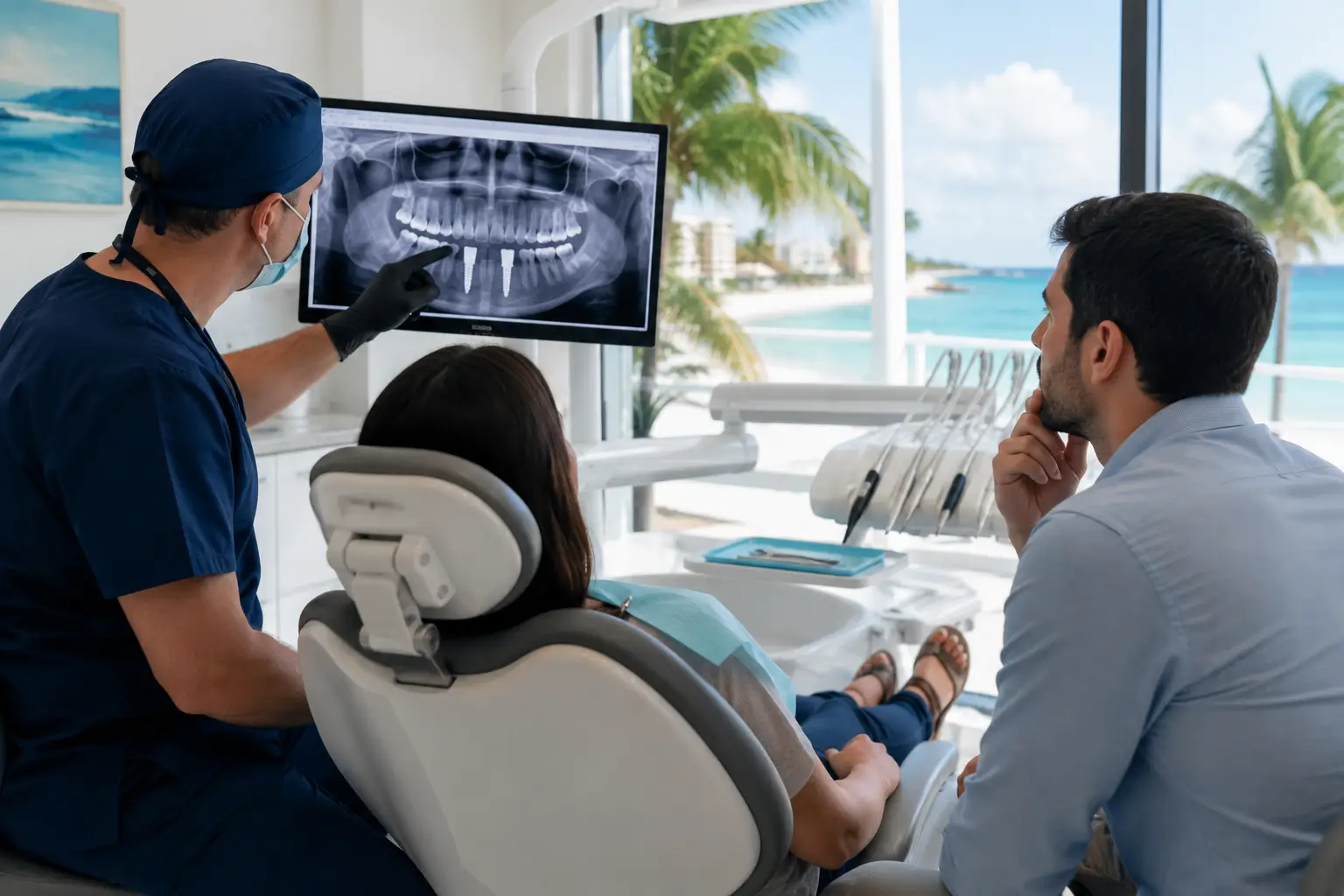
If you were my family member asking about getting dental implants abroad, here's what I'd want you to understand before you book anything.
You're not just "buying an implant." Dental surgery itself is only one piece of a much bigger puzzle. Proper planning, sterile protocols, bite design, lab quality, and reliable follow-up all work together to keep an implant stable for years. Your bone quality, overall health, and oral health habits matter too. When you pay for dental implants, you're really paying for a system of dental care—and that system needs to be documented and dependable.
Your safety comes from proof, not promises. A trustworthy Cancun dental clinic can quickly provide current PDFs naming the treating clinician with their license number, an itemized quote, the implant brand and restorative materials, and written aftercare and warranty policies. You can verify credentials yourself through Mexico's SEP cédula profesional registry at cedulaprofesional.sep.gob.mx. If a clinic pushes you to "just book" before providing documentation, that's a red flag.
Follow-up care is the hidden make-or-break factor. Most implant treatment plans happen in stages: dental surgery now, then a final crown or bridge months later once the implant has integrated with your bone (a process called osseointegration). Even excellent dental work sometimes needs adjustments. A safe savings plan includes a realistic timeline, buffer days built in, written guidance on when it's safe to fly, and a clear process for what happens if something goes wrong after you're back home.
Everything below unpacks these three truths in detail—price ranges, implant options, how to compare clinics, and a practical framework for vetting any dental clinic without guessing.
"Cheap dental implants" only make sense when the dental care is predictable and high-quality. Dental implants aren't like getting fillings—you're placing a medical device into bone. Success depends on planning, sterility, surgical skill, prosthetic execution, and reliable follow-up. Patient-specific factors matter too: bone density, systemic health, and lifestyle habits like smoking all influence outcomes.
The safest way to protect both your outcome and your budget is to treat documentation as your starting point. Before committing to anything—including a "refundable" deposit—request downloadable, up-to-date documents confirming exactly who will treat you, what materials will be used, what you'll pay, and what happens if you need help after you're home.
In practice, every clinic falls into one of three categories. Ready to move forward: they provide dated PDFs covering pricing, clinician credentials, implant system and materials, warranty and aftercare, plus a written timeline—and you can verify key details independently. Need more proof: they seem credible, but one or more items are incomplete, undated, not downloadable, or not specific to your case. Don't book: they refuse documentation, pressure you to pay first, won't name the treating clinician, won't provide a real warranty in writing, or won't itemize what you're buying.
Start here: Ask for a dated, downloadable verification pack—itemized quote, clinician IDs and licenses, written warranty and aftercare terms, materials and implant system details, and a written schedule—before paying any deposit. If that request is met quickly and clearly, you're likely dealing with a clinic that runs on process, not pressure.
If you're early in your research and want a structured way to compare options without starting from random ads, a curated marketplace can help—but only if it's built around verification and transparent treatment plans. The Globalcare app, for example, is designed for patients from the USA and Canada exploring dental care in Mexico who want to compare clinics with bilingual dental teams, clear treatment details, and pricing you can review before committing. As with any platform, you should still independently verify credentials and documentation for your specific case.
Dental implants can be life-changing. They can also become a long, expensive problem when poorly planned or poorly supported. If an implant fails, gets infected, or your bite ends up "off," your outcome hinges on two things: the training and credentials of the clinicians who planned and placed your implants, and your ability to get follow-up care and enforce warranty commitments once you're back home.
What makes a bad clinic choice so costly isn't just the initial dental procedure—it's the long tail of consequences. Persistent complications like repeated infections, gum inflammation, loose screws, fractured temporaries, or chronic bite discomfort may require multiple adjustments. You might face repeat procedures: removal and replacement, additional grafting, extended healing, or a full prosthesis remake—often paid out of pocket.
Then there's the cross-border stress: time off work, emergency local visits you didn't plan for, and the emotional toll of coordinating care remotely while in pain. "Warranties" that sound reassuring online can become nearly impossible to use if the terms are vague, unsigned, or unclear about what happens once you're back in the USA.
This is especially true for full mouth restoration cases—often marketed as All-on-4 or All-on-6 dental implants in Cancun. These full arch treatments can deliver excellent results in the right hands, but they demand careful diagnosis, a clear prosthetic plan, strict infection control, and planned follow-up. What reputable clinics have in common: they don't ask you to trust marketing. They provide proof—credentials, materials, sterilization standards, itemized pricing, and enforceable aftercare—without evasiveness or pressure.
Before you compare prices, understand what type of dental treatment you're being quoted for. Two quotes can look "similar" and represent completely different treatments.
A single-tooth implant includes an implant fixture placed in bone, then an abutment and crown—often done in two phases, with the crown placed after healing. Multiple implants means several implants with individual dental crowns, or implants supporting a bridge. Planning here is more complex because bite balance matters more. Full-arch implant bridges (often called all on 4 dental implants or All-on-6) use 4 to 6 implants per arch supporting a fixed bridge, typically delivered with a temporary first and a final bridge after healing. Immediate placement or immediate load means an implant placed right after tooth extraction, sometimes with a temporary tooth attached quickly. This approach is case-dependent and not suitable for everyone—it should be explained with clear criteria, patient selection factors, and associated risks.
Materials that should be named in your quote: For the implant system, ask for the exact brand and product line. Globally recognized examples include Straumann, Nobel Biocare, Zimmer Biomet, BioHorizons, and Osstem—the point is traceability so your components are identifiable later for maintenance or if you need care elsewhere. For crown or bridge material, common options include zirconia crowns and lithium disilicate (E.max) for dental crowns; for full-arch work, you may see acrylic temporaries and zirconia finals.
Ask which you're receiving now versus later. For abutment type, titanium is common, with zirconia abutments sometimes used for aesthetic zones. If a clinic won't name the implant system and restorative materials in writing, you can't truly compare options or plan future maintenance.
Most dental tourists researching dental implants in Mexico want a straight comparison against U.S. pricing. The table below shows representative ranges, but treat it as a starting point. The only number that truly matters is a dated, itemized quote for your specific case.
Price snapshot (USD) — last reviewed: May 2025. These ranges were compiled from publicly posted clinic price lists, marketplace listings, and common patient quote patterns. Because pricing shifts with materials, lab choices, and complexity, use these ranges to sanity-check offers—not to shop by sticker price alone.
How to judge if a listed price is reliable: Look for a last-updated date and a verification badge explaining what was checked and when. A badge is only useful if you can see what it means and how current it is.
Red flags in pricing: Is the crown and lab work included, or just the implant? Is the abutment included? For full mouth restoration, what's the temporary made of and what will the final prosthesis be? Are imaging and follow-ups included during your stay, and what happens after you return home? Is the quote dated and clearly in USD? If you only receive a number in a chat message or a "package price" with no line items, you don't have pricing—you have a marketing teaser.
Mexico is often the best country for dental implants for U.S. patients paying out of pocket.
People understandably want a list of "top clinics." The honest way to use any list is as a starting shortlist, not a shortcut. A dental clinic is only "top" for you if it can produce the documentation, materials transparency, and aftercare support that match your case.
Well-known clinics actively marketing implant dentistry in Cancun Mexico include Cancun Dental Specialists, Ocean Dental Cancun, Cancun Cosmetic Dentistry, Dentcare Cancun, Dental Experts Cancun, and Smile Center Cancun. Many are located in or near the Hotel Zone, making them convenient for patients combining dental work with a dental vacation.
Important caveat: This isn't a ranking or medical endorsement. Clinic staffing, ownership, and protocols can change. Use the documentation process described below to verify who will treat you, what system they'll place, and what happens if you need help after you get home.
If you'd prefer to start with clinics that have been screened for documentation readiness, you can compare options in the Globalcare app and still apply the same verification steps yourself.
To keep things simple, collect these five items—preferably as PDFs you can save and print. If even one is missing, you're relying on hope instead of evidence. Save copies yourself (PDF downloads, email attachments, or screenshots). If a dispute happens later, your saved files are often what you can rely on—especially when messages disappear, staff changes, or policies evolve.
Start with the basics for each clinician involved—oral surgeon, restoring dentist or prosthodontist, anesthesiologist if used. Get their full name, role or specialty, and professional license number. Ask where the license can be verified (Mexico's federal cédula profesional registry at cedulaprofesional.sep.gob.mx is a common starting point). If they claim a specialty like oral surgery, periodontics, or prosthodontics, request supporting documentation. Some Mexican dental specialists also hold memberships with professional organizations such as the Asociación Dental Mexicana (ADM) or international bodies like the International Congress of Oral Implantologists (ICOI).
Make verification real: Ask the clinic to confirm that the name on the license matches the treating clinician's government photo ID on the day of treatment. You're not being difficult—you're preventing substitution, where the person you consulted isn't the person who performs the dental procedure. Acceptable proof includes a screenshot from the official registry, a scanned certificate, or a PDF letter from the clinic listing clinician names and license numbers with clear ID matching. "Don't worry, they're certified" without a verifiable license number doesn't count.
Red flags: Missing license numbers, names that don't match documentation, unverifiable specialty claims, or a dental clinic refusing to tell you who will actually place the implant.
Good clinics don't rely on verbal promises. Ask for a written warranty and aftercare document that clearly states what's covered (implant fixture, abutment, crown, full-arch prosthesis, repairs), how long coverage lasts for each component (fixtures and prosthetics often differ), and what support looks like geographically—whether that's teleconsults while you're in the USA or Canada, partner clinic options, or whether warranty care requires return travel.
The document should also spell out exclusions (trauma, lack of hygiene follow-up, third-party repairs, unmanaged medical risks), the claims process (steps, timelines, required documentation, and a named contact—not just a generic email), and response expectations with escalation procedures if you don't hear back within the stated window.
If a clinic says "we have a warranty" but won't provide it in a downloadable, signed, and dated format, treat that as no warranty until proven otherwise.
Your quote shouldn't be a single number. It should be a dated, itemized treatment plan—ideally a signed or stamped PDF—specifying the implant system brand and product line, abutment type and material, crown material (zirconia, lithium disilicate/E.max, titanium), imaging included (CBCT/3D scan, X-rays) and any additional imaging fees, plus line-item costs for extractions, bone graft procedures, membranes or biologics, temporary restorations, sedation or anesthesia, lab fees, and follow-up visits. Payment schedule, cancellation terms, and refund rules should be in plain language.
Watch for surprise costs: "Starting at" pricing, bundled quotes with no materials listed, and unclear language around grafting (for example, "if needed" without a price range). A practical tip: ask for a de-identified sample showing how they format real patient quotes, so you can see how detailed their documentation typically is.
A reputable dental clinic should be able to show evidence of the tools and protocols that protect you. World-class facilities invest in state-of-the-art technology and maintain rigorous safety practices. Ask for implant brand and product line documentation with clear photos of packaging or labels for traceability, information about the dental lab used for crowns, bridges, or full-arch prostheses (and expected turnaround time), a written sterilization protocol with basic autoclave documentation (sterilizer type, maintenance records, routine testing logs), and how they handle sterile zones, instrument processing flow, and single-use items. Some clinics also use CAD/CAM technology for precise crown fabrication.
Be wary of claims like "hospital-grade sterilization" without documentation to back them up. For dental surgery abroad, specificity is safety.
Ask for a written itinerary that includes procedure date(s), follow-up appointment(s), and normal healing milestones. It should clarify whether your plan is staged (implant first, crown later) or includes a temporary tooth or prosthesis, how many days they recommend you stay after dental surgery (with a written reason including at least one buffer day), written post-op travel restrictions specifying when it's safe to fly (especially after sedation or anesthesia), and emergency contact details—who answers after hours and where you should go locally if you need urgent help.
If the clinic offers logistics like airport pickup, hotel discounts in the Hotel Zone or Riviera Maya area, or transport to appointments, ask for that in writing too. Clear logistics are part of safety in dental tourism.
Reviews, testimonials, and glossy bios can be helpful, but they're not enough. A more reliable approach is checking whether the clinician's real-world experience matches your situation.
Ask for targeted, case-matching proof. How many dental procedures like yours have they completed in the past 12 months—front-tooth implants, immediate placement, grafting-heavy cases, full mouth restoration cases? Can they share relevant before-and-after galleries for cases similar to your starting point (bone level, tooth position, complexity), ideally showing multiple stages rather than only final "glamour" photos? How do they handle complications—failed integration, peri-implant inflammation, fractured temporaries, bite issues? What's the plan, and who does the fix?
Look for credible documentation signals: dated treatment notes, clear timelines, and images that match the story—not random portfolio photos. If a clinic can't show comparable cases (de-identified and ethically shared) or can't explain the "why" behind your treatment plan, you're seeing promotion, not proof.
Complications can happen anywhere, including at excellent clinics—and some level of minor adjustment or follow-up is normal, not necessarily a sign of poor dental care. The difference is how clearly the clinic responds and whether you have written terms to rely on.
When aftercare is handled well, it usually follows a predictable path. Within 24 to 48 hours of noticing a problem, you contact the clinic using the warranty channel with photos and a description of symptoms. Within 1 to 3 business days, a coordinator or clinician reviews your case and schedules a video or telehealth check, then provides written next steps. Within days to weeks, you may need a local evaluation (an X-ray, for example) or need to plan an in-clinic adjustment or repair visit, depending on what failed. Resolution means documented repair and replacement steps, plus an updated plan you can save.
When filing a warranty or aftercare request, prepare: Photos or videos with timestamps showing swelling, gum changes, or prosthesis fractures; your treatment summary and surgical notes (or at minimum: implant brand, positions, dates); any new imaging your local dentist takes along with the written report; receipts and payment records including deposits and dates; and travel records if the warranty requires return visits.
If responses are slow: Your warranty should identify who to contact next (clinic manager, medical director, patient coordinator). If a clinic claims it has partner dentists in the USA for interim support, ask for the partner's name, location, and exact terms in writing.
An important reality to plan for: Some dentists in the USA or Canada may be reluctant to perform follow-up work on implants placed abroad—due to liability concerns, unfamiliarity with the implant system, or inability to verify the original work quality. Before you travel, consider identifying a local dentist who is willing to provide follow-up care if needed. Having your implant system documentation (brand, product line, and component specifications) makes it easier for any dentist to help you.
"All-inclusive" isn't a regulated term in dentistry, and clinics use it differently. Even when the base price looks reasonable, the total can shift significantly based on what's included versus what's charged as extras.
A single implant package might include implant placement, abutment, and crown—but exclude CBCT, grafting, extractions, or sedation. A full-arch package might include implants and a temporary prosthesis, but the final prosthesis material and long-term warranty terms may be an upgrade. Common add-ons include grafting or sinus lifts (often hundreds of dollars per site), material upgrades for crowns or abutments, additional imaging, lab rush fees if your schedule is tight, extra adjustments or after-hours visits, and non-cash payment surcharges (commonly a few percentage points for credit cards).
Payment protections that reduce risk: Credit cards may offer dispute or chargeback options depending on your issuer and documentation. For large cases, ask about staged payments tied to treatment milestones. Regardless of payment method, your strongest protection is still clear, dated paperwork and saved receipts.
A negotiation tip that works: Don't negotiate the total number first. Negotiate clarity. Ask the clinic to rewrite the quote so it explicitly lists inclusions, exclusions, and materials. Once the scope is precise, it's much harder for surprises to appear later.
Any dental clinic can post modern-looking photos. Instead of relying on visuals, ask for proof you can validate.
Request a simple photo sequence—"Please send 3 to 5 photos showing your sterilization-area workflow from dirty to clean," or "CBCT room plus machine plus the clinic sign at reception." Stock photos rarely come in coherent sequences. Ask for timestamps or "today's proof": a quick photo with the day's date written on a card in the frame. Request maintenance or calibration confirmation where it matters—for CBCT scanners and sterilizers, basic service records or routine test logs. Verify the lab relationship: which lab makes your crown or bridge, where it's located, typical turnaround time, and what materials will be used.
If answers stay vague, treat that as a signal to slow down.
How long you'll need to stay—and whether you'll need more than one trip—depends on whether your implant can be safely restored immediately or needs a staged approach. Individual healing times vary based on factors like age, overall health, smoking status, and bone quality.
Sample trip plans to sanity-check what you're told: For a single implant—Day 1 consult and imaging, Day 2 dental surgery, Days 3–4 check, Day 5 buffer and fly home (with written clearance)—then return later for the crown. For multiple implants with bone grafts—Day 1 imaging and planning, Day 2 surgery, Days 3–5 monitoring and adjustments, Days 6–7 buffer and fly—then return later for restorations. For full-arch—Day 1 diagnostics and final plan confirmation, Day 2 surgery, Days 3–7 temporary delivery and adjustments, Days 8–10 buffer and final checks—then return for the final prosthesis after healing.
Travel-smart basics: Carry digital and printed copies of your records (treatment plan, imaging summary, implant system details, prescriptions, warranty/aftercare, emergency contacts). Plan at least one contingency day after surgery before flying home. If you buy travel insurance, confirm in writing whether dental surgery complications are covered—many standard policies exclude them.
The right decision balances cost with verifiable quality, logistics, and your ability to get follow-up care. "Cheaper vs. expensive" is too simple. What you really want is the best total outcome per dollar, with realistic aftercare.
A simple scoring approach (rate 1–5 for each): Cost clarity—is pricing itemized, dated, and comparable? Verification strength—can you verify licenses, materials, and processes? Aftercare enforceability—is the warranty downloadable, specific, and realistic across borders? Travel burden—number of trips, length of stay, and your ability to return if needed.
Weight factors by your situation: If you're value-focused with a straightforward case, weight cost clarity and verification most heavily—you're optimizing savings without gambling on quality. If you're cautious with low risk tolerance, weight aftercare enforceability and travel burden heavily—you're paying for predictability. If you have a complex case (medical history, heavy grafting, full-arch complexity), weight verification, aftercare, and travel burden highest. For many complex situations, local specialist care may be the safer option.
Where Globalcare fits: If you want options in Cancun but also want to compare against other Mexico destinations, Globalcare can help you evaluate dental clinics across Cancun, Los Cabos, Los Algodones, Puerto Vallarta, Playa del Carmen, Guadalajara, Mexico City, Querétaro, Monterrey, Ciudad Juárez, and Mérida. That's especially useful if you're balancing budget, flight time, and how easy it would be to return for a second phase or warranty visit. You can start by browsing in the Globalcare app, rather than trying to reconcile inconsistent quotes across multiple chat threads. As always, apply your own verification process regardless of the source.
Some issues are hard stop signs, not negotiation points. Before booking, run through this quick checklist:
If you can't check every box, pause. If the clinic refuses to provide what you need, treat that as your answer and move on.
Certain conditions may make it safer to wait, pursue dental treatment locally, or require additional coordination with your medical team. These include poorly controlled diabetes (HbA1c levels around 8% or higher are often flagged—your physician and dental surgeon should advise what's appropriate for your situation), recent heart attack, stent placement, or cardiac surgery (timelines vary, but many patients are advised to wait several months and obtain medical clearance), bleeding or clotting disorders or complex anticoagulant regimens (requiring coordination between your physician and surgeon), active chemotherapy or significant immune suppression, severe jawbone loss requiring staged, complex grafting where close follow-up is critical, current or recent bisphosphonate use (medications for osteoporosis or certain cancers) which can affect bone healing, and active smoking, which is associated with higher implant failure rates.
If any of these apply, consider a local dental specialist evaluation first. If you still want to travel for dental work, get written clearance from your physician and discuss it with your dental surgeon before booking international treatment.
If work or family responsibilities leave you no buffer for swelling, infection concerns, bite adjustments, or an unexpected extra visit, postpone. Common risky scenarios include booking a flight the day after surgery, having no flexibility for follow-up appointments, or needing to travel again soon after sedation or anesthesia. Build at least one "just-in-case" day after surgery before flying home.
Great clinics document cases carefully. Strong patient stories usually include photos or videos showing multiple stages (not only the final new smile) with clear sequencing and context, proof the clinic has patient permission to share images (consent/release with personal details protected), and brief case notes explaining treatment steps, timeline, and how complications (if any) were handled.
Quick authenticity checks: Ask whether the clinic can share de-identified dated milestones or corresponding imaging snapshots for a comparable case. For video testimonials, look for continuous, minimally edited sequences—not jump cuts—and be skeptical of heavily filtered "instant transformation" clips that skip over temporaries and healing.
Most delays come down to missing clarity. Here's how to unblock the process without taking on unnecessary risk.
If aftercare is vague, ask for a downloadable, signed warranty/aftercare policy with coverage, exclusions, response expectations, and a claims process. If pricing is unclear, request a current, itemized quote in USD (or clearly stated currency) including what's excluded and what could change after imaging. If clinician ID is uncertain, request the treating clinician's full name, license number, and where to verify it—then verify it yourself. If you're unsure about insurance, ask your insurer (not the clinic) in writing what out-of-country reimbursement requires. If you have travel safety questions, ask the dental clinic for written post-op travel restrictions.
Wording you can copy to request missing items: "Before I place a deposit, please email me a dated, itemized PDF quote, plus your downloadable warranty/aftercare terms; the full names and license numbers of the treating clinicians (including where to verify them); the implant system and materials for my case; and a written timeline, including when it's safe to fly after treatment."
Start by filtering out clinics that don't show current pricing standards. Look for a clear last-updated date and a verification badge explaining what was checked and when. Then sanity-check the clinic's numbers: does a sample advertised price match what they're willing to send in a dated PDF quote?
Request all five CARED documents and save them with clear names and dates (for example: "ClinicName_Warranty_2025-05-07.pdf"). An efficient order: start with Real Prices so scope is clear, then Credentials and Aftercare so safety and enforceability are clear, then Equipment and Dates/logistics so quality and travel planning are realistic.
Compare your top 2–3 options side by side in a spreadsheet—evaluate the same line items: clinician identification, implant system, prosthesis materials, total price, warranty terms, timeline, and follow-up plan. Before paying anything, your downloadable quote should include a detailed price breakdown, treating clinician identification (name plus license number), and a dated warranty/aftercare summary.
How priorities shift by situation: If you're budget-focused with a straightforward case, prioritize itemized pricing, strong documentation, and a reasonable travel timeline—don't "save money" by accepting vague materials or no aftercare. If you have complex needs, prioritize verified credentials, staged planning, and realistic aftercare logistics, even if it reduces savings. The rule stays the same: no documentation, no deal.
Tools like the Globalcare app can help you centralize your search by organizing quotes and storing documents in one place—especially if you're comparing multiple clinics or deciding between destinations based on travel time, budget, or your ability to return for a second phase.
What makes Globalcare most useful in the implant research stage is that it's built around what matters to patients: transparent information (pricing, clinic credentials, patient reviews, and before/after photos), and support for planning and travel logistics.
Within the app, you can filter and discover dental clinics by treatment type, location, and preferences; see pricing and clinic details in one place; chat directly with clinics to request multiple quotes and clarify treatment plans before booking; and keep documents organized for side-by-side comparison while exporting and sharing records.
If you're ready to compare clinics side by side and keep your CARED documents organized, explore the Globalcare app. Remember that regardless of platform, you should still independently verify credentials and documentation for your specific case.
For smoother consultations, upload recent dental X-rays and/or CBCT (if you have them), your dental and medical history, and your written checklist covering timeline, materials, aftercare, and travel logistics. Always read privacy terms before sharing health data, keep backups outside the app, and export your files for long-term access. In dental tourism, organization is protection.
Get in touch to get started!
Our team of experts will ensure your all-on-4 dental implants journey is safe and easy. We're dedicated to guiding you to your new smile every step of the way!
ConnectConcierge Services

Trusted Dentists

Safe Locations

Concierge Services
Trusted Dentists
Safe Locations

Disclaimer: Dental Cost Estimation Calculator
This Dental Cost Estimation Calculator is designed to provide users with estimates of potential savings when seeking dental treatments abroad compared to the cost of similar procedures in the United States. However, please be aware of the following important information before using this tool:
1. Estimations Based on Publicly Available Data:
The estimates provided in this calculator are derived from publicly available data sources, including average procedure costs, exchange rates, and other relevant information. These figures may not reflect the exact costs of your specific treatment or location. Estimations include non-dynamic assumptions for travel and lodging costs that may not reflect the actual costs at the time of your research.
2. Quantitative Model Assumptions:
The calculations are based on assumptions and data inputs that may not account for all factors influencing dental treatment costs. Variations in individual treatment needs, dentist fees, and other variables can significantly affect the final expenses.
3. No Substitute for Professional Advice:
This tool is not a substitute for professional dental advice. Before making any decisions about your dental treatment, it is crucial to consult with a qualified dental professional who can provide you with a personalized assessment of your needs and potential costs.
4. Currency Exchange Rates:
Estimates involving foreign treatment costs rely on currency exchange rates, which can fluctuate. The rates used in this calculator may not accurately represent the current market rates at the time of your treatment.
5. Geographic and Facility Variations:
Dental costs can vary significantly based on geographic location, dental facility, and the complexity of the procedure. The estimates provided are general in nature and may not reflect the specific conditions in your chosen destination or dental clinic.
6. Non-Inclusive Costs:
This calculator may not account for additional expenses such as per diem costs in destination or unforeseen complications during or after the procedure. These costs can substantially impact your overall expenses.
7. Liability Waiver:
By using this calculator, you acknowledge that the estimates provided are for informational purposes only, and Globalcare Network Inc or any of its representatives bear no responsibility for the accuracy of the estimates or any decisions made based on them.
8. Independent Research Recommended:
It is strongly recommended that you conduct independent research, obtain quotes from dental professionals, and consider all relevant factors when making decisions about dental treatment abroad.
In summary, while this Dental Cost Estimation Calculator aims to provide helpful information, it should not be the sole basis for your decision-making process. Your individual circumstances and dental needs may differ, and it is essential to seek professional advice and conduct thorough research before pursuing dental treatment abroad

