All-On-4 Cost in Mexico: Real Prices from Top Clinics
June 4, 2026

Back to Blog
.png)
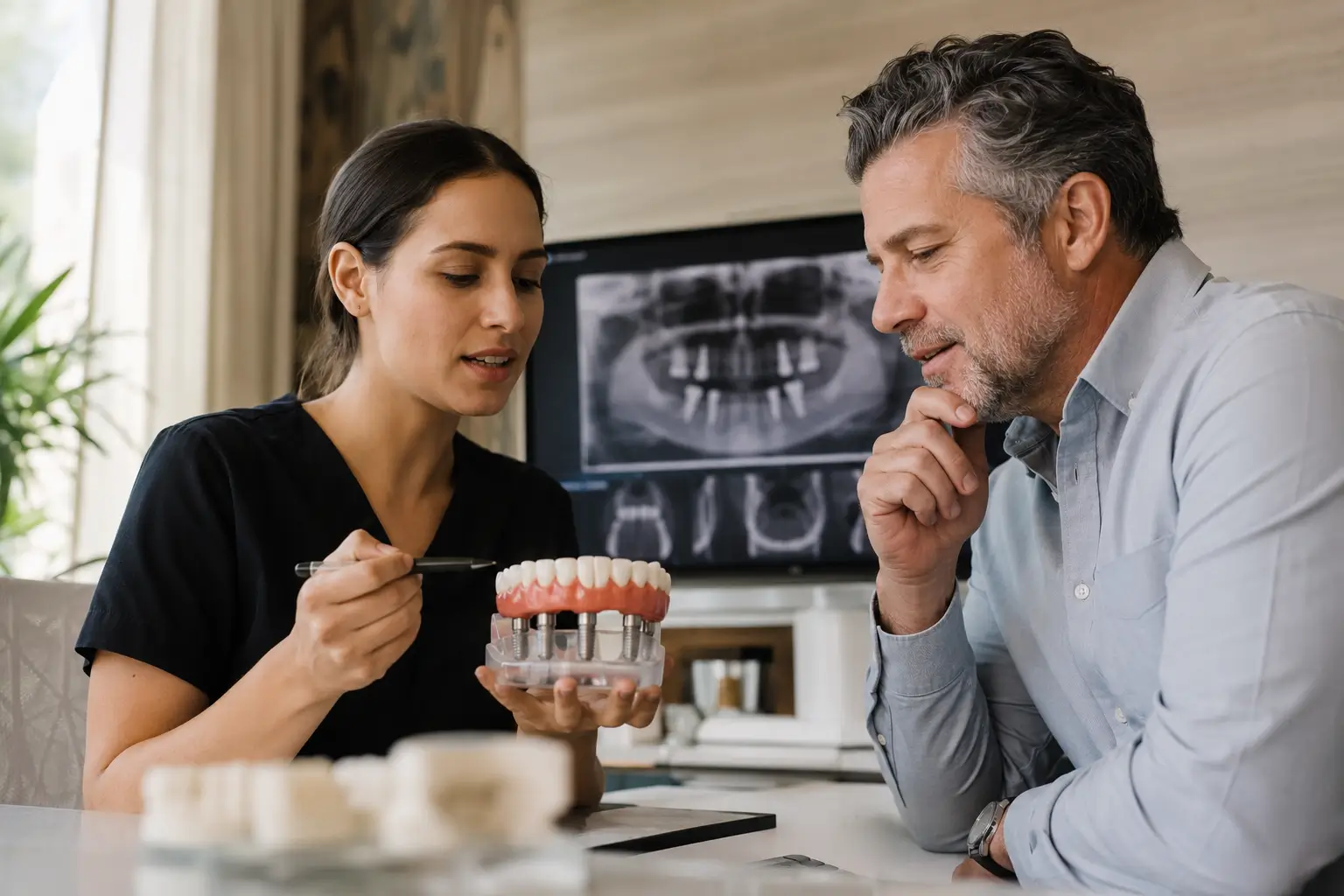
If you're weighing whether Mexico is really worth it for all on 4 implants, there are three things you need to get right. These aren't meant to scare you—they're the difference between a smooth, affordable full mouth restoration and an exhausting project that keeps draining your wallet long after you've come home.
Make clinics prove the "real price." Those "starting at" figures you see online? That's marketing, not a quote. A dental clinic that's serious about earning your trust will send you a dated, itemized quote that spells out exactly what's included—implants, abutments, temporary teeth, the final bridge, CBCT imaging, sedation, medications, and follow-up visits. It should also tell you what's not included. Without this document, you can't compare dental implants cost fairly, and you definitely can't budget with confidence.
Don't fly based on a guess. Your treatment plan should be built from a CBCT (3D scan) and should name the surgeon who will actually operate on you. This dramatically reduces a common dental tourism surprise: you arrive for what you thought was a "fixed package," only to learn you need extractions, bone grafting, or a sinus lift—each with its own fee and timeline implications.
Think like your future self. Ask for the implant brand and model (such as Nobel Biocare, Straumann, BioHorizons, or Zimmer Biomet), plus a warranty you can read from start to finish. If a screw loosens or your bridge chips years down the road, you'll want clear rules about what's covered—parts, labor, return travel, maintenance requirements. You'll also want components that can be serviced beyond a single clinic, not a proprietary system that locks you in.
Get those three things right, and Mexico can absolutely be a smart choice for full-arch restoration—assuming you're a good candidate. Not everyone is—factors like jawbone density, overall health, and certain medical conditions can all affect whether All-on-4 makes sense for you. The rest of this guide walks you through how to gather the right documents, compare offers fairly, and sidestep the hidden costs that typically wipe out savings.
Most people start by searching something like "average dental implants cost Mexico 2026 USD" or "full arch dental implant cost Mexico." These searches will give you ballpark ranges, but they won't reveal what's actually bundled into those numbers.
To find clinics that are willing to be transparent, try searches that naturally force more details: "dental implants Mexico itemized quote," "All-on-4 Mexico what's included," or "full mouth dental implants and bone grafting Mexico cost." If a dental clinic can't answer the questions these searches imply—questions about brands, materials, imaging, sedation, and warranty terms—that's an early warning sign.
Mexico can make real financial sense for full-arch work, but only when you hold clinics to the same documentation standards you'd expect at home. The simplest way to decide? Use the 5-point booking checklist later in this guide. If you can't get those items in writing, don't send a deposit.
It's also worth noting that all-on-4 dental implants aren't the right fit for everyone. Some patients do better with alternatives—All-on-6 (more implants for added jawbone support), implant-supported overdentures, or even traditional dentures, depending on bone quality, health status, and personal goals. A thorough evaluation during your initial consultation should clarify which option suits your situation and whether your jawbone density supports immediate load protocols.
Once you've determined you're a good candidate and feel confident about a clinic's documentation, protect your money the way you would for any major purchase.
Credit cards may offer dispute options if the delivered dental work differs materially from what was promised, though disputes for services already rendered can be difficult to win and typically must be filed within 60–120 days (check your card's terms and ask about any processing fees).
Request staged payments—a smaller deposit to reserve your dates, then a schedule tied to clear milestones like your scan, implant surgery, provisional placement, and final bridge.
Some patients ask about escrow-style arrangements or payment processors that create a stronger paper trail than a wire transfer. And always get the refund policy in writing: if you need to cancel due to medical issues, timeline changes, or a revised treatment plan, you want those rules spelled out upfront.
A message you can send to clinics: "Before I reserve dates or pay a deposit, please email me: (1) a PDF of your full, dated itemized quote with currency rules, (2) the complete warranty document, and (3) my CBCT-based treatment plan showing whether grafting or sinus lift is expected, along with the surgeon's name. Also confirm your refund and deposit terms, whether you accept credit card or escrow payments, and all accepted payment methods."
If you'd rather start with a curated shortlist of options—especially for high-stakes implant procedures like full mouth dental implants—Globalcare connects you with a network of clinics across Mexico that have been screened for credentials and documentation practices. Many feature English-speaking staff, modern equipment, and clearer treatment-plan expectations, plus support as you plan and travel.
Headline pricing like "All-on-4 for $6,500 USD" often leaves out essential components—imaging, sedation, temporary teeth, or even details about what material your final bridge is made from. That makes fair comparisons nearly impossible and sets you up for package switches, surprise add-ons, or a timeline that shifts the moment you land.
This guide moves you from "What's the dental implants cost?" to "Which clinic can I actually book with confidence?" You'll learn how to collect verifiable documents—quotes, CBCT plans, warranties—so you're not relying on screenshots or sales chat. You'll see how to compare up to three offers cleanly by requiring each clinic to quote the same categories: implants, abutments, temporaries, finals, imaging, sedation, medications, follow-ups, and likely add-ons.
You'll reduce surprise return trips by planning realistic follow-up care and choosing cities and clinics that make aftercare practical. And you'll simplify warranty enforcement by understanding what "parts," "labor," "return travel," and "maintenance requirements" actually mean before you pay.
Set realistic expectations here: doing this right takes time. Most patients spend one to three evenings gathering records, requesting documents, and comparing offers. That investment is small compared to the cost of one extra flight, one unexpected graft charge, or one denied warranty claim.
If you're close to committing, use this checklist as your safety net. It's designed to catch the exact issues that lead to hidden fees, clinical surprises, and warranty problems after you're home. If any item is missing, pause until it's resolved in writing.
"Starting at" pricing is marketing. Your actual quote should be comprehensive, readable, and specific enough that another dental clinic could understand exactly what's being offered.
Look for the number of implants per arch along with the brand and model, abutment type and brand, extraction costs (both simple and surgical), whether bone reduction or grafting is expected (and how it's billed), provisional (temporary) teeth, final bridge material and lab location, all lab fees and imaging (including CBCT scans and X-rays), anesthesia or sedation method, medications and post-op visits, and hotel or transport details if "included" is advertised.
Two seemingly small details matter for fair comparison. First, your quote should be dated with a stated validity window—prices change. Second, ask about currency rules: if the clinic charges in pesos, get their conversion policy (which exchange rate, and when it's applied). If they quote in USD, confirm whether you'll actually be charged in USD or if that's just an estimate.
Many patient frustrations surface after dental treatment, when a chip, loose screw, bite issue, or fracture appears and the warranty turns out to be murky. Protect yourself by requesting the full warranty document in advance, then reading it like a contract.
Confirm these points in writing: length of coverage (when it starts, when it ends, and what can void it), what's covered (parts, labor, or both), shipping and lab logistics (if a component must be remade, who pays?), maintenance requirements (required cleanings, check-ups, night guard use, and documentation rules), geographic limits (whether dental work must be done at the Mexico clinic to qualify), and exclusions (bruxism, smoking, missed maintenance, trauma, or third-party work).
A warranty that covers only "parts" may still leave you paying for labor, travel, and hotel costs. If anything is vague, ask the clinic to walk through specific scenarios: "If a tooth chips on my temporary bridge, what do you cover and what do I pay?" Missing or unclear warranty terms should be a stop signal until you have a readable PDF.
A note on enforceability: Even a well-written warranty depends largely on the clinic's willingness to honor it. Pursuing legal remedies across international borders is expensive and impractical for most patients. Your best protection is choosing a clinic with a documented track record of honoring warranty claims—ask for references or look for reviews that specifically mention how the clinic handled problems after treatment.
Insist on the implant system, abutments, and prosthesis material in writing. Widely used international brands like Nobel Biocare, Straumann, BioHorizons, and Zimmer Biomet are often preferred because they have established clinical track records and replacement components that are generally easier to source globally. That said, outcomes depend heavily on surgical technique, case selection, and your individual healing—brand alone doesn't guarantee success.
Ask for proof, not just a brand name dropped in a chat message. Request manufacturer labels or serial numbers for implants and abutments (and photograph them for your records), an implant passport or component list in your chart at the end of treatment, and lab documentation stating material type (such as "monolithic zirconia" or "PMMA provisional") and where the final prosthesis was fabricated.
If a clinic uses an unbranded or "compatible" system and won't provide clear documentation, you could be locked into that single clinic for future repairs—especially if parts are proprietary. That can erase your savings quickly if you need an urgent fix years later.
All-on-4 success depends on multiple factors: correct diagnosis, surgical technique, your bone quality and overall health, and how well you follow post-operative care instructions. A strong plan starts with a CBCT (3D scan) reviewed by the surgeon who will actually operate on you. It should state whether you're likely to need extractions, grafting, a sinus lift, or other add-ons—and flag relevant medical risk factors like poorly controlled diabetes, certain blood thinners, active smoking, sleep apnea (for sedation planning), or a history of bisphosphonate use.
Bisphosphonates deserve special attention: these medications, often prescribed for osteoporosis, can increase the risk of a serious complication called medication-related osteonecrosis of the jaw (MRONJ). If you've taken bisphosphonates—especially intravenously—make sure your surgeon knows, as this may require medical clearance or reshape your implant treatment entirely.
Why does this matter for travel patients? The surprises that blow up budgets and timelines are often visible on the CBCT or in your medical history: hidden bone loss that changes implant placement or requires grafting, teeth grinding (bruxism) that increases chipping or wear risk and can trigger night-guard requirements affecting warranties, or medication conflicts requiring clearance or schedule changes.
If a clinic says they can't estimate your needs until you arrive, that may be true for borderline cases. But you should still receive a written plan with clear if/then pricing and a realistic timeline before you book flights.
Even good clinics can't promise you'll never need add-ons—your anatomy and health determine that. What they can do is explain exactly how add-ons are billed and provide a written list of likely extras so you can budget with less anxiety.
Common add-ons to ask about include bone grafting ($350–$1,200 USD per site), sinus lift ($600–$1,400 USD per side), upgrade from local anesthesia to IV sedation ($200–$500 USD), additional CBCT or intraoral scans ($50–$250 USD each), unexpected extractions ($50–$200 USD each, with surgical extractions potentially higher), shipping or courier fees for lab remakes or parts (varies—ask for the policy), taxes or card-processing fees (if applicable—ask upfront), emergency return travel if an urgent repair can't wait (varies—budget for it), and extra hotel nights ($80–$200 USD per night in resort cities, often less near border towns).
Many travelers set aside an extra 25% to 40% above the base quote as a contingency—$2,000 to $3,000 USD as a practical buffer, especially for full-arch implant cases. The key is getting the clinic's extras list in writing so "extras" don't quietly morph into "surprise bills."
Don't compare sticker prices in a vacuum. Compare your expected total cost over the next several years, including base dental treatment plus realistic add-ons, travel expenses (flights, hotel, food, insurance), maintenance and repairs (material choice matters—acrylic typically needs more upkeep than zirconia), and at least one what-if return trip for adjustments or repairs.
A simple "cost per functional year" calculation: Start by totaling your Mexico cost—the quote plus expected extras, travel for Trip 1, travel for Trip 2, and a contingency amount. Then estimate functional years conservatively, using a range like 5 to 10 years rather than a best-case promise (keep in mind that longevity varies significantly based on materials, maintenance, and individual factors). Add a repair assumption: plan for at least one meaningful adjustment or repair event. Finally, divide your total cost by years to get a usable comparison against a U.S. option.
Quick example: If your Mexico plan runs $12,000 USD, travel totals $1,800 USD, likely add-ons hit $1,000 USD, and you set aside a $2,000 USD buffer, you're at $16,800 USD. Assuming 7 years of functional use (a conservative mid-range estimate), that's about $2,400 USD per year. Stack that against a U.S. quote of $28,000 USD with lower travel costs but potentially higher local maintenance fees, and see which per-year picture feels safer for your finances.
Run a sensitivity check: Calculate both your best case (minimal extras, no urgent return trip, longer lifespan) and worst case (grafts added, one return flight for repair, shorter lifespan or early remake). If Mexico only wins in the best case and looks close or worse in the worst case, the smarter move may be choosing a city and clinic that makes follow-up visits cheaper—or paying more for clearer warranty terms and stronger documentation.
Note: These are general 2026 ranges that vary by city, clinic, materials, complexity, and what's included. Your written treatment plan and itemized quote are what matter.
How to handle pricing claims with no source: If you spot a number online with no clear explanation of what's included, treat it as a headline only. Label it "source unclear" in your notes and don't let it drive your decision. Build your comparison on 2026 dental implant price comparison US vs Mexico, PDF quotes and written policies, not web banners.
Precision protects you. If a line item affects your outcome or your wallet, get it confirmed in writing and save it.
When you encounter vague phrases, push for clarity.
If they say "package includes everything," respond: "Please itemize everything in a dated PDF and list what is excluded."
If they say "top-quality implants," ask: "Which brand and model? Please include it on the quote and provide component documentation or serials."
If they say "zirconia bridge," ask: "Is it monolithic, full-contour zirconia? What are the design specs? Which lab makes it?"
If they say "sedation available," ask: "What type—local, oral, or IV? Who administers it? What's the fee, and what monitoring is included?"
If they say "warranty included," respond: "Please send the complete warranty PDF and confirm whether return travel is required."
Save every email, PDF, and receipt. Create a simple folder (or use Google Drive) and name files with dates—for example, "ClinicA_Quote_2026-08-12.pdf." If there's ever a dispute about what was promised, your time-stamped documentation is leverage.
Where you go in Mexico shapes your travel logistics—and that affects both your true cost and your ability to return for adjustments. Border cities can make quick follow-up visits easier. Resort destinations may offer convenient flights but often come with steeper hotel costs.
When comparing cities, weigh four practical factors. First, consider travel mode and recovery comfort: driving or walking across a border can be easier for repeat visits, while longer flights may require more hotel nights and a bigger buffer in case you need to stay an extra day.
Second, think about emergency access: where does the clinic send patients for emergencies, and how quickly can they get you there? A clear plan with a nearby hospital option is a real safety advantage.
Third, factor in peak-season pressure: in high-tourism destinations, lodging costs rise and clinic schedules tighten, so you may need to book earlier and build in timeline flexibility. Finally, consider local transport: if you'll be sedated or swollen, simple logistics matter. Ask whether the clinic coordinates pickups and whether your hotel is realistically close enough for multiple visits.
Patients tend to fit a few city profiles. If you want to minimize travel risk and simplify follow-up care, border-friendly options like Los Algodones or Ciudad Juárez can make return visits less expensive and less disruptive—many USA and Canadian patients find the lower cost of quick border crossings attractive for ongoing dental care.
If you want major-city clinical depth with straightforward flights, hubs like Guadalajara, Mexico City, Monterrey, and Querétaro offer broad specialist availability—helpful for complex or medically nuanced cases.
If you want to combine treatment with vacation, destinations like Cancun, Los Cabos, Puerto Vallarta, Playa del Carmen, and Mérida offer convenient direct flights, though you'll want to budget more carefully for lodging and build in extra time for follow-ups.
To filter clinics by location and procedure type, then compare documentation side by side—quote structure, materials, and aftercare expectations—you can use the Globalcare app, which organizes clinics that have met Globalcare's screening criteria so you're not wrestling with a dozen incompatible packages across different cities.
Your bridge material influences more than upfront price—it changes how your permanent teeth feel, how they wear, and what repairs may cost later. The "best" choice depends on your priorities, budget, and individual circumstances.
Acrylic on a titanium bar typically costs less and is often easier to adjust and repair, but it may stain, chip, or wear faster over time. PMMA is commonly considered an upgrade over basic denture teeth, though both can require maintenance. Full zirconia carries a higher initial cost but is strong and stain-resistant with a solid, tooth-like feel. Repairs or remakes can be pricier and may be easiest when handled by the original lab for the closest color and contour match.
Beyond durability, comfort often tips the scales. Zirconia feels substantial and natural—closer to your natural teeth in weight and bite; acrylic is lighter and more forgiving during the early bite-settling period. Zirconia generally resists staining better, while acrylic can discolor depending on your diet and habits. Acrylic repairs are usually simpler and faster; zirconia issues can be more all-or-nothing depending on the damage.
For budgeting, plan for maintenance realistically. Even without major failures, full-arch cases often require periodic adjustments—bite refinements, screw tightening, or wear-related work. Ask each clinic how they price common maintenance visits and what they recommend annually. If you plan to handle maintenance in the U.S., ask whether a U.S. dentist can obtain replacement parts and whether third-party work affects your Mexico warranty. Be aware that some U.S. dentists are reluctant to work on implants placed elsewhere due to liability concerns—you may need to call several practices or seek out a prosthodontist experienced with dental tourism cases.
The fastest way to get a reliable plan and quote is to give clinics the information they need upfront. Gather your medical conditions and medications (especially heart conditions, diabetes, bisphosphonates, and blood thinners), allergies, smoking status, and any history of sleep apnea (important for sedation safety). Collect recent dental X-rays and notes (ask your local dental office for digital copies). If you have a CBCT scan, include it; if not, ask whether the clinic can refer you to a U.S.-based imaging center or whether you should arrive early for scanning.
If your medical history is complex—a recent cardiac event, uncontrolled diabetes, or heavy anticoagulant use, for example—expect that medical clearance may be needed before dental implant surgery can be confirmed. Some conditions may delay or preclude treatment entirely; a thorough evaluation helps ensure you're a suitable candidate before you invest in travel.
A note on smoking: Active smoking significantly raises the risk of implant failure and complications. Many surgeons recommend quitting or at least stopping for several weeks before and after surgery. Be honest about your smoking status—it affects both your treatment plan, your oral health outcomes, and your warranty coverage.
A simple patient summary to paste into your email:
Full name / age:
City/state traveling from:
Goal: (e.g., "Upper All-on-4, possible lower in future")
Medical conditions: (diabetes, heart issues, sleep apnea, etc.)
Medications + doses: (especially blood thinners, osteoporosis meds, steroids)
Allergies:
Smoking/vaping: yes/no
History of grinding/clenching: yes/no/unsure
Recent imaging: (date of CBCT/panoramic + attached files)
Preferred timeline: (months available for travel + flexibility)
Depending on your health and sedation plan, some clinics request updated labs or medical notes before confirming surgery dates. If you already have recent results—or can get them from your primary care doctor—it can speed up approval and reduce last-minute cancellations. Many high-quality dental clinics in Mexico offer a free consultation to review your records before you commit to travel, and some provide a phone number or direct chat line for questions.
Most all on four cases wrap up in two main trips with a healing period in between. During your first trip (typically 3–7 days)[3], you'll undergo surgery—often including extractions—implant placement, and receive immediate load temporary teeth. Then comes a healing period of 3–6 months[4] while your implants integrate with the jawbone (a process called osseointegration) and you wear the temporary bridge. Your second trip (usually 5–7 days)[5] involves final impressions, lab fabrication, and placement of your permanent set of teeth.
If grafting, sinus lifts, or complications are involved, timelines can stretch and additional visits may be needed. Healing times also vary between individuals—some people integrate faster than others, and factors like smoking, diabetes, and jawbone density can affect the schedule. Ask for a clinic-signed treatment calendar with projected dates, expected visit durations, and clarity on what would change the plan—and cost—if healing takes longer than expected.
A border city with flexible follow-up might look like this: initial surgery plus temporary, then a quick return visit 1–2 weeks later if needed for bite adjustments, then your final trip months later. This works well when return travel is a drive or short flight. A standard two-trip plan (the most common approach) involves Trip 1 for surgery and temporary, followed by Trip 2 for the final bridge after integration. A multi-trip or extended timeline may be necessary if significant grafting or sinus lift is required—you might have preparatory surgery first, then implant placement later, then final restoration. This isn't "bad"—it's often the safer sequence—but it changes the travel math.
Most people read a warranty like a promise. Read it like a checklist instead: what the clinic must do, what you must do, and what could void coverage. Use a simple warranty-extraction method—copy key clauses into a note you can compare across clinics.
When reviewing, track the clinic name, document title and version/date, what's covered (quote the clause), what's not covered (quote the clause), whether parts and labor are both included or just one (with clause text), whether return travel is required (with clause text), maintenance requirements (cleanings, check-ups, night guard, proof required), how to file a claim (who to email, response time, required photos/docs), and the effective date (when coverage starts).
As you review, highlight phrases like "parts only," "labor excluded," "must return to clinic," "void if treated elsewhere," and "patient responsible for travel." These clauses most often shift the true cost of ownership.
To strengthen enforceability, ask the clinic to send the warranty as a PDF with your name and the clinic name included, and confirm key points in an email reply. If language is a concern, request an English version or a written bilingual confirmation of the clauses that matter most. The goal is clarity you can reference later, not legal theatrics.
Before you leave Mexico, collect and save your final invoices, a component list with serial numbers (if available), a copy of your treatment notes, and clear photos of the final result. These make future warranty conversations faster and far less stressful.
You're not being difficult by asking for credentials. Serious providers expect it and will usually respond confidently. Use a consistent checklist so you're not relying on gut feel alone.
Ask for the surgeon's full name and cédula profesional (this is the professional license number used in Mexico). Confirm the clinic license and registration with COFEPRIS, Mexico's federal health regulatory authority, verifying that the clinic operates legally under Mexican health rules.
Request a clear description of sterilization and infection control protocols for instrument processing. Ask about All-on-4 training specifically—request specific courses or certificates, not just "years of experience." Inquire about case volume and team roles: how many full-arch cases does the surgeon and team complete per month, and who does what (surgeon vs. restorative dentist vs. lab technician)? If the clinic references ISO-style processes or other quality frameworks, ask what that means in practice and what proof they can share.
Check on communication readiness—ask who your point of contact is and whether the clinic regularly supports U.S. or Canadian patients. Clear communication reduces preventable mistakes. Finally, request case documentation: before-and-after cases that are dated, de-identified, and tied to real treatment details.
If a clinic can't provide basic proof—license numbers, surgeon name, written sterilization answers—don't argue. Move on. In full-arch dentistry, the downside of hoping things are fine is simply too expensive.
Even in well-run cases, medical tourism has variables. Plan for realities that can add cost: extended hotel stays if swelling or healing delays travel, adjustments or relines (especially with temporaries), lab rework, emergency local dental visits, replacement medications, and an emergency travel fund if a repair can't wait.
To reduce unknowns, ask clinics about practical risk-control options before you pay. Some clinics will bundle common add-ons (like extractions) or set a maximum surcharge for certain items if they believe your case is predictable based on CBCT. Request staged payments tied to deliverables—this protects you if the plan changes materially after new imaging or medical clearance.
Credit card payments, secure payment links, or escrow-style arrangements provide a better paper trail than wire transfers. Consider travel insurance that covers trip changes, and ask whether the clinic offers extended protection plans—if so, get terms in writing and compare them to the standard warranty.
Whatever you negotiate—caps, bundles, refund credits—get it added to the quote or confirmed in a dated email. A "yes" over the phone won't help later.
Complications, while not the norm, can happen with any surgical procedure. If you face an issue, document it clearly and communicate in a way that gets you help faster while preserving your warranty position.
Take these steps immediately: Capture dated photos and/or video of the issue (and any visible components, like a chipped bridge). Write down symptoms, onset time, and anything that triggered it—a bite shift, fall, or chewing incident. Get written documentation from any dentist, ER, or urgent care provider you visit. Email the clinic a clear, factual summary with attachments (don't rely only on chat apps).
Build a repair-packet folder containing your quote, invoices, warranty PDF, CBCT plan, component or serial documentation (if provided), photos/videos, and a timeline of what happened. Clinics can often help faster when you send one organized email instead of scattered messages.
For minor issues like bite adjustments, sore spots, or provisional concerns, many clinics will try remote troubleshooting first using photos and videos—that's appropriate. But if you have signs of infection, uncontrolled pain, swelling, fever, or a major structural problem, get an in-person evaluation quickly.
If you must see a local U.S. dentist temporarily, ask your Mexico clinic (in writing) what's allowed without voiding the warranty, and keep receipts and notes in case reimbursement, credit, or dispute support becomes necessary. Be aware that finding a U.S. dentist willing to work on implants placed elsewhere can be challenging—some decline due to liability concerns, so you may need to contact multiple practices or seek a prosthodontist experienced with cases from other providers.
Understand your practical limits: While documentation strengthens your position, pursuing formal legal action against a Mexican provider from the U.S. is expensive, time-consuming, and rarely practical for most patients. Your realistic leverage is the clinic's reputation and willingness to resolve issues—which is why choosing a clinic with a track record of honoring commitments matters more than assuming you can enforce a contract in court.
A worst-case scenario might include a short-notice flight, extra hotel nights, and an urgent repair. Having a dedicated contingency fund and a payment method with protections isn't pessimism—it's what keeps a complication from spiraling into a financial crisis.
Reviews are most useful when they include details you can verify. Look for reviews mentioning approximate dates (month/year) and how long the patient has had the dental work, the exact procedure (single implant vs. full-arch all-on-4 dental implants, grafting, etc.), and healing experience, follow-up support, and how problems were handled.
Run a quick credibility check: Does the review name the procedure, timeline, and what was included? (That's specificity.) Do multiple reviews echo the same strengths and weaknesses—communication, cleanliness, follow-up? (That's consistency.) Are there updates at 6–12+ months, not just "I'm so happy day one"? (That's longevity.) Do photos show consistent lighting and angles, real healing stages, not only perfect-smile shots? (That's verifiability.)
Watch for fake-review and manipulated-photo red flags: many reviews posted in a tight time window with similar wording, profiles with little history or only one review, before/after photos that look like different people or show inconsistent facial features, and heavily filtered images or repeated marketing photos across multiple clinics. If you're comfortable doing a light check, you can run a reverse-image search on promotional before-and-after photos to see whether they appear elsewhere online.
It's fair to ask clinics: "Can you verify the date, procedure, and treating surgeon for these photos?" Reputable providers can usually share de-identified context. Cross-check patterns across Google, Facebook, and independent review platforms rather than relying on a single source.
A message to send when reviews or photos lack detail: "Do you have any de-identified cases similar to mine—same arch, similar bone loss, similar material? Please confirm the month/year, the surgeon, materials used, and whether the patient required grafting or additional trips."
Once you're clear on the non-negotiables—itemized pricing, CBCT-based planning, named materials and brands, and a readable warranty—the next step is comparing clinics in a way that keeps those standards intact.
If you want a single place to evaluate options with more visibility into quality, cost, and convenience, explore the Globalcare app. It connects you with clinics that have been screened for credentials, documentation practices, and patient communication. You can filter and discover clinics by treatment type, location, and preferences to find exactly what you're looking for.
You'll see transparent, real-time pricing and clinic details—including photos, reviews, and procedure costs—all in one place. You can chat directly with clinics, request multiple free consultations, ask questions, and clarify treatment plans before booking. And when you're ready, you can book your appointment with confidence.
This is especially helpful if you're weighing different travel styles and budgets—whether you're targeting border convenience for easier follow-ups or planning dental care in destinations like Cancun, Los Cabos, Los Algodones, Puerto Vallarta, Playa del Carmen, Guadalajara, Mexico City, Querétaro, Monterrey, Ciudad Juárez, Tijuana, or Mérida. You can compare clinics consistently and keep your decision anchored to documentation, not marketing. You can make a confident decision—just make sure you've done your homework first.
Get in touch to get started!
Our team of experts will ensure your all-on-4 dental implants journey is safe and easy. We're dedicated to guiding you to your new smile every step of the way!
ConnectConcierge Services

Trusted Dentists

Safe Locations

Concierge Services
Trusted Dentists
Safe Locations

Disclaimer: Dental Cost Estimation Calculator
This Dental Cost Estimation Calculator is designed to provide users with estimates of potential savings when seeking dental treatments abroad compared to the cost of similar procedures in the United States. However, please be aware of the following important information before using this tool:
1. Estimations Based on Publicly Available Data:
The estimates provided in this calculator are derived from publicly available data sources, including average procedure costs, exchange rates, and other relevant information. These figures may not reflect the exact costs of your specific treatment or location. Estimations include non-dynamic assumptions for travel and lodging costs that may not reflect the actual costs at the time of your research.
2. Quantitative Model Assumptions:
The calculations are based on assumptions and data inputs that may not account for all factors influencing dental treatment costs. Variations in individual treatment needs, dentist fees, and other variables can significantly affect the final expenses.
3. No Substitute for Professional Advice:
This tool is not a substitute for professional dental advice. Before making any decisions about your dental treatment, it is crucial to consult with a qualified dental professional who can provide you with a personalized assessment of your needs and potential costs.
4. Currency Exchange Rates:
Estimates involving foreign treatment costs rely on currency exchange rates, which can fluctuate. The rates used in this calculator may not accurately represent the current market rates at the time of your treatment.
5. Geographic and Facility Variations:
Dental costs can vary significantly based on geographic location, dental facility, and the complexity of the procedure. The estimates provided are general in nature and may not reflect the specific conditions in your chosen destination or dental clinic.
6. Non-Inclusive Costs:
This calculator may not account for additional expenses such as per diem costs in destination or unforeseen complications during or after the procedure. These costs can substantially impact your overall expenses.
7. Liability Waiver:
By using this calculator, you acknowledge that the estimates provided are for informational purposes only, and Globalcare Network Inc or any of its representatives bear no responsibility for the accuracy of the estimates or any decisions made based on them.
8. Independent Research Recommended:
It is strongly recommended that you conduct independent research, obtain quotes from dental professionals, and consider all relevant factors when making decisions about dental treatment abroad.
In summary, while this Dental Cost Estimation Calculator aims to provide helpful information, it should not be the sole basis for your decision-making process. Your individual circumstances and dental needs may differ, and it is essential to seek professional advice and conduct thorough research before pursuing dental treatment abroad

