Is It Safe to Get Dental Implants in Mexico?
April 27, 2026

Back to Blog
.png)
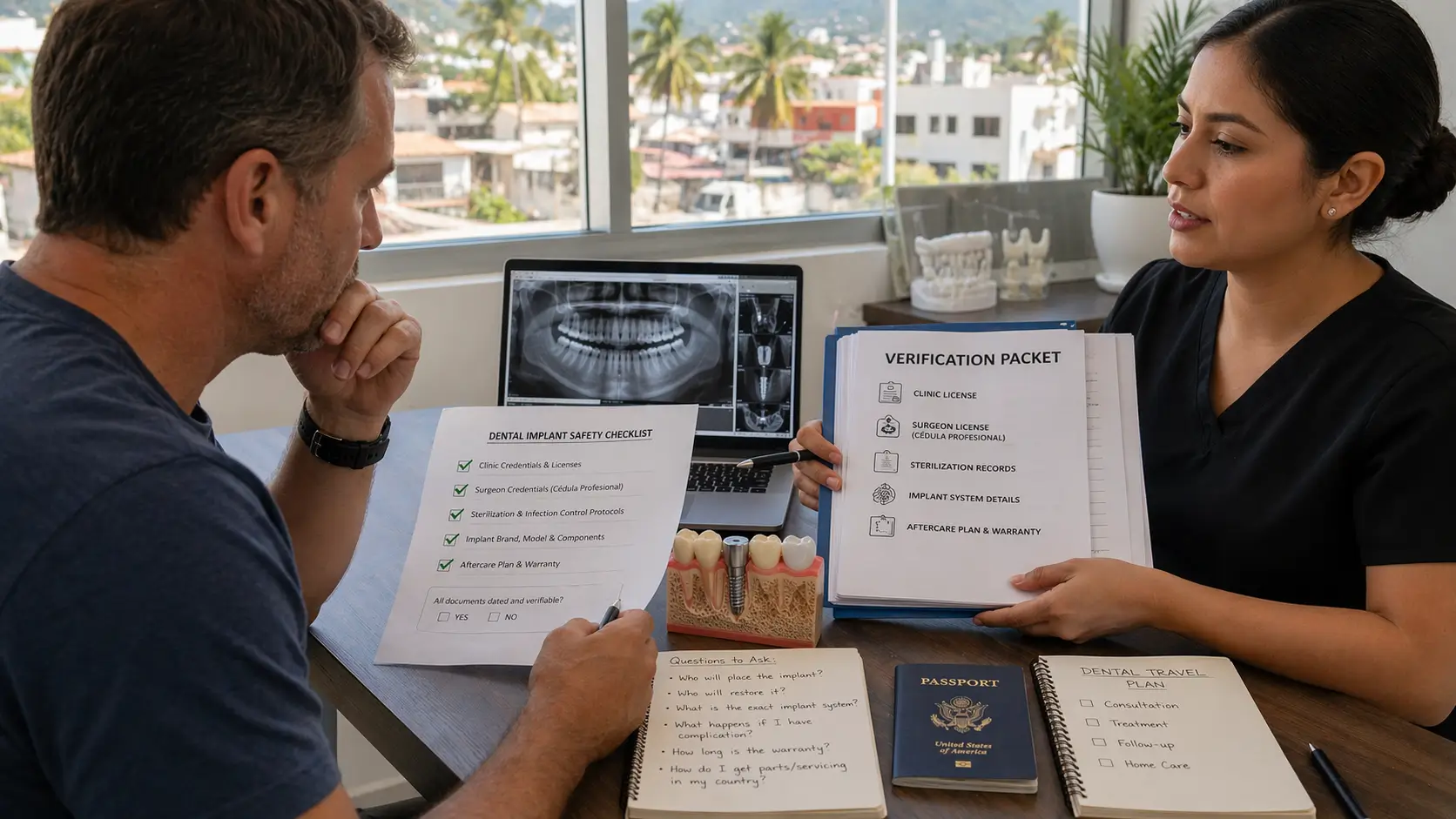
Let's be direct: this is surgery, not a spa day. When dental tourism goes wrong, it's almost never because "Mexico can't do implants." It happens when someone skips the unglamorous parts—paperwork, verification, and a real follow-up care plan.
Three things actually matter. First, safety comes from proof, not promises. A trustworthy clinic can show you dated records of sterilization practices, equipment maintenance, and infection-prevention protocols. If they won't share actual records—marketing brochures don't count—that's a warning sign, not a reason to trust them anyway.
Second, your outcome depends on the specific dentist, the treatment plan, and your own health—not just the country. You need to know your dentist's full name and Mexican license number (cédula profesional), and verify it through the SEP/DGP registry. Get clarity on who is placing the implant and who is restoring it—and get all names and license numbers in writing.
Third—and this is what most people miss—the biggest risk is what happens after you fly home. You need the exact implant brand, model, and connection type in writing so any U.S. or Canadian dentist can service it later. You also need a real aftercare plan, clear emergency contacts, and warranty terms that actually work across borders.
When a clinic backs up all three areas with dated documents, you get real quality of care at a fraction of U.S. prices. When they can't, no discount is worth an avoidable complication with no paper trail.
Thousands of U.S. and Canadian patients get dental implants in Mexico every year with excellent results. The real question isn't "Is Mexico safe?" It's whether your specific clinic and your specific treatment plan are set up to deliver safe implant procedures, predictable healing, and workable follow-up care once you're home.
Here's a simple rule that prevents most problems: don't pay anything until you have dated, verifiable proof for all five SAFER checkpoints (explained below). If even one item is missing, undated, or vague—stop and wait.
This works best for healthy adults with a straightforward case—usually one or a few implants—who understand that healing takes time and can return for follow-ups if needed.
If verification feels incomplete, don't gamble just because the price looks good. Get a second opinion from a local implant dentist using the clinic's plan, or wait until the documentation is complete. A cheaper procedure isn't a bargain if it leads to an expensive repair cycle later.
Medical tourism for dental work exists because the cost savings are real. A single tooth implant with a crown typically runs $3,000–6,000+[3] in the U.S., compared to $1,200–2,800+ in Mexico—a lower price that reflects different overhead, not different standards. Your final implant cost depends on imaging, materials, complexity, and whether you need grafting or sedation.
Lower overhead, different insurance dynamics, and high patient volume drive the price down. None of that reduces quality of care—as long as the clinic's systems, materials, and documentation are solid. Many Mexican dentists trained at the same institutions as U.S. specialists and focus specifically on implant dentistry.
The safest quotes are itemized, dated, and specific. A solid written quote breaks down: the implant fixture, abutment, and crown (with crown material listed—like zirconia or porcelain), imaging (X-rays or CT scans), sedation if used, bone grafting or sinus lift if needed, all follow-up visits for that phase, and warranty terms with clear exclusions.
Red flags: no date on the estimate, vague "all-in" pricing with no breakdown, no written warranty, refusal to name the implant brand, or pressure to pay before sending you documents. Any one of these should make you stop and reconsider.
The cost savings are worth it when you have a dated, itemized plan, know your travel costs, and confirmed the implant system can be serviced at home. They’re often not worth it when the plan is vague, the warranty is unclear, or parts availability is unknown.
Mexico is often a great option for patients paying out of pocket who want a clear, documented plan and can schedule efficiently. It's usually most straightforward for single implants or limited dental work where follow-up is manageable. Many clinics also offer veneers, root canals, full mouth dental implants, and complete smile makeovers—letting you combine multiple procedures in one trip.
To keep those benefits from turning into hidden problems, a few things matter. Don't book nonrefundable travel until you have your written treatment plan and verification packet—healing and lab timelines can shift. Before you go, get the implant brand, model, and connection in writing and confirm parts availability with a U.S. dentist or lab. Build buffer days into your schedule for swelling, bite adjustments, or lab delays—especially for crowns.
Where you go matters. Border towns like Los Algodones, Tijuana, or Ciudad Juárez make follow-ups easy—you can walk across the U.S. border and be home for dinner. Resort areas like Cancún, Playa del Carmen, Puerto Vallarta, or Los Cabos offer a relaxed recovery setting. Larger cities like Mexico City, Guadalajara, Monterrey, or Mérida often have broader specialist availability for complex cases. The best location is whichever fits your health needs, timeline, and follow-up reality.
The biggest risks in cross-border dental care aren't really about Mexico—they're about continuity of care and accountability when you're no longer near your dentist. Even with great documentation and a skilled provider, implants can sometimes fail. Success depends on your bone quality, overall health, hygiene habits, and whether you smoke. Long-term studies report success rates above 90% for well-placed implants in good candidates, but individual results vary.
Language barriers are rarely an issue at established clinics that work with international patients—most dentists who treat Americans and Canadians speak fluent English. Still, confirm this during your first contact.
For a complex case—multiple implants, full mouth rehabilitation, All-on-4, or major bone grafting—raise the bar. Require complete documentation and strongly consider a second opinion from a local specialist before committing.
Think of SAFER as your checklist before you commit. A trustworthy clinic should hand over these documents without hesitation. Slow, defensive, or evasive responses tell you something—usually not something good.
Here's what to ask for under each letter—so you're never left relying on "trust me" answers.
You can't judge infection control by looking at the waiting room. You need records. Ask for dated proof that shows how the clinic's sterilization system works consistently, every day.
Ask for: recent dated autoclave cycle logs, spore test or biological indicator records confirming sterilization works, maintenance records for sterilization equipment, and a clear breakdown of what is single-use versus reusable—and how reusable tools are processed. If the clinic cites certifications, ask for the actual dated logs, not just the certificate.
Why does this matter? A dental infection can be serious, costly, and hard to treat when you're far from the clinic. Verified sterilization records cut that risk significantly.
A license matters—but so does current experience. Confirm that your dentist is properly licensed and is actively placing implants right now, not just "years ago."
Ask for: the dentist's full legal name and Mexican license number (cédula profesional), a current CV showing training and focus areas, recent dated case examples (de-identified photos, X-rays, or case summaries), and clarification of who does what if multiple clinicians are involved—get all names and license numbers in writing.
To check it yourself, look up the cédula profesional in the official SEP/DGP registry—Mexico's government database for professional licensing.
This is one of the biggest hidden problems. Many implant issues are fixable—but only if your U.S. or Canadian dentist can identify the exact system and find compatible parts.
Get these details in writing: brand, model line (and version if relevant), connection type (this is critical for compatibility), abutment type, and batch or lot number—often called "implant passport" details—documented in your chart. Also get written confirmation that replacement parts are available in the U.S. or Canada.
Before you travel, have a U.S. or Canadian dentist or dental lab confirm the implant system details in advance—especially if you're getting multiple implants, All-on-4, or full-arch work.
Aftercare is where cross-border dental care either goes smoothly or falls apart. A real plan isn't "message us anytime"—it needs to be specific.
A real aftercare plan includes: clear post-op instructions (medications, diet, what's normal vs. concerning), direct emergency contact info (phone and WhatsApp) with who actually responds and realistic response times, guidance on when to see a local dentist or ER after you're home, and a follow-up schedule with timing, purpose, and cost.
Written plans reduce stress and delays when you're healing far from the clinic—and protect you from "we never said that" disputes.
"Warranty included" is not a protection plan. You need a dated, signed document that spells out exactly what's covered, what isn't, and what happens if something goes wrong.
Ask for: a dated, itemized cost estimate and payment schedule; a signed warranty specifying what's covered (fixture, abutment, crown), how long, and what's excluded; how disputes are handled and where; and redo or refund policies with timelines. If the clinic claims dental insurance coverage or third-party protection, ask for the policy details in writing.
Without signed agreements, your options often come down to "pay again" or "fly back and hope for the best."
If a clinic is well-organized, verifying everything takes about five to seven days. Here's a realistic schedule to follow.
A professional clinic should send you core documents within 48–72 hours. Consistent delays are a warning sign—they often predict poor communication later when it matters most.
If you want a simpler way to compare options, the Globalcare app lets you message clinics directly, request free quotes, and track each one against the SAFER checklist—all in one place, without juggling emails and spreadsheets.
Use these tables as a starting point for gauging implant cost ranges, not a replacement for your clinic's actual written estimate. For a fair comparison, make sure every quote covers the same scope: implant, abutment, crown material, imaging (CT scans vs. basic X-rays), sedation, and follow-ups. Then add your travel costs and a contingency buffer.
Last updated: April 2024. Prices are estimates and may not reflect current rates in all locations.
If a clinic uses an unfamiliar implant system, verify parts availability with a U.S. lab or manufacturer before moving forward.
If something feels wrong after surgery or after your crown is placed, act quickly. Follow your written aftercare plan—and trust your instincts about warning signs.
Emergency (seek care immediately): severe facial swelling, difficulty breathing or swallowing, fever above 101°F (38.3°C), major bleeding that doesn't stop with pressure, new facial numbness that worsens or spreads. Get urgent health care first, then notify the clinic.
Urgent (contact clinic and local dentist within 24–48 hours): worsening pain after the first few days, pus or discharge, the implant feels mobile, sudden bite changes, severe sinus symptoms after upper jaw implants.
Monitor (track and follow instructions): mild soreness that's steadily improving, minor gum irritation that isn't getting worse. Some swelling, bruising, and discomfort in the first few days is normal and varies by individual.
Protect yourself by documenting everything: time-stamped photos, dated messages, copies of any notes from a local dentist or ER. Keep your full clinical file—X-rays, CBCTs, surgical notes, implant labels, receipts, and the signed warranty. For life-threatening issues, get local care immediately. For non-emergencies, a local evaluation can stabilize the situation and protect your options.
A warranty only helps if it's clear, enforceable, and practical when you're far away. Strong paperwork gives you the best shot at resolving disputes without endless back-and-forth.
Real protection looks like this: the document is signed and dated, identifies you and the clinic, covers the implant fixture, abutment, and crown separately (not just "implant"), has clear timeframes, lists exclusions plainly (most warranties exclude failures from smoking, poor oral hygiene, or certain medical conditions), and includes a step-by-step process for filing a claim—not just "contact us."
Red flags: unsigned "guarantees," no dates, vague phrases like "we'll take care of it," no defined claim process, or terms that make enforcement nearly impossible. Ask for the signed contract as a dated PDF before you pay a deposit. If the clinic won't commit to clear written terms upfront, that's usually your answer.
Dental implant procedures are usually a two-trip process, even at efficient clinics: one trip for the placement, one for the final crown, with a healing phase in between. Many patients combine their implant with other work—veneers, root canal treatment, or replacing dentures with implant-supported options.
Check clinic hours before you go—many close early and vary on weekends—and ask about weekend emergency coverage. Build in a buffer day before flying home after surgery; swelling and soreness can make travel genuinely uncomfortable. Confirm your passport is valid well in advance. Ask whether the clinic offers virtual follow-ups and how to send photos or updates after you're home.
If a clinic promises "one trip, teeth in a day," ask for documentation showing you're actually a candidate for immediate loading (same-day implants). These protocols are real and can work—but only for carefully selected patients, including some All-on-4 cases or patients replacing dentures. They require more pre-treatment screening, not less.
Consult + Imaging + Placement[4] osseointegration[5] Abutment + Crown[2]
The best approach is to request everything in one dated PDF with scanned signatures where relevant. That makes it easy to compare clinics and share with a U.S. or Canadian dentist for review.
Your goal is simple: make sure someone at home can identify your implant and find parts if you ever need a repair. Confirm compatibility with a U.S. or Canadian implant-capable lab, your home dentist, or the manufacturer—and save the reply as a dated PDF.
Questions to ask a lab or manufacturer (email works best): "Do you source components for [brand + model line + connection]?" "Are replacement abutments or screws typically available in the U.S. or Canada?" "What's the typical lead time if parts need to be ordered?" "Is there an 'implant passport' format you recommend keeping for future service?" "Are there look-alike systems that get confused with this connection?"
Save their reply as a dated PDF or email thread. Bring it to your home dentist if you ever need service. For any U.S. or Canadian appointment about a concern, bring your CBCT or X-rays, surgical notes, restorative notes, implant IDs (brand, model, connection, lot if available), and crown/abutment details.
Comparing clinics across cities gets complicated fast. Globalcare helps you find and compare vetted dental clinics in one place, with clear upfront visibility into credentials, quality of care, pricing, and services—so you're not starting from scratch with every search.
That said, no platform replaces your own due diligence. Even with a recommended clinic, you still need to verify SAFER for your case—especially the final treatment plan, exact implant details, aftercare expectations, and a fully itemized cost breakdown.
Ready to move forward? Keep it simple: request the SAFER packet as one dated PDF and don't pay a deposit until you've reviewed it. For anything beyond a basic case, have a local implant dentist look it over first.
Expect core documents within 48–72 hours. If they don't arrive, treat that as a professionalism signal and keep comparing.
Transparency note: if any clinic, facilitator (including Globalcare), or recommendation has a financial relationship with this publication, that relationship should be clearly disclosed so you can weigh recommendations objectively.
Get in touch to get started!
Our team of experts will ensure your all-on-4 dental implants journey is safe and easy. We're dedicated to guiding you to your new smile every step of the way!
ConnectConcierge Services

Trusted Dentists

Safe Locations

Concierge Services
Trusted Dentists
Safe Locations

Disclaimer: Dental Cost Estimation Calculator
This Dental Cost Estimation Calculator is designed to provide users with estimates of potential savings when seeking dental treatments abroad compared to the cost of similar procedures in the United States. However, please be aware of the following important information before using this tool:
1. Estimations Based on Publicly Available Data:
The estimates provided in this calculator are derived from publicly available data sources, including average procedure costs, exchange rates, and other relevant information. These figures may not reflect the exact costs of your specific treatment or location. Estimations include non-dynamic assumptions for travel and lodging costs that may not reflect the actual costs at the time of your research.
2. Quantitative Model Assumptions:
The calculations are based on assumptions and data inputs that may not account for all factors influencing dental treatment costs. Variations in individual treatment needs, dentist fees, and other variables can significantly affect the final expenses.
3. No Substitute for Professional Advice:
This tool is not a substitute for professional dental advice. Before making any decisions about your dental treatment, it is crucial to consult with a qualified dental professional who can provide you with a personalized assessment of your needs and potential costs.
4. Currency Exchange Rates:
Estimates involving foreign treatment costs rely on currency exchange rates, which can fluctuate. The rates used in this calculator may not accurately represent the current market rates at the time of your treatment.
5. Geographic and Facility Variations:
Dental costs can vary significantly based on geographic location, dental facility, and the complexity of the procedure. The estimates provided are general in nature and may not reflect the specific conditions in your chosen destination or dental clinic.
6. Non-Inclusive Costs:
This calculator may not account for additional expenses such as per diem costs in destination or unforeseen complications during or after the procedure. These costs can substantially impact your overall expenses.
7. Liability Waiver:
By using this calculator, you acknowledge that the estimates provided are for informational purposes only, and Globalcare Network Inc or any of its representatives bear no responsibility for the accuracy of the estimates or any decisions made based on them.
8. Independent Research Recommended:
It is strongly recommended that you conduct independent research, obtain quotes from dental professionals, and consider all relevant factors when making decisions about dental treatment abroad.
In summary, while this Dental Cost Estimation Calculator aims to provide helpful information, it should not be the sole basis for your decision-making process. Your individual circumstances and dental needs may differ, and it is essential to seek professional advice and conduct thorough research before pursuing dental treatment abroad

