Does Dental Insurance Cover Veneers? What You Really Need to Know
May 22, 2026

Back to Blog
.png)
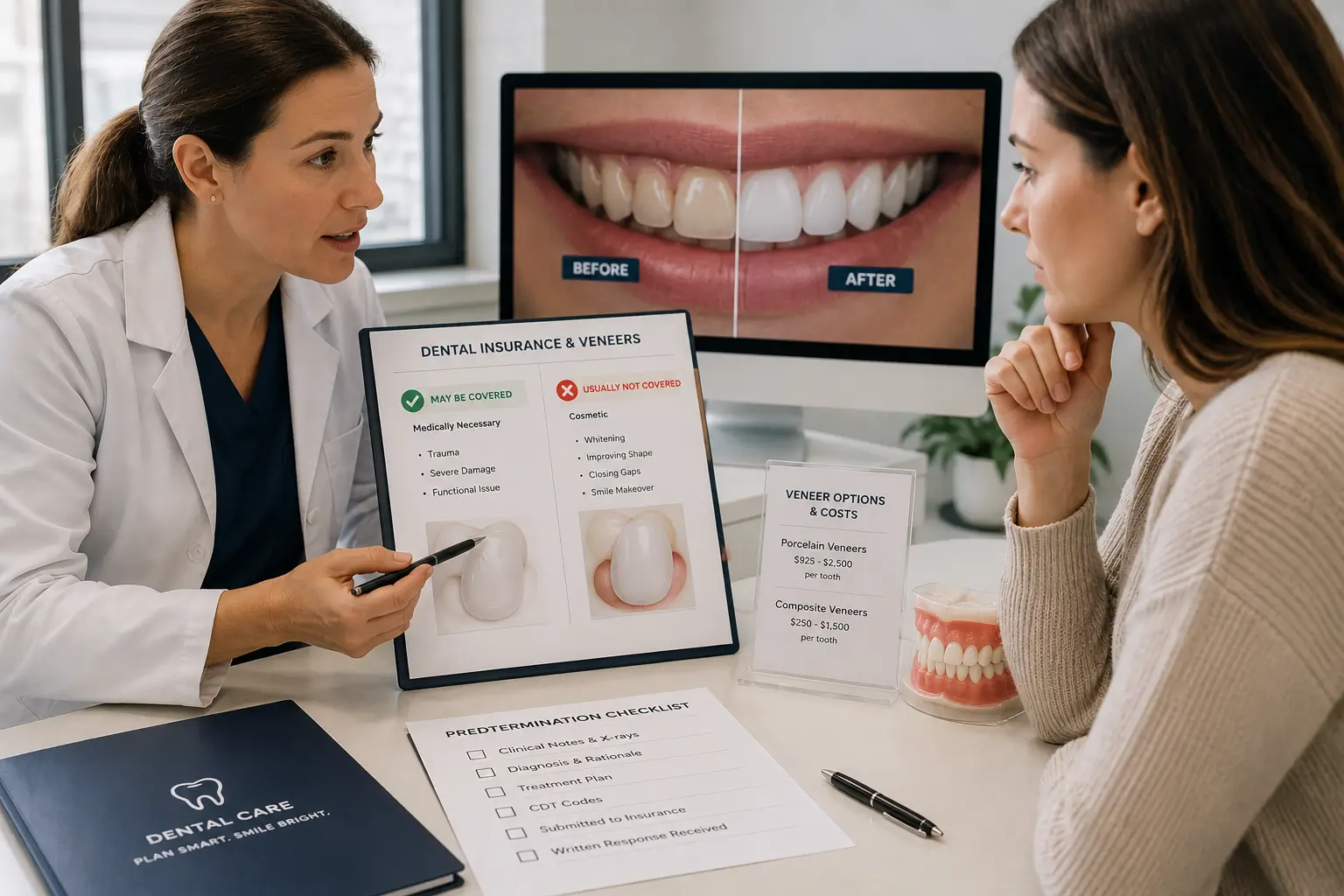
A note before we dive in: This article is consumer education, not medical, legal, or financial advice. Always get dental benefits confirmed in writing and follow your dentist's clinical guidance. Results vary based on your oral health, anatomy, and individual circumstances.
Before we get into the details, let's cut to what actually matters. If you take away only three ideas from this entire guide, make them these:
"Covered" doesn't mean "paid for." Even when an insurance provider agrees that a veneer is medically necessary, your out-of-pocket bill can still be substantial. Between deductibles, coinsurance percentages, fee schedules, and annual maximums[1] (usually capped at $1,000 to $2,000), dental insurance often chips away at—rather than covers—the full cost of veneers. The real goal isn't "insurance will handle it." It's "insurance might take the edge off."
Predetermination is everything. If there's any realistic shot at coverage, you want the insurer's answer before your tooth gets prepped. Once veneers are placed, denials become far harder to fight. Have your dental office submit a predetermination request, and always ask for the insurance company's response in writing.
If you're considering dental care abroad, plan for what happens afterward. The biggest mistake people make is comparing only the per-tooth price while ignoring what happens afterward: adjustments, a chip, a bite issue, a remake. Cross-border healthcare makes the most sense when you're treating multiple teeth, the clinic is upfront about materials and lab work, and you have a clear follow-up plan once you're back home. And remember—dental veneers typically require multiple appointments (preparation, temporaries, then final placement), which affects your travel logistics.
That's why we emphasize documentation, written quotes, and honest cost comparisons throughout this guide. It keeps you in control, even when insurance says no.
As noted above, most U.S. dental insurance plans lump veneers into the "cosmetic" category, meaning they're excluded or heavily restricted—even when a skilled dentist is placing them to address a real tooth problem.
That said, insurance coverage becomes more plausible when your dentist can show that a veneer restores function and structural integrity (not primarily appearance), and your insurance provider agrees to this before treatment through predetermination.
The situations that tend to support a medical-necessity argument include tooth trauma from an accident with documented fracture or structural loss, severe enamel erosion or developmental conditions (like amelogenesis imperfecta or enamel hypoplasia) that compromise function, structural fractures that affect chewing or bite stability, and documented failure of less invasive restorations—such as fillings or bonding—on the same tooth.
Notice the common thread? Each scenario involves something functional that goes beyond how the tooth looks. If your primary goal is closing small gaps, brightening tooth color, or improving symmetry, plan on self-pay—and treat any insurance approval as an unlikely bonus rather than something you're counting on.
By the time you finish reading, you'll have a clear sense of whether you have a realistic insurance path based on your plan language and what your dentist can document. You'll also understand what dental veneers actually cost—with notes on international options for those exploring alternatives. Most importantly, you'll know your best next step: whether that's pursuing predetermination, self-paying with staged treatment, or waiting until your documentation is stronger.
Whether you're pursuing insurance or preparing to self-pay, understanding realistic costs helps you plan. Veneer pricing varies based on material (porcelain versus composite), the dentist and lab you choose, how many teeth are involved, and where you live. The ranges below reflect typical pricing for straightforward cases—complex situations involving bite adjustments, gum recontouring, or other prep work may cost more.
Why insurance often doesn't change the math: Even if a veneer or alternate benefit gets approved, most plans cap annual payouts at $1,000 to $2,000. Multiply that by several teeth, and you'll quickly see why annual maximums dominate the equation more than approval status.
Why Mexico sometimes does: Mexico can slash per-tooth fees significantly. But the smart comparison isn't the headline price—it's your landed cost, including travel, lodging, imaging, time off work, and your plan for adjustments or repairs once you're back home.
One more consideration: Traditional porcelain veneers require removing a thin layer of enamel, and this is irreversible. The durability of veneers is excellent—with proper dental care, porcelain veneers typically hold up for 10 to 15 years or longer—but they will eventually need replacement. Your dentist should walk you through these factors during your consultation.
When people ask "Does insurance cover veneers?" what they usually mean is "Will this feel affordable?" That depends on a handful of numbers that appear in almost every U.S. dental plan.
Your annual maximum is the most your plan will pay out per year—commonly $1,000 to $2,000, though some go higher. Your deductible is what you pay first before insurance kicks in, typically $25 to $100 per person annually. Coinsurance is your percentage share after the deductible—often 50% for major dental services.
The allowed amount (or fee schedule) is what the plan considers "reasonable," which can be substantially lower than your dentist's actual fee. And alternate benefit means the plan may refuse to pay for veneers but still reimburse as if you'd chosen a less expensive covered procedure.
Let's say one porcelain veneer is quoted at $1,800 in the U.S. Your plan says veneers aren't covered, but offers an alternate benefit—paying as if it were a different restoration with an allowed amount of $900. Your major-services coinsurance is 50%, and your deductible is $50. Your remaining annual maximum is $1,200.
Here's how the math actually plays out: The allowed amount is $900. Subtract your $50 deductible, leaving $850 eligible for coverage. The plan pays 50% of that ($425). You pay the other 50% of $850 ($425), plus the deductible ($50), plus the gap between the dentist's fee and the allowed amount ($1,800 minus $900[6] = $900).
Your total out-of-pocket: $1,375. (Note: This example assumes you're seeing an out-of-network provider or that your plan allows balance billing for non-covered procedures. With in-network dentists, the gap between the dentist's fee and allowed amount is often reduced or eliminated for covered services—though arrangements vary for procedures the plan considers cosmetic.
Ask your dental office how your specific plan handles this.) That's not "insurance doesn't help," but it's also not "insurance covers veneers." Multiply this across 6 to 10 teeth, and you'll see why annual maximums and allowed amounts dominate the real math—not whether something is technically "covered."
This guide focuses on veneers. If you're also considering dental implants—perhaps due to tooth loss or trauma—the snapshot below may be useful. Otherwise, feel free to skip ahead to the next section.
A word of caution: When people search "average cost dental implant Mexico," they're often comparing apples to oranges. An "implant price" may or may not include surgery, abutment, crown, imaging, bone grafting, sedation, or follow-up. The table below uses a common apples-to-apples bundle: implant + abutment + crown. And remember—not everyone is a candidate for implants. Adequate bone density, healthy gums, and overall health need to be evaluated by a dentist first.
Mexico's savings typically stem from lower labor and overhead costs—not necessarily shortcuts in quality. That said, quality varies between providers just as it does anywhere else. The safest clinics are transparent about implant systems, abutment components, lab work, and what happens if you need adjustments after returning home. Also keep in mind that dental implants require healing time (often 3 to 6 months)[7] before the final crown can be placed, which may mean multiple trips.
Insurance companies don't evaluate veneers the way you do. You think, "My tooth is damaged, and a veneer fixes it." Insurers think, "Is this the least costly covered treatment that restores function, and is it required under the plan language?"
Veneers typically get tagged as cosmetic procedures when they primarily change tooth color, shape, or size for aesthetic reasons, close small gaps or correct minor chips that don't materially affect function, or represent one of multiple reasonable treatment options (allowing the insurer to argue they're not medically required).
Even with genuine damage, an insurer may deny veneers if it believes a covered alternative—like bonding, fillings, a crown, or another restoration—can restore function. Predetermination gives your dentist the chance to explain why a veneer specifically is appropriate and why alternatives won't work for your particular tooth, bite, and history.
A note on carriers: Similar patterns show up across major U.S. dental insurers including Delta Dental, Cigna Dental, MetLife, Aetna Dental, Guardian, and Humana. But your specific employer plan document controls coverage—not the insurer's brand name alone. Plan language can vary significantly even within the same carrier.
If there's any real chance of insurance coverage, you want predetermination before treatment begins. Submitting paperwork after the fact is where patients get stuck. Once veneers are placed, denials become much harder to contest.
Step 1: Verify your plan language in writing. Confirm whether veneers are excluded, whether exceptions exist, and whether predetermination is required.
Step 2: Your dentist builds the submission. A thin submission ("patient needs veneers") is easy to deny. A strong one ties the veneer to a functional diagnosis, includes dated evidence, and explains why alternatives aren't appropriate for your specific situation.
Step 3: Wait for insurer review. Most predeterminations take 2 to 6 weeks, depending on the plan and whether additional records are requested. If your case is time-sensitive (post-trauma, for example), ask about expedited review.
Step 4: Receive the decision. You'll see one of three outcomes: approved as requested (uncommon for veneers), approved with limitations (an alternate benefit paying like a different procedure), or denied as cosmetic or not necessary.
Step 5: Appeal if warranted. Appeals succeed when you submit new, stronger evidence or correct a misunderstanding—not when the plan categorically excludes veneers.
To prevent missed deadlines or preventable denials, track submission confirmation (portal receipt, reference number, or certified mail), requests for additional information and their due dates, appeal deadlines from any denial letter, and exactly what was reviewed so you can fill gaps rather than resubmit the same packet.
About codes: Your dentist may reference ICD-10 diagnosis codes for conditions like tooth fracture or erosion, plus CDT (Current Dental Terminology) procedure codes. D2960 (resin laminate veneer), D2961 (resin laminate veneer, indirect lab-fabricated), D2962 (porcelain/ceramic laminate veneer) Code selection depends on clinical circumstances and insurer processing rules.
A denial usually means one of two things: your plan considers veneers cosmetic, or it believes a less expensive covered alternative is appropriate. From there, several realistic options exist. Consider whether an appeal is worth pursuing—appeals work best when the initial packet was missing evidence or the insurer misunderstood the diagnosis, not when the plan categorically excludes veneers. You might also ask about alternate benefit options, where the plan pays the equivalent of a different covered restoration.
Your dentist may recommend covered clinical alternatives that address the underlying problem. HSA or FSA funds may be eligible (confirm with your administrator, especially for medically necessary cases). If financing, compare options by total payoff cost rather than just monthly payments. If considering Mexico, protect your flexibility—don't lock into nonrefundable deposits until you have a finalized treatment plan with written quotes and warranty terms.
When insurance coverage falls short, many patients explore financing options to manage the cost of veneers. Most dental offices offer in-house dental payment plans for veneers or work with third-party lenders like CareCredit or Lending Club. Before signing up, compare offers carefully. Watch for promotional 0% APR periods that jump to high interest rates if you don't pay off the balance in time.
A dental savings plan (sometimes called a dental discount plan) isn't insurance—it's a membership that provides discounted rates at participating dentists. For cosmetic dentistry like veneers, these plans can reduce out-of-pocket costs by 10–60% depending on the provider and procedure. However, savings plans work best when you've already chosen a dentist who participates in the network. Before enrollment, confirm that the cost of veneers discount applies to your specific treatment and that the annual membership fee makes sense given what you'll save.
When switching from an insurance attempt to self-pay—whether in the U.S. or Mexico—the biggest pitfalls are administrative. Avoid paying large deposits until you have itemized pricing, materials, and the exact timeline in writing, especially if you might still appeal. Ask what's refundable, by what date, and what happens if the clinic reschedules. And don't book travel before your treatment plan is final—timing can shift if the case requires diagnostics, periodontal treatment, bite adjustments, or a remake.
In insurance terms, medical necessity means the treatment restores function, protects tooth structure, or addresses pain—not just appearance. Cases more likely to be taken seriously include documented trauma with structural loss, severe erosion or developmental defects with functional compromise, and repeated failures of other restorations (such as fillings or root canal-treated teeth with subsequent damage) with clear chart history. Veneers for whitening, symmetry, small chips, or spacing are almost always treated as cosmetic by insurers.
Beyond insurance questions, your dentist should evaluate whether veneers are clinically appropriate for you. Factors that affect candidacy include sufficient healthy enamel (since traditional veneers require removing some), absence of severe teeth grinding (bruxism)—or willingness to wear a night guard, good overall oral health with no active gum disease or decay, and realistic expectations about results and maintenance. If you grind your teeth significantly, your dentist may recommend a night guard to protect your investment—or may suggest alternative dental treatments entirely.
Your dentist (DDS or DMD) will also assess periodontal health during your evaluation. Issues like gum recession or inflammation may need to be addressed before veneers can be placed. Maintaining good dental health through regular check-ups, brushing, and flossing helps ensure the longevity of any cosmetic restoration.
Sticker price tells only part of the story. You need the full landed cost—including what happens if you need an adjustment after you're home.
$7,200–$15,000[14] and $25–$400[13]
If you're pursuing coverage, submit a clean, organized packet: a short cover sheet plus clearly labeled attachments (dated photos, radiographs, chart notes, narrative letter, codes and tooth numbers). A small but high-impact detail: ask your dental office to label images in plain English—"Tooth #8 fracture photo," "Bitewing X-ray dated 05/12/26"—so reviewers don't have to guess what they're looking at.
Verbal answers are helpful, but written proof protects you. Request a dated PDF or secure message confirming whether veneers are excluded, whether exceptions exist for trauma or developmental defects, whether predetermination is required and what documents they need, and whether out-of-network or international reimbursement is possible. Keep the representative's name, date, and reference number for every interaction.
Think of insurance approval as a potential discount—not the foundation of your plan. Map out three scenarios. If approved, estimate your balance after deductible, coinsurance, and annual maximum. If denied, decide whether to self-pay in the U.S., stage treatment, use HSA/FSA funds, or finance. If considering Mexico, don't commit deposits until you have itemized quotes, materials info, and written warranty terms.
If you're exploring dental care in Mexico, the same due diligence applies as anywhere else—perhaps more so, since follow-up logistics are more complex. Mexico has many experienced dental providers, along with the same variability in quality you'd find anywhere. The safest approach is vetting the clinic like you would any high-stakes healthcare provider: identity, credentials, materials, and a real aftercare plan.
Before paying a deposit, confirm the dentist's credentials (full legal name and cédula profesional, which can be verified through Mexico's official professional registry), materials and lab details (high-quality ceramic systems used, such as lithium disilicate like IPS e.max, or zirconia, and where lab work is made), infection control standards and what's single-use versus sterilized, an itemized quote with temporaries, imaging, adjustments, and remake terms, the timeline including number of visits and minimum stay, warranty and redo policy with coverage duration and exclusions, and the aftercare plan for handling adjustments once you're back in the U.S.
Don't rely on "we'll take care of you" promises. Get everything in writing.
Whether you're seeking insurance reimbursement, planning an appeal, or relying on a warranty later, documentation is your leverage. The goal: if someone questions what you were promised, submitted, or paid, you can prove it in minutes.
Save as PDFs when possible: plan documents with relevant paragraphs highlighted, predetermination submissions and portal confirmations, denial letters with appeal deadlines, U.S. and Mexico quotes with full details, and invoices, payment proof, and warranty terms.
1. Ask your insurer about veneers in writing—request the policy excerpt mentioning cosmetic exclusions (save as PDF).
2. Get an itemized treatment plan from your dentist including tooth numbers, procedure codes, and medical rationale.
3. Collect current imaging or schedule updated photos and X-rays if yours are outdated.
4. If exploring international options, request two written quotes specifying materials, lab details, timeline, aftercare, and warranty terms (in English and Spanish).
For those considering cross-border dentistry, a care coordinator can help reduce uncertainty and prevent expensive, avoidable mistakes—especially for veneers, where materials, lab work, and aftercare matter.
Globalcare support includes independent clinic verification—screening credentials, documented standards, and transparency so you're not relying on marketing alone. Quote clarity—collecting dated, itemized treatment plans specifying materials, lab details, timeline, and warranty terms. Insurance organization—helping you assemble and track predetermination documents so avoidable omissions don't trigger denials. Payment safeguards—encouraging milestone-based payment structures and clear deposit/refund terms. Aftercare planning—ensuring you understand who handles adjustments and the follow-up process.
If you use a different service, treat these as your audit standards. Reputable coordinators should offer comparable transparency and protections.
A managed process typically looks like this: You choose your preferred region and priorities (timeline, budget, materials), and Globalcare matches you with credentialed clinics that fit. You receive itemized, date-stamped quotes with materials, warranty, and aftercare details before committing.
You get a clean side-by-side cost comparison including travel considerations so you can decide with clarity. If pursuing insurance, you'll identify predetermination requirements and assemble a reviewer-friendly packet you can submit and track.
The goal is straightforward: maximize your chance of approval when approval is realistic, while maintaining a safe, transparent self-pay option if insurance says no.
The right plan stays safe and transparent even if insurance declines. For many U.S. patients, that means pursuing predetermination if medical necessity is plausible while building a clean self-pay fallback with itemized quotes and a clear aftercare plan. For some, the best choice may be a trusted provider close to home; for others, international options make sense.
Explore the Globalcare app to take the next step. Compare pre-screened clinics side by side—each vetted through Globalcare's Clinic Selection Process before joining the network. Within the app, you can filter and discover clinics by treatment type, location, and preferences; see transparent, real-time pricing and verified clinic details including photos, reviews, and procedure costs; chat directly with clinics and request multiple free quotes; and book your appointment once you've found the right fit.
This is the fastest way to evaluate options with full visibility into quality, cost, and convenience—before you commit deposits, travel, or irreversible treatment.
Cost ranges are based on commonly referenced U.S. fee survey resources (including ADA-related references), published consumer pricing platforms, and real-world clinic price sheets. Mexico pricing varies by city, materials, lab workflow, and exchange rate—treat all numbers as planning ranges, not guarantees.
Insurance guidance reflects common predetermination and claim review workflows across major U.S. dental insurers and standard dental office administrative steps. Individual plan terms vary significantly.
Clinical review: This content is intended for consumer decision-making and reviewed for clarity and alignment with typical dental workflows. Your plan document controls coverage; your treating dentist controls clinical decisions. Individual results depend on your specific oral health, anatomy, and other factors your dentist will assess.
Editorial transparency: This article includes references to Globalcare and links to Globalcare tools. Globalcare may benefit if you choose to use its platform. We aim to keep recommendations grounded in patient safety, documentation, and cost clarity—regardless of where you receive care.
Use questions that force specific, verifiable answers—and document the response: "Can you send me the exact section of my plan addressing veneers and cosmetic dentistry?" "Are veneers always excluded, or can they be covered with documented trauma or severe enamel loss?" "Do you require predetermination, and what documents are needed?" "Does my plan allow out-of-network or international reimbursement, and what proof is required?"
Log the representative's name, date, and reference number. Save PDFs and take timestamped screenshots of secure messages.
Ask for estimates in writing that cover fee per tooth and what's included (preparation, temporaries, final placement appointment), materials and lab details, warranty and remake policy with exclusions, follow-up care process and pricing, and any additional charges (imaging, sedation, night guards, bite adjustment visits).
The easiest way to compare two clinics isn't the headline per-tooth price—it's whether quotes are equally detailed and equally specific about what happens after you go home.
A clean submission includes a cover page with patient ID, teeth involved, diagnosis summary, and the functional problem being treated; an attachment index listing photos, X-rays, chart notes, narrative letter, and evidence of failed alternatives; and appropriate CDT procedure codes plus any diagnosis coding your insurer requests.
Submit through the insurer portal when possible and keep the confirmation number (or use certified mail if required). If the insurer requests more information, respond within the stated deadline—many delays happen simply because requests sit unanswered in someone's inbox.
Request the written denial letter with the exact reason and any denial codes. If appealing, submit new evidence (missing photos, clearer narrative, additional imaging) rather than resending the same packet. Compare financing options by total payoff cost, not just monthly payment—be cautious with promotional rates that jump later. If choosing Mexico, use milestone payments when possible and get warranty and remake terms in your written agreement before booking travel. Keep every invoice and email; they become critical for appeals, reimbursements, and warranties.
Get in touch to get started!
Our team of experts will ensure your all-on-4 dental implants journey is safe and easy. We're dedicated to guiding you to your new smile every step of the way!
ConnectConcierge Services

Trusted Dentists

Safe Locations

Concierge Services
Trusted Dentists
Safe Locations

Disclaimer: Dental Cost Estimation Calculator
This Dental Cost Estimation Calculator is designed to provide users with estimates of potential savings when seeking dental treatments abroad compared to the cost of similar procedures in the United States. However, please be aware of the following important information before using this tool:
1. Estimations Based on Publicly Available Data:
The estimates provided in this calculator are derived from publicly available data sources, including average procedure costs, exchange rates, and other relevant information. These figures may not reflect the exact costs of your specific treatment or location. Estimations include non-dynamic assumptions for travel and lodging costs that may not reflect the actual costs at the time of your research.
2. Quantitative Model Assumptions:
The calculations are based on assumptions and data inputs that may not account for all factors influencing dental treatment costs. Variations in individual treatment needs, dentist fees, and other variables can significantly affect the final expenses.
3. No Substitute for Professional Advice:
This tool is not a substitute for professional dental advice. Before making any decisions about your dental treatment, it is crucial to consult with a qualified dental professional who can provide you with a personalized assessment of your needs and potential costs.
4. Currency Exchange Rates:
Estimates involving foreign treatment costs rely on currency exchange rates, which can fluctuate. The rates used in this calculator may not accurately represent the current market rates at the time of your treatment.
5. Geographic and Facility Variations:
Dental costs can vary significantly based on geographic location, dental facility, and the complexity of the procedure. The estimates provided are general in nature and may not reflect the specific conditions in your chosen destination or dental clinic.
6. Non-Inclusive Costs:
This calculator may not account for additional expenses such as per diem costs in destination or unforeseen complications during or after the procedure. These costs can substantially impact your overall expenses.
7. Liability Waiver:
By using this calculator, you acknowledge that the estimates provided are for informational purposes only, and Globalcare Network Inc or any of its representatives bear no responsibility for the accuracy of the estimates or any decisions made based on them.
8. Independent Research Recommended:
It is strongly recommended that you conduct independent research, obtain quotes from dental professionals, and consider all relevant factors when making decisions about dental treatment abroad.
In summary, while this Dental Cost Estimation Calculator aims to provide helpful information, it should not be the sole basis for your decision-making process. Your individual circumstances and dental needs may differ, and it is essential to seek professional advice and conduct thorough research before pursuing dental treatment abroad

