How Much Do Veneers Cost in Mexico? Prices at Top-Rated Clinics
February 13, 2026

Back to Blog
.png)
In the U.S., veneers typically run between $900 and $2,500 per tooth, depending on your dentist, the material used, and where you live. The cost of veneers in Mexico is dramatically lower—reputable clinics generally charge $370 to $530 per tooth for premium ceramics. Multiply that difference across a full set of eight or more veneers, and you're looking at thousands of dollars in potential savings.
That said, crossing the border for dental work isn't the right choice for everyone. Getting veneers in Mexico makes sense when you're pursuing elective cosmetic care (not an emergency), you have the flexibility to schedule adequate time for try-ins and adjustments, your savings remain meaningful after factoring in travel costs, and you're willing to do your homework upfront—verifying credentials, comparing itemized quotes, and documenting everything.
On the other hand, dental tourism might not be ideal if you can't realistically return for follow-up care, your dental history is complex enough to require close ongoing supervision, or you simply value the convenience of local aftercare even if it costs more.
One important thing to understand: traditional veneers require permanent removal of a thin layer of tooth enamel. This is irreversible. If you have untreated gum disease, active tooth decay, insufficient enamel, or severe teeth grinding (bruxism), you may need preliminary treatment or may not be a good candidate. A thorough evaluation—either in person or through detailed imaging shared with the clinic—should confirm you're a suitable candidate before you commit to travel.
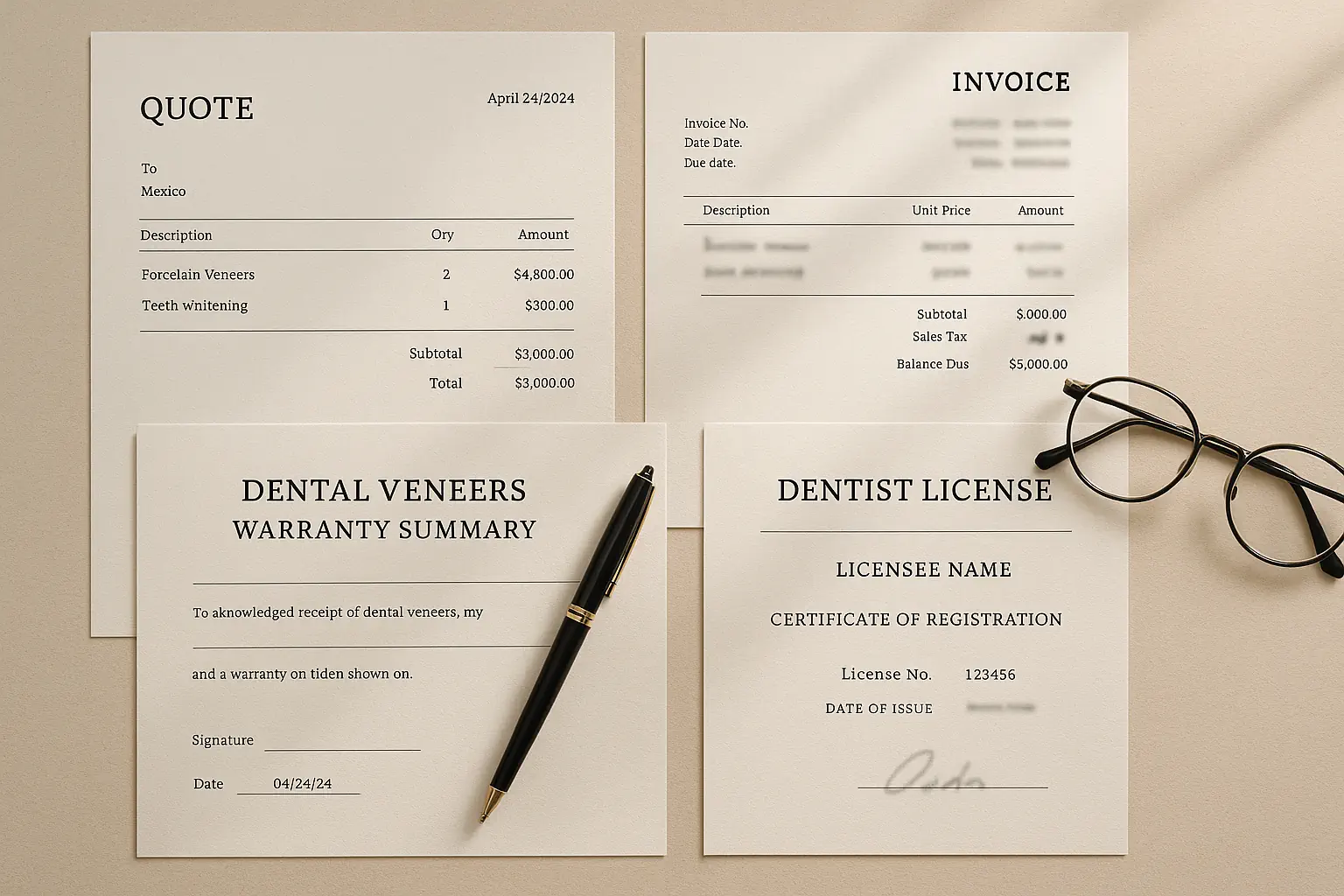
Where Globalcare fits in: If juggling quote requests feels overwhelming, Globalcare helps you collect quotes, invoices, licenses, and warranties from vetted clinics across Mexico in one place, with bilingual support. You skip the inbox chaos and get the documents you need to make a confident decision.
The table below shows reported list prices from clinics that commonly treat international patients seeking dental veneers in Mexico. These figures are meant for comparison only—they don't include travel, accommodations, or case-specific add-ons like gum treatment, bite adjustments, or nightguards. Always request a dated, itemized quote based on your exam, then compare it against a sample invoice to see what "included" actually means in practice.
Prices last updated June 2024. Some prices are sourced from comparable clinics in each city to represent typical market rates. Actual costs vary by case complexity, dentist, lab, and what's included in your quote.
As you can see, the price of veneers in Mexico varies by location and material. Veneers in Cancun, Mexico tend to fall in the mid-range for porcelain options, while border towns like Los Algodones often attract patients seeking quick, accessible treatment.
Disclosure: Globalcare may earn a referral fee if you book through the platform. This will be disclosed before you share personal information or pay anything.
The material you choose doesn't just affect price—it shapes how your veneers look, wear, and hold up against bite forces over time. Use these ranges to set realistic expectations, then confirm your exact total with a dated, itemized quote and matching sample invoice from each clinic you're considering.
Ranges last updated June 2024. Lifespan estimates assume good oral hygiene, regular dental check-ups, and no significant grinding habits. Individual results vary.
For context, U.S. veneer pricing typically runs $900 to $2,500 per tooth. The Mexico veneers advantage becomes most apparent on multi-tooth cases—as long as your quote is properly itemized and your warranty and aftercare plan are solid. Whether you're considering porcelain veneers in Mexico or zirconia veneers for added durability, the savings compared to U.S. cosmetic dentistry prices remain substantial.
Source for full-arch pricing range[9]
A "top-rated" clinic isn't necessarily the one with the most polished Instagram feed. It's the clinic that can show you—before you travel—verifiable credentials, recent cases using the same material you're considering, and a warranty that actually works when you're thousands of miles away. Here's how to separate reliable clinics from risky ones.
Before paying any deposit, your estimate should be dated, itemized, and crystal clear about what's included. If you can't map every line on the quote to a sample invoice, you're not making a fair comparison. A thorough quote covers per-tooth costs, smile design fees, prep work, temporaries, impressions or scans, lab fees (with lab name if external), try-ins, adjustments, and follow-up visits. It should also specify whether pricing is in USD or MXN, what card or wire fees apply, and whether taxes are included.
The fastest way to spot hidden "extras"? Ask for a de-identified invoice from a similar veneer case using the same material you're quoted.
Legitimate clinics expect you to check credentials—you're not being difficult, you're being responsible. Request the treating dentist's full name and cédula profesional (license number), along with a scan or photo of their credentials and any clinic operating permits. Then confirm the license details through official sources (verification links are provided below). Save PDFs, screenshots, and messages in one folder. If you ever need to make a warranty claim or dispute a charge, documentation is your leverage.
A warranty only protects you if it's enforceable and specific. "We'll take care of you" isn't a policy—it's marketing. Before you commit, clarify exactly what's covered (debonding, fracture, fit issues, shade problems) and for how long. Find out whether coverage includes only the veneer itself or also bonding and adjustment time. Clarify who pays for lab remakes, shipping, and repeat visits. Most clinics cover the dental work but not your flights or hotel if you need to return. Get the claim process and response timeline in writing.
Marketing photos are easy to produce. Consistent, comparable case documentation is what actually matters. Ask to see three recent cases (from the past 12 months) using the same material and similar tooth count to your treatment plan. Require a wax-up or digital smile design with mock-up approval before final fabrication. Find out where the veneers are made—in-house or at an external lab—and which ceramic or composite system is used. And ask when those portfolio cases were completed; outdated galleries can mask changes in staff or lab partnerships.
Veneers involve precision manufacturing, not just dentistry, and your treatment plan should reflect that reality. Ceramic cases typically involve multiple appointments: prep and scan, lab fabrication, try-in, then bonding, spread across several days. Same-day dentistry exists but isn't appropriate for every case. Get a written, day-by-day itinerary showing appointment lengths and lab turnaround assumptions. What happens if a try-in fails? How many reworks are included? Who pays if you need extra hotel nights?
Want help gathering this documentation? Start a quote request through Globalcare to collect quotes, invoices, warranties, and credentials from multiple clinics in one organized place.
The most common way people overpay—or get blindsided by surprise charges—is comparing one "all-in" number to another without digging into the details. Instead, compare fully itemized quotes side by side and push vague line items to become specific.
A quote request template you can use: "Please send a dated, itemized quote for [number] veneers (teeth: [specify]), including: per-tooth fee by material; smile design, wax-up, and mock-up fees; imaging (X-rays, scans, CBCT if needed); temporaries; lab fees (and lab name if external); number of try-ins and adjustments included; follow-up policy; payment methods and card fees; deposit amount; refund and cancellation terms; and a matching de-identified sample invoice for a similar case."
When reviewing quotes, watch for vague line items like "materials," "lab," "clinical supplies," or "smile design" with no breakdown. Ask for exact inclusions and per-unit amounts. A reliable clinic can tell you precisely what you're paying for.
Also confirm whether billing is in USD or MXN, what card processing fees apply, and whether the total changes based on payment method. If a deposit is required, get the refund policy in writing—and make sure the quote version and date match the deposit request.
Real-world example: Say you need eight E.max veneers. Clinic A quotes $3,200 all-inclusive. Clinic B quotes $2,800, but lab fees ($400) and temporaries ($120) are add-ons. Actual totals: Clinic A costs $3,200; Clinic B costs $3,320. Itemization makes the true comparison obvious.
Professional license verification should be routine, and any serious clinic will expect it. Here's how to do your due diligence.
Professional license (cédula profesional): You can verify many Mexican professional licenses through the official SEP registry. Use the advanced search function to look up your dentist: SEP Professional License Registry (Advanced Search)
Facility oversight: COFEPRIS (Mexico's Federal Commission for the Protection Against Sanitary Risk) handles sanitary regulation for many healthcare facilities. Depending on permit type and location, state-level authorities may also be relevant: COFEPRIS Portal
Start by asking for the treating dentist's full name and license number—not just the clinic brand. Search the SEP registry and save a screenshot or PDF with the date. Request credential scans or photos of the dentist's license and any clinic permits. Keep everything organized in one folder with categories like "Quote," "Invoice," "Warranty," "License," and "Before/After."
If your search returns no results, don't panic—but don't ignore it either. Names can appear inconsistently in databases, and some searches are finicky. Ask the clinic to confirm spelling, provide a clear credential photo, and explain where the license was issued. If you still can't verify after that, treat it as a risk signal and consider other providers.
A note on international memberships: A valid professional license and appropriate permits are your baseline for accountability. International memberships or cosmetic dentistry associations can be positive signals, but they're not substitutes for legal credentials, a traceable clinic identity, and a signed service agreement.
A strong warranty works like insurance—but only if it's specific, written down, and usable from another country. Focus less on the number of years offered and more on how claims actually work in practice.
Warranty red flags to watch for: Vague language like "we'll handle it," no commitment to response times, exclusions broad enough to swallow coverage ("fit issues not covered"), no clarity on who pays for lab work or shipping, or refusal to provide the warranty document before you pay a deposit.
Common exclusions you should know about: Most warranties don't cover damage from teeth grinding without a nightguard, trauma or accidents, failure to follow aftercare instructions, or normal wear over time. Ask specifically what's excluded so you understand your actual protection.
Gather your dated invoice, warranty scan, treatment plan (specifying materials and tooth count), mock-up approval documentation, and your own before photos of your teeth. These documents become essential if you ever need to file a claim.
The same day you notice an issue, email the clinic with photos. Within 2 to 5 business days, you should receive acknowledgment plus next steps. Within 1 to 2 weeks (depending on lab time and your schedule), you should have a clear plan: local evaluation instructions, a shipment plan if needed, or specific appointment dates.
Email template for warranty claims:
Subject: Veneer Warranty Request | [Your Name] | Treatment Dates [MM/DD–MM/DD]
Hello [Clinic Name], I received [number] veneers on [date(s)]. One veneer on tooth #[number] has [describe issue: chipped/debonded/feels high/shade mismatch]. Attached are photos, my dated invoice, and the warranty document. Please confirm receipt and advise next steps under the warranty, including expected timeline and any costs (lab/shipping/appointments). I'm available for a video call on [two time windows]. Thank you, [Full name] · [Phone] · [Best contact method]
If the clinic doesn't respond, your documentation file—invoice, warranty, messages, photos, credential proof—enables escalation through your card provider's dispute process (if eligible), written complaints to relevant consumer or health channels, or formal requests for resolution. The goal isn't conflict; it's accountability.
Smart travel planning isn't just about convenience—it directly protects your clinical outcome. Your goal is to arrive with a confirmed plan, enough time built in, and no pressure to accept veneers you're not sure about.
A video consult before booking can help confirm you're a suitable candidate, review smile goals, and establish how many visits you'll need. After treatment, virtual check-ins can handle basic questions and help determine whether you truly need to return in person.
A single composite veneer often takes just one day[5]—morning exam, shade matching, treatment, and a brief follow-up. Eight ceramic veneers with an external lab typically require 7 to 14 days[6]: exam and scan on day one, prep and temporaries on day two, lab fabrication over days three through six, try-in on day seven, bonding on day eight, plus buffer days for adjustments. Full-arch cosmetic work (12 to 14+ teeth)[7] often needs 10 to 14 days or more due to additional design and bite planning.
If a clinic promises complex work "in a weekend," ask how they're managing risk. Compressed timelines can compromise results.
Look for policies with trip interruption or cancellation coverage, emergency medical coverage, and (if available) emergency dental complication coverage. Some policies include medical evacuation. Confirm details before purchase and keep all receipts.
Test your bite carefully and confirm it feels comfortable. Collect your final invoice, warranty, and material documentation. Take clear photos of the final result from multiple angles. Ask about a nightguard if you grind your teeth—this can significantly extend veneer lifespan. Get written aftercare instructions explaining what's normal versus what requires urgent attention.
Different Mexican cities suit different priorities. Some patients want a quick border-adjacent trip (Los Algodones, Ciudad Juarez). Others prefer combining treatment with a vacation destination (Cancun, Puerto Vallarta, Los Cabos, Playa del Carmen). Still others choose large metro areas for complex planning (Mexico City, Guadalajara, Monterrey, Merida, Queretaro). Globalcare helps compare clinic options and logistics across all these destinations based on your timeline and preferences.
Most worries about getting veneers abroad are completely reasonable. The key is turning those concerns into specific, answerable questions before you pay.
If you're worried about quality: "Can you share three dated before/after cases from the last 12 months using the same material you're quoting me, plus lab/material brand details and what's included (mock-up, temporaries, try-ins) at this price?"
If you're anxious about aftercare: "Please send the warranty as a signed document and confirm the claim process, response time in business days, who pays lab/shipping, and what happens if an in-person visit is required."
If you can't risk another trip: "If a veneer needs adjustment or remake after I return home, what's your documented contingency plan (remote support, local dentist coordination, shipping options), and which costs are mine versus yours?"
If you don't trust the photos or reviews: "Can you share original links to reviews/video testimonials and date-stamped case sets with multiple angles, and confirm the material brand and whether it's made in-house or by an external lab?"
Focus on evidence and process, not hype. Ask for three recent cases at your price and material tier. Require mock-up approval before fabrication. Request a one-page materials spec covering the brand, lab workflow, and maintenance guidance (like whether a nightguard is recommended). Keep in mind that results also depend on individual factors—your bite pattern, grinding habits, oral hygiene, and dietary choices all affect how veneers wear over time. If a clinic can't provide dated cases and lab details, lower their reliability rating on your shortlist.
Have your documents ready—invoice, warranty scan, treatment dates, photos—then email the clinic the same day using the template above. Before you book, ask the clinic to commit to a response window (2 to 5 business days is reasonable). If communication breaks down, your saved documentation supports escalation through payment disputes and formal complaint channels.
This must be defined before you pay a deposit. Request a written contingency policy stating who covers lab remakes, shipping, appointments, and whether any travel costs are included. To estimate second-trip risk conservatively, budget for flights plus lodging plus local transport, then decide whether travel insurance and credit card protections make sense for your situation.
Start with a dated sample invoice for eight veneers from each clinic you're considering—this reveals your real dental cost more accurately than any advertised number. In most markets, eight ceramic veneers are quoted around $3,200 to $3,800, but your invoice should confirm whether temporaries, scans, and try-ins are included.
Then add conservative travel costs: flights ($400 to $700 typically), hotel ($400 to $900 for a week-plus depending on city and season), local transport, meals, and a contingency buffer ($300 to $600) for schedule changes or extra adjustments. Plan a "just in case" amount for potential follow-up needs like a local evaluation or nightguard.
Many patients land somewhere around $4,500 to $5,800 all-in—but build your number from actual documents, not averages, since individual costs can vary significantly.
Start by documenting your treatment details—tooth count, material preferences, cosmetic goals—so comparisons are relevant to your specific case. Filter clinics by verified credentials, warranty clarity, and documented results, then shortlist 3 to 5 options. Request 2 to 3 dated, itemized quotes from your shortlist, plus sample invoices and warranty scans, before paying any deposit. Finally, schedule a virtual consult to review mock-ups, confirm timelines, get a written itinerary and backup plan, and finalize payment and refund terms before booking travel.
Never pay a deposit until documentation is confirmed.
Ready to get started? Explore the Globalcare app to compare pre-screened clinics side by side and request verified documentation when you're ready.
We update this page periodically with verified prices and documentation standards where possible. Clinics listed are not paid placements. If Globalcare receives referral fees or provides credential verification services, that will be disclosed before you submit any personal data or book.
Don't shop for veneers by price alone—shop by proof. Request verified, itemized quotes. Confirm credentials through official registries. Secure a signed warranty that clearly defines your recourse if something goes wrong. Understand that veneers require permanent enamel removal and that your results depend on both clinical quality and individual factors like your bite, habits, and oral care.
When those documents are in place and you've confirmed you're a suitable candidate, you can move forward with confidence—protecting both your savings and your smile.
Get in touch to get started!
Our team of experts will ensure your all-on-4 dental implants journey is safe and easy. We're dedicated to guiding you to your new smile every step of the way!
ConnectConcierge Services

Trusted Dentists

Safe Locations

Concierge Services
Trusted Dentists
Safe Locations

Disclaimer: Dental Cost Estimation Calculator
This Dental Cost Estimation Calculator is designed to provide users with estimates of potential savings when seeking dental treatments abroad compared to the cost of similar procedures in the United States. However, please be aware of the following important information before using this tool:
1. Estimations Based on Publicly Available Data:
The estimates provided in this calculator are derived from publicly available data sources, including average procedure costs, exchange rates, and other relevant information. These figures may not reflect the exact costs of your specific treatment or location. Estimations include non-dynamic assumptions for travel and lodging costs that may not reflect the actual costs at the time of your research.
2. Quantitative Model Assumptions:
The calculations are based on assumptions and data inputs that may not account for all factors influencing dental treatment costs. Variations in individual treatment needs, dentist fees, and other variables can significantly affect the final expenses.
3. No Substitute for Professional Advice:
This tool is not a substitute for professional dental advice. Before making any decisions about your dental treatment, it is crucial to consult with a qualified dental professional who can provide you with a personalized assessment of your needs and potential costs.
4. Currency Exchange Rates:
Estimates involving foreign treatment costs rely on currency exchange rates, which can fluctuate. The rates used in this calculator may not accurately represent the current market rates at the time of your treatment.
5. Geographic and Facility Variations:
Dental costs can vary significantly based on geographic location, dental facility, and the complexity of the procedure. The estimates provided are general in nature and may not reflect the specific conditions in your chosen destination or dental clinic.
6. Non-Inclusive Costs:
This calculator may not account for additional expenses such as per diem costs in destination or unforeseen complications during or after the procedure. These costs can substantially impact your overall expenses.
7. Liability Waiver:
By using this calculator, you acknowledge that the estimates provided are for informational purposes only, and Globalcare Network Inc or any of its representatives bear no responsibility for the accuracy of the estimates or any decisions made based on them.
8. Independent Research Recommended:
It is strongly recommended that you conduct independent research, obtain quotes from dental professionals, and consider all relevant factors when making decisions about dental treatment abroad.
In summary, while this Dental Cost Estimation Calculator aims to provide helpful information, it should not be the sole basis for your decision-making process. Your individual circumstances and dental needs may differ, and it is essential to seek professional advice and conduct thorough research before pursuing dental treatment abroad

