Porcelain Veneers: Types, Cost, and What to Expect
May 4, 2026

Back to Blog
.png)
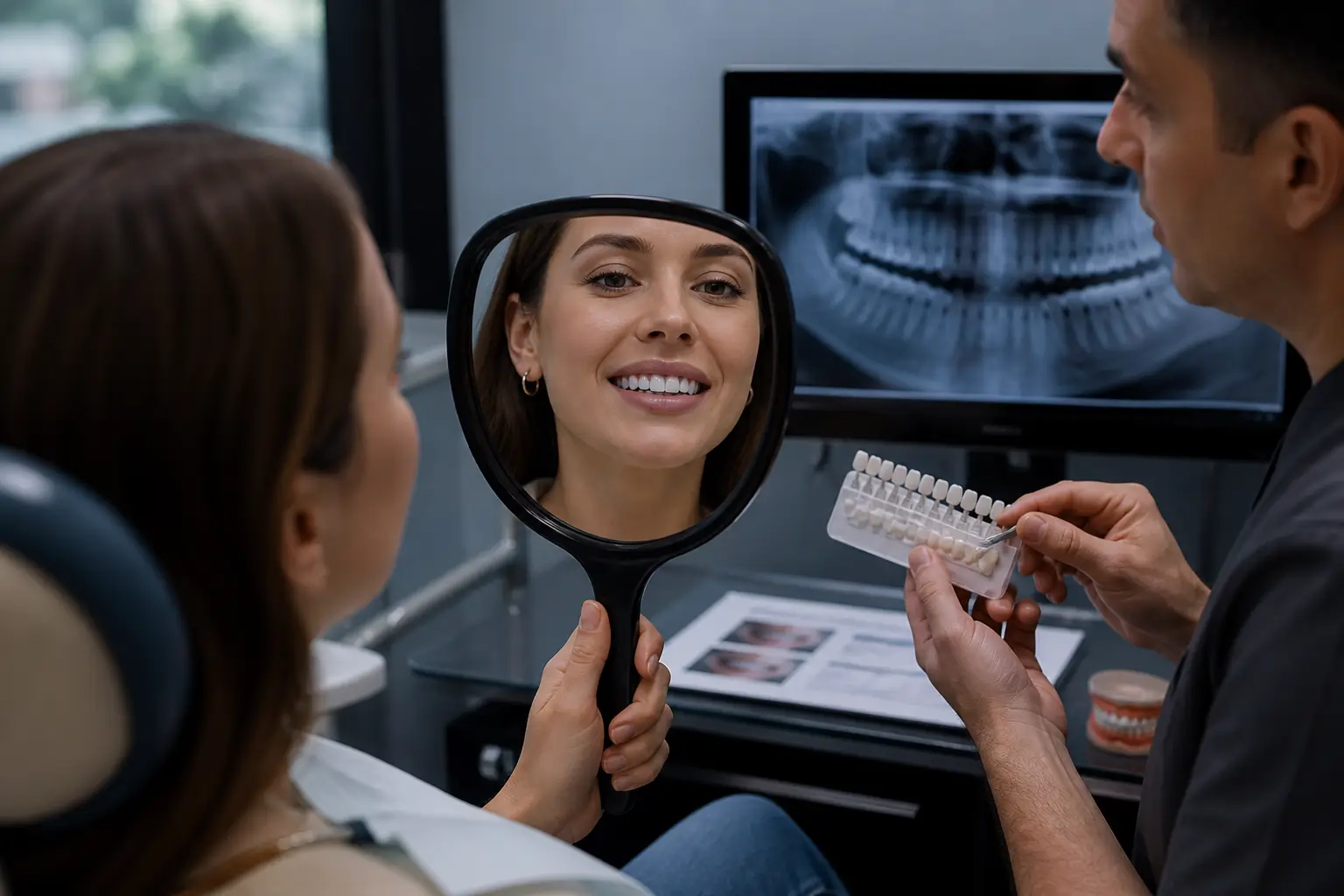
Veneers can genuinely transform the way you feel about your smile. But without understanding what you're signing up for, some people end up paying twice—once for the initial work, and again to fix problems nobody warned them about.
Veneers are a cosmetic upgrade, not a fix for damaged teeth. They're excellent at correcting color issues, minor chips, and uneven shapes in your front teeth. But if you have active decay, gum disease, or structurally weakened teeth, veneers aren't the answer. When the foundation isn't solid, even beautiful veneers can fail early. And importantly, veneers cannot fill gaps left by missing teeth—they require an existing tooth to bond to. If you're missing teeth entirely, you'll need dental implants or another restorative solution first.
What matters isn't just "porcelain"—it's the details. How your dentist prepares your teeth, whether you grind or clench, the specific ceramic system used, and the quality of the lab work all play a role in how your veneers turn out. Don't hesitate to ask specifics: Which material? (IPS e.max? Feldspathic porcelain?) Which lab? Who's actually doing the bonding?
Think beyond the sticker price. Veneers aren't a single-visit purchase. A comprehensive quote should include planning, temporaries, final bonding, follow-up visits, and what happens if something chips down the road. Then factor in ongoing maintenance and eventual replacement—even excellent veneers don't last forever.
Most people looking into veneers aren't doing it on a whim. Maybe a photo caught you off guard, or there's a chip you keep feeling with your tongue, or your teeth have discoloration that whitening just can't fix.
Veneers work best for cosmetic concerns in your front teeth when you're ready for a lasting improvement and committed to maintaining it. They're generally not the right choice when the main issue is severe decay, major fractures, or teeth that need structural reinforcement more than aesthetic enhancement.
Before scheduling any appointments, get clear on a few practical points. Start by defining your goal in one specific sentence—"I want my six upper front teeth even and naturally white" is more useful than "I want a perfect smile." Identify your two non-negotiables, whether that's budget or limiting how much enamel gets removed.
If you're doing virtual consultations, prepare six clear photos: a full straight-on smile, a relaxed smile, two close-ups of your front teeth (together and slightly apart), plus right and left side views showing how your teeth meet. And be realistic about timing—veneers take multiple appointments, so if you're working around travel or an important event, make sure the clinic can accommodate your schedule with buffer time for lab work.
A thoughtful clinic uses this information to figure out what works for your mouth—not to push a generic "Hollywood smile." For example, if a front tooth is darkened after root canal treatment, a veneer may or may not mask it depending on remaining enamel and underlying color. Sometimes a crown or preliminary treatment offers more predictable results. And if crowding is part of the picture, orthodontics first might preserve more tooth structure than trying to create the illusion of straight teeth through aggressive preparation.
Getting veneers should feel like a transparent collaboration, not a leap of faith. The goal is simple: eliminate surprises before you commit.
Even excellent clinics have limitations. Your job is discovering those limits early, while you still have options.
At minimum, you should know your treating dentist's full name and active license number (and where it's registered), the clinic's complete physical address, who prepares your teeth and who bonds the veneers, and who your point of contact is for scheduling, questions, and urgent issues—along with expected response times.
This becomes especially important if you're traveling for treatment, because it determines who's accountable for follow-up care.
The phrase "all-inclusive" is often where hidden costs lurk. A clear estimate should break down the per-tooth clinical fee (and whether it varies by tooth position or complexity), lab fees (in-house versus third-party), material type (lithium disilicate like IPS e.max, feldspathic porcelain, or zirconia-based ceramics), temporaries while final veneers are made, anesthesia or sedation if needed, follow-up visits including bite adjustments and polishing, and revision or remake policies including what triggers them and what they cost.
If you're traveling, confirm in writing any real-world expenses like recommended overnight stays between visits, coordinator fees, and transportation logistics.
A veneer plan is only as strong as the tooth and gum foundation beneath it. An ethical dentist evaluates your gum health (inflammation or periodontal disease needs treatment first—according to CDC data, nearly half of U.S. adults 30 and older have some form of periodontal disease), your enamel condition and existing fillings (veneers bond best to healthy enamel, and significant erosion or large restorations reduce predictability), your bite (heavy or poorly distributed forces increase chipping, cracking, and debonding risk), whether you grind or clench (bruxism, estimated to affect 8 to 16% of adults, makes veneers riskier if unaddressed), any cracks or structural weakness (where a crown or onlay might work better), and diagnostic records as needed—photos, X-rays, and sometimes scans turn opinions into a defensible plan.
A smart question to ask: "Can you give me a written yes/no/maybe candidacy decision, with reasons?" That single document makes comparing providers much easier.
There's no universal industry warranty—policies vary widely by clinic and location. What you're looking for is clarity, not promises.
Expect written aftercare instructions and a realistic discussion of expected lifespan for your specific case based on material, bite risk, and habits. A written policy should state how long coverage lasts (and what starts the clock), what counts as a failure (chip, crack, debonding, staining, margin issues), whether remakes are free, discounted, or full price, whether follow-up adjustments are included and for how long, and what could void coverage—common exclusions include not wearing a recommended night guard, missed follow-ups, trauma, or untreated grinding.
Marketing photos are easy to post. Proper documentation is harder to fake.
Ask for at least three before-and-after cases from the same treating dentist, unfiltered high-resolution images (full smile and close-up), a brief case summary explaining what was done, how many teeth were treated, and any special challenges, plus which ceramic system and lab were used.
If you're making a significant investment, dig deeper. Ask about revision or remake patterns—many clinics won't publish complication rates, but they can often explain how frequently remakes happen and why. Look for independent reviews tied to real locations that mention the treating dentist, timelines, and follow-up—not just "great service." And insist on named labs and material brands. "High-quality porcelain" isn't a specification; traceability matters for remakes and long-term support.
A porcelain veneer is a custom-crafted, wafer-thin shell of dental ceramic that bonds to the front surface of your tooth. Most veneers run about 0.3 to 0.7 mm thick, though exact thickness—and how much enamel is reduced—depends on tooth position, desired color change, and the chosen material. Unlike more invasive restorations, this is a conservative dental procedure that preserves most of your natural tooth structure.
Porcelain veneers commonly address color improvement (including deeper intrinsic discoloration like tetracycline staining that whitening won't touch), shape and length refinement (worn edges, uneven teeth, small chips), and creating a more uniform smile when minor spacing or small asymmetries are the main concern.
The final result depends heavily on smile design choices—shade, brightness, translucency, tooth shape—plus how well veneers fit at the gumline and how your bite is managed. Veneers aren't designed to solve major structural problems.
Veneers work because modern dentistry creates a strong bond between ceramic and enamel using controlled surface preparation and resin cement.
On the tooth side, your dentist prepares the front surface (often removing a small amount of enamel) and conditions it so bonding resin can lock in. On the veneer side, the ceramic interior is treated to bond with resin cement—with glass ceramics like lithium disilicate (such as IPS e.max), the surface is typically etched for better adhesion. The "glue" is dental resin cement that permanently attaches the veneer; commonly used systems come from companies like 3M and Ivoclar. Technique matters enormously: moisture control and precise steps are why two veneer cases can have very different longevity even with identical materials.
After bonding, your bite is checked and adjusted so your veneers aren't taking unnecessary force during chewing or grinding.
Veneers are primarily cosmetic. If the real issue is disease, decay, or structural weakness, veneers can fail early—and you end up paying twice.
You may need a different approach if you have active gum disease or persistent bleeding (treatment comes first; healthy margins and stable gums are essential), major decay, large fillings, mobile teeth, or fractures (crowns, onlays, or other restorative work often provide better protection), severe grinding or clenching (veneers might work in some cases, but you may need a documented bruxism assessment, night guard, careful bite planning, or a different restoration entirely), significant misalignment (orthodontics may be the more conservative, longer-lasting route), or uncertainty about the final look (ask for a digital mock-up or wax-up to preview the direction before committing to irreversible preparation).
A common point of confusion: veneers and dental implants serve fundamentally different purposes. Placing veneers where teeth are missing simply isn't possible—veneers require an existing tooth to bond to. If you have gaps from extracted or missing teeth, dental implants and veneers address separate problems: implants replace the missing tooth root and crown, while veneers enhance the appearance of teeth you already have.
Some patients benefit from both treatments as part of a comprehensive smile makeover. For example, a combined procedure might involve placing implants to fill gaps, then adding veneers to adjacent natural teeth for uniform color and shape. But these remain distinct procedures with different planning, timelines, and costs. If you're researching these procedures as a combined solution, understand that you're likely looking at a multi-step treatment plan—not a single product.
Understanding the different porcelain veneers types helps you evaluate recommendations and compare quotes. The material and preparation style affect how natural veneers look, how strong they are, and how repairs work if something chips. In practical terms: the more durable and stain-resistant the solution, the more you should expect careful planning, precise bonding, and higher upfront cost.
Veneers typically require multiple visits. The exact schedule depends on whether your clinic uses traditional impressions or digital scanning, and how the lab workflow operates.
A real veneer consultation combines cosmetic planning with risk assessment. Expect photos, a gum and bite check, and focused conversation about your goals. Many clinics can provide a preliminary plan at this stage—how many teeth, material options, approximate shade direction, and timing—but final decisions should wait until proper evaluation.
Preparation involves precise enamel shaping, then impressions or digital scans. Depending on how many teeth you're treating, this can take a few hours. If you're making noticeable shape or color changes, temporaries are typically placed to protect your teeth while the lab fabricates final veneers.
At the bonding appointment, veneers are tried in, color is confirmed, and they're permanently bonded. This visit should include a careful bite check (not just "tap your teeth") and polishing. Small bite adjustments in the days following are normal, especially if multiple front teeth were treated.
If you're traveling for treatment, get the schedule and contingency plan in writing—especially if you're coordinating around flights, lab timing[7], or important dates.
step-by-step porcelain veneer treatment process
Porcelain veneers can be genuinely life-changing, but they come with trade-offs. You gain a refined look; you commit to maintenance and eventual replacement.
Why people love them: They look exceptionally natural when well designed, resist staining better than composite, and deliver consistent color and shape across multiple teeth.
The downsides to consider: The procedure is usually irreversible, veneers can chip or crack under heavy bite forces, they don't last forever, and the underlying tooth can still develop decay at the margins where the veneer meets tooth structure.
If preserving natural tooth structure is extremely important to you, say so early. A thoughtful dentist can discuss conservative alternatives—orthodontics, whitening, bonding, enamel recontouring—and show mock-ups so you can preview the direction before committing to irreversible preparation.
Durability is where veneers can justify their price—if the plan is built to last. To keep veneers going strong for 10-plus years, prioritize a strong ceramic system, a well-documented bonding protocol, and bite design that protects your front teeth's edges. When comparing quotes, weigh expected lifespan and replacement timing—not just the initial invoice. Keep in mind that published longevity data comes from studies with variable follow-up periods and patient populations, so individual results may differ.
"Natural" means different things to different people. Some want bright and uniform; others prefer lifelike translucency and subtle variation. Details like translucency, surface texture, incisal edge character, and shade layering depend on both the dentist's smile design and the ceramist's execution.
If top-tier aesthetics matter to you, expect to invest in higher-end ceramics and a lab that consistently produces cosmetic work—not simply the lowest bidder. Also worth knowing: porcelain veneers cannot be whitened after placement, so if you plan to whiten your other teeth later, discuss shade matching and timing with your dentist beforehand.
Composite is generally easier to patch or re-polish. Porcelain can sometimes be repaired with composite bonding for minor chips, but significant fractures or damage often require full replacement. If convenience matters—frequent travel, possible relocation—ask how your records will be documented so another dentist can help if needed, and whether the clinic can quickly remake a veneer using stored scans and shade notes.
The real cost of veneers extends well beyond the first invoice. Over time, most patients also pay for routine cleanings and exams, a custom night guard if recommended (often a few hundred dollars), occasional bite adjustments, and repairs or replacement down the road. Many people treat veneers like any long-term investment: setting aside a small annual amount for maintenance so replacement isn't a financial shock later.
To compare clinics fairly, you need a line-by-line breakdown—especially if one quote looks too good to be true.
A practical approach: keep a dated comparison file for each clinic with the same checklist every time. Include per-tooth fee, lab or material brand, temporaries, sedation, follow-ups, warranty exclusions, and expected replacement interval. If you're traveling, add non-clinical costs—lodging, flights, local transport—into the same comparison so you're evaluating total cost, not just dental fees.
$7,200–$15,000[16] is a common range quoted for six porcelain veneers, while composite veneer totals can run $900 to $15,000[15] depending on technique and case complexity.
Temporaries can add $50–$300[12] per tooth, and anesthesia or sedation may range from $75–$1,000 per visit[11]. For follow-ups and adjustments, many clinics quote $75–$250[10] depending on what's included.
Porcelain veneers are usually considered cosmetic, which means dental insurance typically won't cover them. There may be exceptions for cases tied to trauma or documented restorative necessity, but coverage varies significantly by plan—you'll only know by checking your specific policy.
To avoid surprises, ask the clinic for the ADA/CDT procedure code(s) they plan to use—for porcelain laminate veneers, a commonly used code is D2962 (though coding varies by scenario). Call your insurer and request a written predetermination or pre-authorization explaining what is and isn't covered, including whether lab fees or repairs are ever considered. If financing is offered (CareCredit or other medical lenders), get full terms in writing: APR, fees, total repayable amount, and whether there's a deferred-interest clause.
When comparing financing options, treat them like any other loan: compare the clinic's offer against third-party medical financing based on APR and total repayable amount, then map it to a simple monthly payment plan to understand real cash flow.
The day your veneers are bonded marks the start of maintenance—not the end of treatment.
A realistic care plan includes brushing and flossing consistently (gum stability is a major factor in long-term success, and the margins where veneers meet natural tooth structure remain susceptible to decay if hygiene slips), avoiding using your front teeth as tools (packages, nails, bottle caps), being mindful with hard foods (ice, hard candy, nutshells) and habits like nail biting, wearing a custom night guard if your dentist recommends it (especially if you clench or grind), and keeping regular checkups so small bite issues or minor chips don't become expensive replacements.
Watch for common problems: chipping, debonding or loosening, staining at the margins (often related to gum inflammation, bite forces, or hygiene), and sensitivity that lingers beyond the first few weeks. If something feels high, rough, or sensitive after bonding, don't wait. Early adjustments prevent larger failures and may be required to keep warranty terms valid.
The best choice depends on whether your main need is cosmetics, strength, or conserving tooth structure—and how much healthy tooth you have left. If a provider recommends a more aggressive option like crowns, it's fair to ask for a written explanation tied to your exam and imaging.
Before-and-after photos can be genuinely helpful—if you know what you're looking at.
Trustworthy photos have consistent lighting and angle (same head position, same smile effort, similar zoom), comparable tooth positions (if "before" is a relaxed smile and "after" is a wide grin, differences are exaggerated), and context (how many teeth treated, material used, any gum reshaping or orthodontics involved).
Keep in mind: outcome differences often reflect starting anatomy—tooth size, gum contour, bite—as much as provider skill. If you see a dramatic transformation, ask what else contributed: whitening, gum contouring, orthodontics, bite changes, or crowns on back teeth.
To keep everything verifiable, ask clinics to send original image files (not screenshots)—ideally with filenames including a date or case ID, a short case note per photo set (starting concerns, number of veneers, material system, any complications, treating clinician's name), and lab and material brand confirmation in the same email thread as the photos.
If a clinic only provides tiny thumbnails or won't give context, treat the photos as marketing, not evidence.
These questions work whether you're vetting a local practice or considering treatment abroad:
Dental tourism can offer meaningful savings, but outcomes depend heavily on planning and accountability. Some patients see costs substantially lower than in major U.S. cities, though the range varies by city, clinic, materials, and case complexity.
If you're in the research phase, a practical way to reduce risk is starting with clinics already screened for quality signals—clear credentials, modern equipment, documented results, bilingual support, and clear aftercare expectations. This is where Globalcare fits: it connects patients with a curated network of verified dental clinics across Mexico, letting you compare options with fewer unknowns. To browse and compare vetted clinics by procedure and destination, you can explore the Globalcare app.
Choosing a destination isn't one-size-fits-all. Some people want the simplest logistics (often border cities like Los Algodones or Ciudad Juárez), while others prefer combining treatment with a longer stay in destinations like Cancún, Los Cabos, Puerto Vallarta, or Mérida. Globalcare supports planning across multiple destinations, each with different pros and cons depending on your budget, time window, and comfort level.
Ask who your point of contact is and what they actually handle—scheduling, language support, and what happens if plans change. The safest setups have a named coordinator with a clear role, predictable availability, and a defined way to reach the clinical team when needed.
Get a written itinerary that answers how many appointments are required and on which days, how many days are needed between preparation and final bonding, the backup plan if lab timing shifts, and whether they recommend buffer days or overnight stays (and why). Dependable clinics can usually provide a dated sample itinerary and help you plan around lab timing so you're not forced into rushed decisions.
Request an emergency contact number and response expectations, clear examples of what they consider an emergency, where after-hours care happens (on-site vs. referral), and whether they have a written escalation plan if hospital care is needed.
Some clinics have relationships with dentists in your home country; many don't. If a clinic claims U.S. partners, ask what that means practically: who the partner is, expected costs for repairs, and whether the arrangement is formal (in writing) or just "we can recommend someone."
Either way, ask for a complete record set—materials used, shades, photos, relevant lab documentation—so another dentist can help if needed.
In most veneer cases, your veneers are bonded in place, so you're not carrying separate prosthetics across the border. The practical risk is usually remakes and records: what happens if a veneer needs remaking after you return home, and whether the clinic can reproduce it accurately.
If any part of your case involves cross-border logistics—lab in a different region, shipping for remakes, physical models transported—ask for the documented plan: who ships, what's tracked, contingencies for delays, and how your case is protected if timelines shift.
If you're collecting screenshots, PDFs, and email threads from multiple clinics, things can get messy quickly. The Globalcare app helps by letting you filter clinics by procedure and destination and request multiple quotes in one workflow, keeping quotes, credentials, lab info, and photos in one place for side-by-side comparison, and centralizing messages so you have one timestamped record of what was promised and when.
Two practical rules make tools like this safer: click into the underlying documents behind any verification indicators (don't rely on badges alone), and use the app to organize—not to outsource judgment. You should still independently verify credentials, materials, and warranty terms.
If you want to see what that looks like for veneer planning, you can compare clinics using the same checklist you'd use at home in the Globalcare app, where every clinic is reviewed through Globalcare's Clinic Selection Process before joining the network.
We believe health information should be transparent. This page is designed to be published with a clear reviewer card and disclosures so you can judge the information itself.
Reviewer card (publish with filled details):
Disclosures: This article features and links to the Globalcare app and clinic network. Any affiliate, referral, sponsorship, or commercial relationship between the publisher and Globalcare should be specified here prior to publication. Readers are encouraged to request clarifications or report potential conflicts.
Ask for the clinician's full license or registration number and the issuing authority, then verify it through the relevant dental authority (for U.S. providers, this is typically the state dental board's online lookup). Save a screenshot or PDF for your records, and confirm the name matches the treating dentist.
Ask which lab is used (full business name and location if possible), what ceramic system is planned and why it fits your case, and request documentation for your records—helpful for future repairs or remakes, including shade notes if available.
Request original, high-resolution images (not screenshots)—ask for original file attachments rather than embedded images when possible. Use reverse image search to spot reused marketing photos. Ask for a short, dated case summary tied to each photo set, including the treating clinician's name and what was actually done. If photos lack dates, context, or clinician identifiers, treat them as incomplete proof and request stronger documentation.
Fee ranges vary by city and clinic level, so use benchmarks to identify outliers—not to price shop blindly. Look for recent, dated fee guides or surveys from reputable dental associations or large regional group practices, and keep a dated copy for fair quote comparisons.
Virtual consultations can be valuable, but you'll get more out of them by leading with clarity. In your first message, include your cosmetic goal in one sentence, key dental history (grinding, sensitivity, gum issues, prior crowns or fillings), and what you expect back in writing—an itemized quote, credentials, example cases, and warranty terms. Then ask for a written candidacy outcome: yes/no/maybe, with reasons.
If you're considering Mexico and want a more structured comparison process, this is a good moment to use a dedicated tool: browse pre-screened clinics, request multiple free quotes, and keep documentation in one place. You can do that in the Globalcare app, where every clinic is reviewed through Globalcare's Clinic Selection Process before joining the network.
For a quicker, more accurate remote assessment, send six labeled photos plus any recent records: straight-on full smile, relaxed smile, front close-up (teeth together), front close-up (slightly open), right side close-up (bite visible), left side close-up (bite visible), and recent X-rays and prior dental records if available (with dates).
Green light: They answer directly, provide documentation promptly, and explain options and risks clearly in writing.
Yellow flag: Some details are missing. Follow up or get another opinion before paying.
Red flag: Evasive answers, no credentials, no itemization, or pressure to pay quickly. Walk away.
When veneers are planned conservatively, bonded carefully, and maintained properly, they can be one of the most satisfying cosmetic upgrades in dentistry. Your best results come from doing the unglamorous work first: verify credentials, get a truly itemized quote, confirm candidacy, and insist on written terms. Your smile—and your investment—deserve that level of diligence.
Get in touch to get started!
Our team of experts will ensure your all-on-4 dental implants journey is safe and easy. We're dedicated to guiding you to your new smile every step of the way!
ConnectConcierge Services

Trusted Dentists

Safe Locations

Concierge Services
Trusted Dentists
Safe Locations

Disclaimer: Dental Cost Estimation Calculator
This Dental Cost Estimation Calculator is designed to provide users with estimates of potential savings when seeking dental treatments abroad compared to the cost of similar procedures in the United States. However, please be aware of the following important information before using this tool:
1. Estimations Based on Publicly Available Data:
The estimates provided in this calculator are derived from publicly available data sources, including average procedure costs, exchange rates, and other relevant information. These figures may not reflect the exact costs of your specific treatment or location. Estimations include non-dynamic assumptions for travel and lodging costs that may not reflect the actual costs at the time of your research.
2. Quantitative Model Assumptions:
The calculations are based on assumptions and data inputs that may not account for all factors influencing dental treatment costs. Variations in individual treatment needs, dentist fees, and other variables can significantly affect the final expenses.
3. No Substitute for Professional Advice:
This tool is not a substitute for professional dental advice. Before making any decisions about your dental treatment, it is crucial to consult with a qualified dental professional who can provide you with a personalized assessment of your needs and potential costs.
4. Currency Exchange Rates:
Estimates involving foreign treatment costs rely on currency exchange rates, which can fluctuate. The rates used in this calculator may not accurately represent the current market rates at the time of your treatment.
5. Geographic and Facility Variations:
Dental costs can vary significantly based on geographic location, dental facility, and the complexity of the procedure. The estimates provided are general in nature and may not reflect the specific conditions in your chosen destination or dental clinic.
6. Non-Inclusive Costs:
This calculator may not account for additional expenses such as per diem costs in destination or unforeseen complications during or after the procedure. These costs can substantially impact your overall expenses.
7. Liability Waiver:
By using this calculator, you acknowledge that the estimates provided are for informational purposes only, and Globalcare Network Inc or any of its representatives bear no responsibility for the accuracy of the estimates or any decisions made based on them.
8. Independent Research Recommended:
It is strongly recommended that you conduct independent research, obtain quotes from dental professionals, and consider all relevant factors when making decisions about dental treatment abroad.
In summary, while this Dental Cost Estimation Calculator aims to provide helpful information, it should not be the sole basis for your decision-making process. Your individual circumstances and dental needs may differ, and it is essential to seek professional advice and conduct thorough research before pursuing dental treatment abroad

