Dental Implants vs. Partial Dentures: Which Is Right for You?
May 21, 2026

Back to Blog
.png)
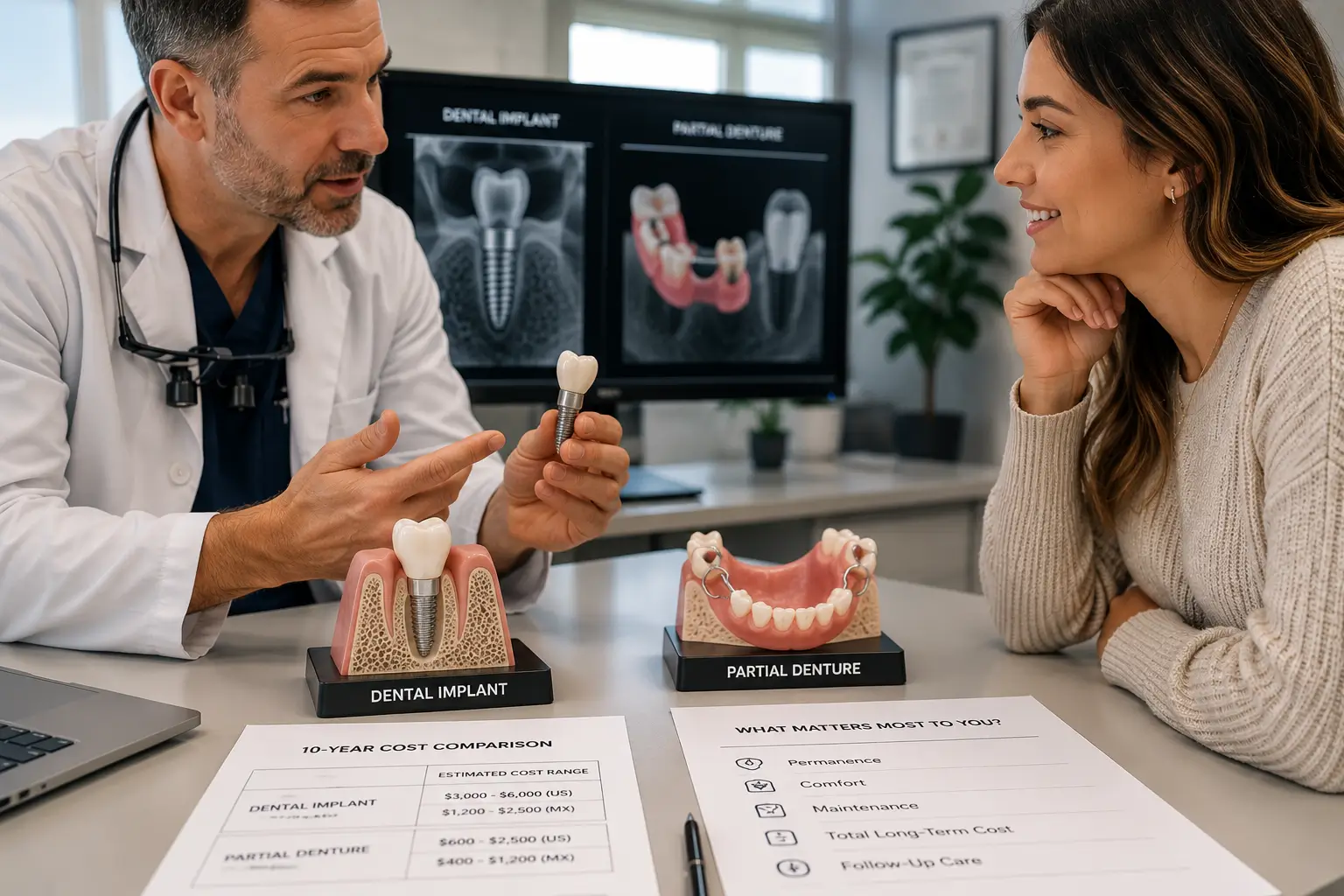
If you're weighing these two tooth replacement options, you're probably dealing with a mix of dental anxiety, budget stress, and information overload. You're not alone—and slowing down to get this right is smart. Here's what tends to catch people off guard:
This is a lifestyle decision as much as a dental one. Dental implants get anchored into your jawbone and stay put. For many people, they end up feeling closest to having natural teeth again—something removable options can't quite match. Partial dentures, on the other hand, come in and out. They can absolutely work well, but you'll be managing them daily—and the fit changes over time as your mouth does. If you already know you'd hate having to remove and soak something every night, that's worth mentioning upfront.
"Cheaper" and "more expensive" only mean something over the long haul. Dental implants cost more to start, but they tend to need fewer do-overs. Partial dentures have a lower initial cost, but expect relines, repairs, and eventually a full replacement. When patients feel blindsided by costs, it's almost always because no one showed them what the total bill looks like over 10 years—including follow-up appointments, time away from work, and travel expenses.
Cross-border savings are real, but aftercare has to be real too. Clinics in places like Los Algodones, Tijuana, and Cancún often have skilled dentists and up-to-date technology. The risk isn't really about the country—it's about sketchy documentation, warranties that don't hold up, and having no plan for what happens when you're back home and something feels wrong. Asking for details in writing isn't being difficult. It's being smart.
If you take nothing else from this guide: get the treatment plan, materials, timeline, warranty, and emergency contacts in writing. Then decide.
Facing a major dental expense—especially when insurance often provides limited coverage—can feel overwhelming. (If you have dental insurance, check your specific benefits before assuming it won't help; coverage varies significantly by plan.) Take your time with this. The choice you make will affect how you chew, how you speak, and how you feel about your smile for years to come.
If budget is your main concern, head straight to Understanding Cost and the 10-year cost guidance. If you need missing teeth replaced quickly, start with How the Treatment Processes Compare. And if you're thinking about Mexico but worried about follow-up care, the CRISP checklist and Planning Care in Mexico sections are your friends.
Every option involves compromise. Here's the honest breakdown:
Bone preservation vs. upfront cost: Dental implants can help slow bone loss where your tooth used to be—but they're pricier and require a surgical procedure. Long-term stability vs. ongoing maintenance: Implants stay fixed and typically feel like your own teeth; partial dentures are removable and need periodic tweaks. Aftercare simplicity vs. travel: If you're going abroad for treatment, having good documentation and a clear follow-up plan matters just as much as the procedure itself.
Think about what you really want: A permanent solution that costs more now but offers greater durability? Or a faster, more cost-effective starting point that requires more upkeep down the road? If you've had recent extractions or notice your gums seem to be "shrinking," bone preservation becomes a bigger factor—make sure imaging and bone measurements are part of any implant conversation.
There's no one-size-fits-all answer here. But there are some reasonable starting points based on common situations.
If you want something that feels natural—a "barely notice it's there" kind of result—and you have enough healthy bone to support it, a dental implant often turns out to be a solid long-term investment. Many patients find that chewing confidence and overall quality of life improve significantly. If your priority is getting teeth back in your mouth quickly without breaking the bank, a removable partial denture is typically the fastest route. Just know that relines and eventual replacement are part of the package.
If health issues make surgery risky right now—say, poorly controlled diabetes, certain medications that affect bone, or other medical concerns—a partial might be a safer place to start. You can always revisit implants later if things change. And if you're traveling for dental care, either option can work beautifully, as long as the clinic puts everything in writing: plan, materials, timeline, warranty, aftercare.
Use this table as a starting filter—not a final verdict. Your specific imaging, bite strength, gum health, and the clinic's treatment plan can all shift costs and timelines. That's exactly why the checklist and quote template below matter so much.
Relines are common every 1 to 3 years.[7] 3 to 6 months; can stretch to 9+ months if grafting is involved[8] 2 to 4 weeks, plus follow-up adjustments[10] $3,900–$5,800[14] $1,200–$2,500[15] $600 to $2,500[16]
The sticker price is just the beginning. What you'll truly spend includes the procedure itself, expected maintenance, travel costs, time off work, and the hassle factor of follow-up visits. That's why some people are shocked to discover that the "cheaper" option can actually cost more over a decade—especially if it needs constant repairs or multiple trips to sort out problems.
Dental implants cost more upfront, but daily upkeep is usually simple when the implant is placed well and you stay on top of oral hygiene. Partial dentures cost less to get started, but most people should budget for relines and likely a complete remake within 10 years.
Note on cost ranges: The comparison table above shows the full range of costs across all case types and materials (implants $3,000–$6,000; partials $600–$2,500). This detailed breakdown uses typical mid-range figures for straightforward, uncomplicated cases. Your actual costs may fall anywhere within the broader ranges depending on complexity, materials chosen, and geographic location.
These figures are estimates for straightforward cases and don't account for travel, hotels, meals, or missed work. Complications or complex cases can drive costs up significantly. If you're traveling for treatment, those "non-dental" expenses can be the difference between a great deal and an expensive headache. The Mexico totals shown above reflect procedure costs only—factor in your travel expenses separately.
A tip for fair cross-border comparisons: Pick one currency (USD or MXN) for all quotes and note the exchange rate. Keep every assumption attached to the quote—materials used, number of visits, warranty details, expected relines, and expiration dates.
For larger cases: Ask whether you can pay in stages tied to milestones (planning deposit, surgery day, final restoration). If a clinic offers a warranty, get crystal clear on how claims actually work—and whether fees for lab costs, shipping, or chair time still apply. You're not trying to argue with the clinic; you're trying to reduce your financial risk when treatment stretches across months.
U.S.) $3,500–$5,000[13]
If you're building a spreadsheet or using a calculator tool, the magic is in entering accurate inputs—not treating the final number like gospel.
Before you trust any output, gather these details: where treatment happens (U.S. or which Mexican city), how many missing teeth you're replacing (single versus multiple changes the math), whether grafting is likely, lifespan assumptions (crown life, partial life, reline frequency), repair and maintenance allowances, and travel costs (number of trips, lodging, meals, time off).
When you look at results, pay attention to annualized cost (total divided by 10 years)—it's the clearest way to compare "expensive now" versus "cheaper now." Check the break-even point to see when a dental implant's higher upfront cost might be offset by fewer remakes. And run what-if scenarios: what if you need more repairs, an extra trip, or the crown doesn't last as long? If the numbers still work under pressure, you're making a safer bet.
To compare clinics fairly, you need quotes that are written, dated, itemized, and in the same currency. Here's a template you can copy and paste for any provider:
"Hi, I'm deciding between a dental implant and a removable partial denture.
Please send a written, itemized quote for both options in USD, including: exam and imaging (CBCT or panoramic), extractions, bone grafting if needed, implant fixture, abutment, crown/bridge materials, lab fees, anesthesia/sedation, all follow-up visits, and expected maintenance over 10 years.
Also include: expected timeline and number of visits, warranty coverage (what's covered, duration, exclusions), and emergency contact info after treatment.
Please date the quote, note assumptions (e.g., grafting not included unless indicated), and include when the quote expires."
Clearing up gray areas: Ask for unit pricing ("What does it cost to replace a crown later?" or "How much is a reline?"). Get lifespan assumptions in writing. If anyone makes a verbal promise—discounts, free repairs, "lifetime warranty"—ask them to add it to the written quote before you hand over money.
If you're still early in this process, thinking through a few key questions can help focus your consultation. Consider this a framework for preparing—not a diagnostic tool. It won't approve or deny you for anything. It just points you toward a sensible next step, whether that's getting imaging, asking about medical clearance, or comparing quotes.
Most people land in one of three zones: Likely candidate (based on basic risk factors, dental implants seem reasonable—your next step is imaging and a written plan). Unclear, needs review (factors like gum disease history, grinding, or uncertain bone density might change things). Not a candidate right now (you may need medical stabilization, periodontal treatment, or alternative planning first).
Whatever your starting point, bring your questions to your consultation and use the CRISP checklist to make sure you leave with real answers.
CRISP is a simple framework to make sure you don't overlook the things that determine outcomes and true cost: clinical fit, long-term maintenance, and follow-up logistics.
Candidacy isn't just "Do you want this?" It's whether your bone density, gums, bite, and overall health support reliable healing. At your consultation, make sure to ask: Will you use CBCT (3D imaging) for implant planning? What are the bone height and width at the site—is grafting likely? How do smoking, diabetes control (many dentists look for A1c below 7 to 8%), active gum disease, or teeth grinding change the risk or timeline?
The goal: avoid surprise grafting, surprise bills, and preventable complications.
Don't settle for one number. Ask for a written 10-year estimate that includes typical crown replacement (for dental implants), repairs, relines, and remakes (for partial dentures), plus follow-up visits. If you're traveling, factor in trip and time-off costs. A lot of Mexico savings calculations fall apart when a case needs multiple trips and nobody planned for that upfront. The true cost of either option only becomes clear when you look beyond the initial procedure.
This is where comfort and long-term oral health live. Dental implants often boost chewing confidence and help slow bone loss, but they require surgery and consistent hygiene to avoid peri-implantitis (inflammation around the implant). Partial dentures restore your smile and basic chewing quickly, but they may stress surrounding teeth and need fit adjustments as your mouth changes. Ask your dentist to explain how each option will affect your remaining teeth, gum tissue health, speech, and daily comfort.
You're not just purchasing a product—you're investing in planning, technique, and follow-up systems. Ask: Who exactly will be doing my treatment (not just the practice name)? How many cases like mine do they handle each year? What implant system and materials do they use, and why? Can they show you dated outcomes for similar cases and explain how they handled any complications? What happens if something goes wrong? For implant cases, ask whether an oral surgeon or periodontist will be involved in placement.
This is the section people regret skipping—especially when travel is involved. Get clarity on: How many appointments, and how far apart? What's the realistic timeline (not best-case fantasy)? What's the warranty—which parts, how long, what's excluded, and how do claims work? Who do you contact for aftercare, what's the response time, and what happens when you're back home?
Here's what the journey typically looks like, broken into six stages.
Consultation and imaging: A clinical exam plus CBCT or panoramic imaging, gum evaluation, and health review. This is where your candidacy gets confirmed and grafting risk gets identified.
Planning: The step that prevents expensive mistakes. A solid treatment plan covers the surgical approach, restoration design (crown or bridge), bite considerations, and a written timeline.
Implant placement surgery: Usually done with local anesthesia (sedation is optional). The implant serves as an artificial tooth root, anchored directly into the jawbone. For a straightforward single implant, expect about 1 to 2 hours[3].
Healing (osseointegration): This takes 2 to 6 months as the implant fuses with surrounding bone. Timelines stretch if grafting is needed or healing runs slow.
Restoration phase: Impressions or digital scans, try-in steps in some cases, and final delivery of your abutment and crown (or dental bridge). Your bite gets checked and adjusted for natural appearance and proper function.
Follow-up checks: Monitoring gum tissue health and bone stability around the implant over time.
Where costs and timelines shift most: discovering low bone volume (needing grafting or a sinus lift), gum disease that needs treatment first, heavy grinding that calls for a nightguard plan, or needing a temporary tooth during healing. If you're traveling to Mexico and the case is staged, plan for two or more trips unless the clinic clearly documents a safe single-trip plan for your situation.
Partial dentures follow a simpler path.
Records and impressions: Your dentist takes impressions or digital scans along with bite records, and plans any tooth shaping needed for better fit.
Design choices: Clasp type, framework material, and how forces are distributed all affect comfort. Metal clasps provide secure attachment to healthy teeth, while flexible options may be gentler on gum tissue. A well-designed partial feels dramatically better than a rushed one.
Try-in: You test fit, bite, and appearance. This is when pressure points and bite issues get spotted—before final delivery. Check that the artificial teeth look natural and match your remaining natural teeth in shade and shape.
Delivery day: You receive your finished partial denture prosthesis along with instructions for cleaning and wearing it. Expect a few fine-tuning visits as sore spots pop up.
Relines and repairs: Normal over time. As gum and bone contours change, the partial loosens. Relines restore fit; repairs address wear and breakage; remakes happen when fit or material is no longer workable.
What to bring to a try-in: A list of foods you struggle with, must-have appearance concerns (tooth shade and shape), and any prior denture frustrations (gag reflex, sore spots, speech issues). This helps your dentist make adjustments early instead of after you're already frustrated.
This guide focuses on dental implants versus removable partial dentures, but a dental bridge—anchored to neighboring teeth—is another option for some people. Bridges can be faster than implants and don't require surgery, but they do mean grinding down adjacent teeth, which removes healthy tooth structure.
Bridges don't preserve bone the way implants can. If you want something fixed but aren't a candidate for implants or prefer skipping surgery, ask your dentist about this alternative treatment option.
Both options can serve you well, but they fit different lifestyles. Think of dental implants as fixed artificial teeth with specific hygiene rules, and partial dentures as a device you own that needs cleaning and periodic fit adjustments.
Brush twice a day and clean between teeth and around implant areas once daily. Flossing with threaders, interdental brushes, or a water flosser all work great. Avoid chewing ice, using teeth as tools, and ignoring grinding—if you grind, ask about a nightguard to protect both your implants and natural teeth.
For follow-up, expect a post-op check, monitoring during healing, maintenance visits every 3 to 6 months in the first year[5] (more often if you have gum disease history or smoke), and regular checkups after that. At these visits, the team checks gum health, bite forces, and crown integrity, and may take periodic X-rays. Some patients benefit from seeing periodontists for specialized implant maintenance.
Warning signs to watch for: bleeding when brushing, swelling, persistent bad taste, pus, or a bite that suddenly feels off. Don't wait—catching problems early is simpler and cheaper. With good planning and proper care, many studies report implant survival rates around 90 to 95% at 10 years[6], though results vary with individual health, smoking, and maintenance habits.
Remove and clean your partial daily using a denture brush and proper cleanser—skip abrasive toothpaste, which can scratch acrylic and trap bacteria. Store as directed (usually in water or denture solution) to prevent warping. Ask your dentist whether sleeping with it in or out is better for your situation; recommendations vary.
The first few weeks often bring sore spots and bite changes—this is normal if you return for adjustments. Relines are common every 1 to 3 years. Come in sooner if your partial starts rocking, rubbing, or loosening.
Warning signs: cracks, bent clasps, looseness, recurring sores, or sensitive supporting teeth. A loose partial denture can put extra stress on your natural teeth and may accelerate tooth decay in anchor teeth if food gets trapped.
Because dental implants transmit chewing forces into your jawbone, they can help slow bone loss where the tooth used to be—though some degree of bone change still happens over time. They also maintain spacing, reducing the risk that neighboring teeth will drift out of position. This preservation of bone and surrounding teeth structure is one reason patients often consider implants despite the higher initial cost.
Partial dentures don't stimulate bone the same way, so bone shrinkage continues at its natural pace. Depending on design, partials can place added stress on supporting teeth, potentially increasing wear, looseness, or cavity risk if hygiene and fit aren't well managed. Because partials rely on remaining teeth for support, keeping those anchor teeth healthy becomes especially important.
Questions that get you real answers: "Can you show me bone height and width measurements at the implant site?" "Do you expect grafting now, or is it borderline?" "If I choose a partial first, will that make implants harder later because of bone changes?" Even if you start with a partial, ask for a written assessment of your bone and future options—knowing what's possible now prevents getting painted into a corner later. Changes in your jawbone and facial muscles over time can affect how any prosthesis fits and functions.
Mexico's major dental hubs—Los Algodones, Tijuana, and Cancún—can offer real savings compared with many U.S. cash prices. Some clinics have excellent dentists, modern equipment, and strong systems. Quality varies, of course, just like it does anywhere. The key risks usually aren't about geography. They're about unclear documentation, vague warranties, and weak follow-up planning—factors that matter even more when you're not local.
Mexico can be a smart choice when the clinic provides a clear staged plan (especially for dental implants), uses recognizable materials and systems, documents everything in writing, and spells out exactly how aftercare works once you're home.
Be cautious when you're pressured to book fast, the quote isn't itemized, the implant system and materials are brushed off with "don't worry about it," or warranty and emergency steps aren't written down.
Get these details in writing before traveling:
Red flags worth taking seriously: no written warranty, no named treating dentist, refusal to share implant system details, one-price-fits-all quotes without imaging, no emergency protocol beyond "call us."
If you're early in your research and want to compare Mexico options without guessing who's legitimate, consider starting with a pre-screened clinic network where credentials, reviews, and treatment-planning norms are visible upfront. For U.S. patients exploring dental implants, crowns, veneers, or larger cases like All-on-4, this is where Globalcare helps: verified clinics, transparent pricing, patient reviews, before-and-after photos, and bilingual communication so your plan is clear before you travel. You can start comparing clinics by location and procedure in the Globalcare app.
Glowing reviews and a slick website don't automatically mean clinical reliability. Ask for evidence you can verify, and save records (screenshots, PDFs) so details can't quietly "change" on you later.
Request the treating dentist's name, training background, and license details (U.S.: state dental board; Mexico: Cédula Profesional lookup). Ask about experience relevant to your case ("How many single-tooth implants like mine do you place each month?"). Get the implant system and materials specified (Nobel Biocare, Straumann, BioHorizons, MIS, etc.) and why they're recommending them for you. Ask for dated before-and-after documentation of similar cases with timelines and notes on any extra procedures. Request written emergency protocols, especially if you'll be back in the U.S. shortly after treatment.
If staff dodge specifics, refuse documentation, or push you to book today, treat it as a red flag. If you can't easily verify credentials, use third-party verification (state dental boards in the U.S. or official professional ID lookups in Mexico) before putting down deposits.
Don't let stock photos substitute for proof. A useful gallery should make outcomes easier to understand and compare to your own situation.
Look for cases with dated photos (before, during if relevant, and after), clear captions explaining what was done with timelines and any additional procedures, and cases similar to yours (front teeth vs. back teeth, heavy bite forces, multiple missing teeth, gum disease history).
Then ask the question that makes any gallery actually useful: "Is my case more like this outcome or that outcome, and why?"
You'll get better answers—and more comparable quotes—when you walk in prepared.
Bring any imaging you already have (panoramic X-ray, CBCT). If you don't have any, ask what they'll take and how much it costs. Bring your health info: medications (including supplements and bone-affecting drugs like bisphosphonates), smoking status, diabetes or A1c if relevant, and any gum disease history. Bring the CRISP checklist and quote template, and ask the clinic to put answers in writing wherever possible.
Before leaving the consultation, try to walk out with: a dated, itemized quote; a timeline with the number of visits; warranty terms; and emergency contact steps. Afterward, run the numbers through your cost framework and decide whether you need a second opinion.
If you're close to deciding but can't quite pull the trigger, these prompts usually break the deadlock:
For value clarity: "What does this choice mean for my jawbone, remaining teeth, and costs over 10 years?"
For pain and process: "What will the first week feel like, and what's the plan if I'm still uncomfortable after adjustments?"
For future flexibility: "If I start with a partial, could I switch to a dental implant later—and what would make that harder?"
For written protection: "Can you provide the warranty coverage and duration in writing, including exclusions?"
Dental quotes—especially cross-border ones—often look simple until you notice what's missing. The Globalcare app makes comparisons easier by showing verified clinic information (pricing, credentials, reviews, before-and-after photos) and supporting bilingual communication so you can request clear, consistent quotes before you travel.
Within the app, you can filter clinics by treatment and location, then compare them side by side. Request multiple quotes and ask clinics to clarify timelines, materials, and warranty terms. Chat directly to confirm aftercare steps and emergency protocols before booking. Make your decision when you've verified the plan—not just the price.
Privacy note: Any platform coordinating care typically needs basic contact details and quote-request information. Before uploading sensitive health documents, check the app's privacy disclosures to understand what gets stored and shared.
This content helps you make better decisions—it doesn't replace personalized medical advice from a licensed provider who has actually examined you. Globalcare's role is coordination and access: helping patients discover vetted clinics, compare information, and communicate clearly. Clinical decisions stay between you and your licensed provider.
Ready to compare vetted clinics side by side? Explore your options in the Globalcare app.
Your mouth, budget, and timeline are personal. The best decision is grounded in specifics: written costs, appropriate imaging, clearly stated aftercare, and verified provider capability. Don't settle for vague promises. Getting clarity now saves pain, time, and money later.
If Mexico is on your radar—or you're wondering whether it should be—the most practical next step is comparing clinics in a way that protects you from common pitfalls: missing line items, unclear materials, and vague aftercare.
Explore the Globalcare app to compare pre-screened clinics side by side, each vetted through Globalcare's Clinic Selection Process before joining the network: Globalcare app.
Get in touch to get started!
Our team of experts will ensure your all-on-4 dental implants journey is safe and easy. We're dedicated to guiding you to your new smile every step of the way!
ConnectConcierge Services

Trusted Dentists

Safe Locations

Concierge Services
Trusted Dentists
Safe Locations

Disclaimer: Dental Cost Estimation Calculator
This Dental Cost Estimation Calculator is designed to provide users with estimates of potential savings when seeking dental treatments abroad compared to the cost of similar procedures in the United States. However, please be aware of the following important information before using this tool:
1. Estimations Based on Publicly Available Data:
The estimates provided in this calculator are derived from publicly available data sources, including average procedure costs, exchange rates, and other relevant information. These figures may not reflect the exact costs of your specific treatment or location. Estimations include non-dynamic assumptions for travel and lodging costs that may not reflect the actual costs at the time of your research.
2. Quantitative Model Assumptions:
The calculations are based on assumptions and data inputs that may not account for all factors influencing dental treatment costs. Variations in individual treatment needs, dentist fees, and other variables can significantly affect the final expenses.
3. No Substitute for Professional Advice:
This tool is not a substitute for professional dental advice. Before making any decisions about your dental treatment, it is crucial to consult with a qualified dental professional who can provide you with a personalized assessment of your needs and potential costs.
4. Currency Exchange Rates:
Estimates involving foreign treatment costs rely on currency exchange rates, which can fluctuate. The rates used in this calculator may not accurately represent the current market rates at the time of your treatment.
5. Geographic and Facility Variations:
Dental costs can vary significantly based on geographic location, dental facility, and the complexity of the procedure. The estimates provided are general in nature and may not reflect the specific conditions in your chosen destination or dental clinic.
6. Non-Inclusive Costs:
This calculator may not account for additional expenses such as per diem costs in destination or unforeseen complications during or after the procedure. These costs can substantially impact your overall expenses.
7. Liability Waiver:
By using this calculator, you acknowledge that the estimates provided are for informational purposes only, and Globalcare Network Inc or any of its representatives bear no responsibility for the accuracy of the estimates or any decisions made based on them.
8. Independent Research Recommended:
It is strongly recommended that you conduct independent research, obtain quotes from dental professionals, and consider all relevant factors when making decisions about dental treatment abroad.
In summary, while this Dental Cost Estimation Calculator aims to provide helpful information, it should not be the sole basis for your decision-making process. Your individual circumstances and dental needs may differ, and it is essential to seek professional advice and conduct thorough research before pursuing dental treatment abroad

