How Much Does a Dental Bridge Cost in 2026?
May 21, 2026

Back to Blog
.png)
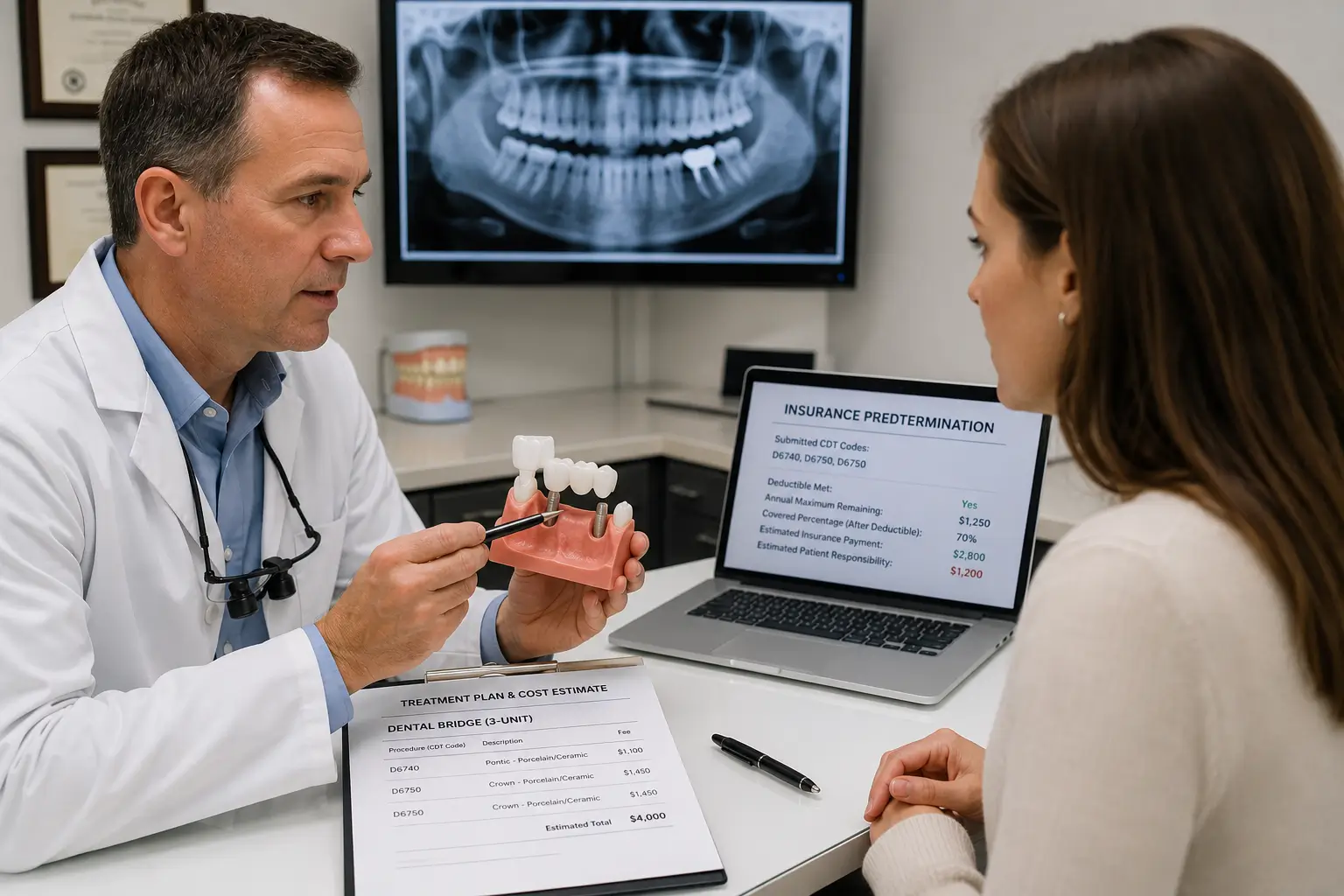
Unexpected dental bills usually aren't because someone was dishonest. What typically happens is that nobody put the actual insurance rules together with the actual billing codes in writing before treatment started. Let's fix that.
Bridges are priced by individual units and codes—not as one flat "bridge" fee. A standard three-unit bridge gets billed as two retainer crowns (the caps on your supporting teeth) plus one pontic (the artificial tooth suspended between them). Your office might use codes like D6740, D6750, or D6240 depending on the materials. The codes vary, but the principle stays the same: you need to see each line item to understand your actual dental bridge cost.
Insurance doesn't work the way most people think. Dental insurance plans from Delta Dental, Cigna, MetLife, Aetna, Guardian, and Humana don't pay "50% to 80% of whatever your dentist charges." They pay a percentage of their allowed amount—which is often lower than your dentist's fee. Then they subtract your deductible, cap the payment at your annual maximum (usually $1,000–$2,000), and apply any exclusions like waiting periods or missing-tooth clauses. This is exactly how people end up owing way more than expected, even when the plan says "major services covered."
Three documents can prevent most surprises. First, get a CDT-coded, itemized estimate from your dental office. Second, get a written predetermination from your insurer for those exact codes. Third, ask about the warranty and aftercare plan so you know what happens if your bridge needs adjustments or a remake down the road.
Once you have these in hand, your decision gets much clearer—whether you're staying local or considering dental care abroad.
Bridge costs start as a range because your final out-of-pocket depends on how your specific case gets coded, billed, and processed by insurance. The fastest way to pin down a real number? A simple two-step process.
First, ask your dental office for a written treatment plan with CDT codes—every single line item, not just a lump sum labeled "bridge." Then submit those codes to your insurer and request a written predetermination (sometimes called a pre-treatment estimate). This forces all the real cost drivers into the open: whether supporting procedures are billed separately, whether you've met your deductible, how much annual maximum you have left, and whether any exclusions apply.
This paperwork makes a real difference. Consider a front-tooth Maryland bridge: the clinic quote might sound straightforward, but your dental plan could classify it as a major service and reimburse at a lower rate than you assumed. With a traditional bridge after a tooth extraction, your annual maximum[3] can cap the insurance payment—so "70% coverage" might not mean 70% of your total bill. And if you're considering care in Mexico, the clinic fee may be lower, but any reimbursement depends on your plan's rules and what documentation you provide.
If you're researching options across multiple clinics, a tool like the Globalcare app can help you collect quotes that align with your insurance process.
Bridge prices vary based on where you live, the materials used, your dentist's experience, and how complex your case is. The ranges below reflect commonly quoted U.S. self-pay pricing from industry surveys and aggregated fee data[9]. Think of them as planning estimates for the average cost of a dental bridge, not guarantees.
The "insurance pays X%" columns assume you've met your deductible, you have enough annual maximum remaining, and the plan's allowed amount is close to your dentist's fee. In reality, any one of those assumptions can shift your numbers significantly.
*Maryland bridges may be classified differently by some plans or excluded entirely. Verify your specific coverage before assuming these estimates apply.
How insurance really pays: Most plans pay a percentage of their allowed amount, not a percentage of your dentist's fee. If you're out of network, the allowed amount is typically lower—which means you'll owe the gap between what the dentist charges and what the plan allows, plus your coinsurance, plus anything beyond your annual maximum.
A calculator is great for "what if" scenarios—comparing this year versus next, in-network versus out-of-network, or U.S. versus Mexico. The most useful calculators let you adjust the variables that actually move your bill: bridge type and number of units, your plan's coverage percentage for major services, whether your deductible is met, how much annual maximum you've used, and a buffer for likely add-ons like build-ups or root canals.
Think of a calculator two ways. First, as a quick reality check: Is the cost of a dental bridge likely manageable right now, or should I explore staging treatment, switching providers, or other options? Second, as a sensitivity test: change one variable at a time to see which factor affects your out-of-pocket costs most. That tells you exactly what to verify in writing.
Just keep in mind: a calculator gives you an estimate. Your written predetermination plus your itemized office estimate is what makes the number reliable.
A good bridge estimate should read like a clear treatment plan, not a mystery total. Most offices include the bridge units themselves (billed as separate retainer crowns and pontics), lab fabrication costs, impressions or digital scans, and standard placement visits.
But several common extras may be necessary—and they deserve a conversation before you start. Temporary crowns often run $150–$400 per unit[4]. Core build-ups, needed when supporting teeth require reinforcement, can add several hundred dollars per tooth. Root canals might be necessary if an abutment tooth can't safely support a crown without endodontic treatment—that can add $600–$1,500 or more depending on tooth location (front teeth typically cost less than molars)[5]. Rush lab fees or special shipping[6] can tack on another $50 and up.
If you're traveling for care: Your bridge price typically won't include flights, lodging, local transportation, meals, a companion's travel, or follow-up visits once you're home. Those belong in your all-in budget, not your clinic quote.
Why the format of your estimate matters: An itemized estimate with each service, its CDT code, and its fee makes insurance verification and clinic comparisons much easier. A bundled "bridge package" total can work if the office clearly states what's included, what's excluded, and what triggers extra charges. Otherwise, two quotes that look similar might represent very different scopes of dental work.
Even when your plan says "70% coverage on major services," your out-of-pocket depends on several moving parts working together.
Coverage category and percentage come first. Bridges are typically classified as major or prosthodontic services, often covered at a lower rate than fillings or cleanings. Your deductible—commonly $50–$150 per year—usually must be met before insurance coverage kicks in for major dental procedures. Then there's your annual maximum, the plan's yearly cap on what it will pay (typically $1,000–$2,000). Once you hit it, you pay 100% until the plan year resets.
The allowed amount is the plan's maximum reimbursable fee for each code. Out of network, you may owe the gap between your dentist's charge and this allowed amount. Waiting periods of 6–12 months are common before major services are covered. And a missing-tooth clause may prevent your plan from covering replacement of a tooth that was missing before you enrolled.
A written predetermination is the closest thing to a preview of how your claim will actually process. It's not a guarantee—plans change, details differ, coverage depends on documentation—but it's far more reliable than anything said over the phone.
This framework keeps you focused on the handful of things that actually prevent billing surprises. The goal: make sure what your clinic plans to bill matches what your insurer says it will pay.
When you complete all five steps, you're not guessing anymore. You're combining insurer rules, clinic billing codes, and your remaining benefits to arrive at a real number—and confirming the treatment plan makes sense so you don't end up paying twice.
Ask your insurer for a written predetermination that spells out the coverage percentage for each CDT code on your treatment plan, how your deductible applies, your annual maximum and how much remains, waiting period rules, missing-tooth clause language, and any documentation requirements (X-rays, narratives, tooth history).
From your dental office, request an estimate that clearly lists each CDT code and number of units, lab or third-party fees (if billed separately), temporaries (if planned), contingency items like build-ups, additional imaging, or endodontics labeled as "only if needed," and any shipping or rush charges. If you're traveling, also ask about non-medical fees like courier costs for records.
Once you have both documents, run the basic math. Start with the allowed amount (if your predetermination shows it) or use the office fee as a placeholder. Subtract any deductible that applies. Apply the coverage percentage. Then cap the insurer payment at your remaining annual maximum.
If your numbers don't match what the office told you verbally, it's usually one of these culprits: out-of-network allowed-amount rules, a waiting period, a missing-tooth clause, different codes than expected, or not enough annual maximum left.
Before you commit, confirm whether your provider is in-network (and which tier, if your plan has them) and how out-of-network reimbursement is calculated. If you're going abroad, find out exactly what documents are required—itemized invoice with codes, proof of payment, clinical notes, translations—and where to submit them. Also plan for how you'll handle adjustments or complications once you're home.
Ask your dentist for a brief written summary covering why this type of bridge is recommended for your specific teeth, bite, and goals; what alternatives were discussed (dental implants, partial dentures, or deferring treatment) and why they weren't chosen; expected timeline and number of visits; aftercare and adjustment policy; and warranty or remake terms—including what's covered, for how long, and what voids coverage.
These scripts are designed to be quick and effective. Copy and paste them, and keep a simple log of the date, who you spoke with, what they said, and what they promised to send. If something gets denied or delayed later, this log makes appeals and follow-ups much easier.
Before calling or emailing, gather your plan ID, date of birth, clinic name and phone number, the dentist's NPI (if available), the tooth number(s) being treated, and the CDT codes from your treatment plan. Save everything as PDFs in one folder with clear file names.
Phone script: "Hi, I'd like a written predetermination for a dental bridge. I have a treatment plan with CDT codes from my dentist. My plan ID is [X], my date of birth is [Y], and my dental office is [Z]. Please confirm the coverage percentage, allowed amount if applicable, deductible, annual max impact, and any exclusions like waiting periods or a missing-tooth clause. Please email me a PDF or tell me how to download it from the portal."
Email subject line: Predetermination Request: Dental Bridge (CDT Codes Attached), [Your Name, DOB]
If the agent won't provide it in writing: "Can you direct me to the predetermination request form or link in the member portal, or transfer me to a supervisor who can confirm the process? I'm not asking for a verbal estimate—I need the written predetermination for my CDT codes."
Email subject line: Request: Itemized Dental Bridge Estimate With CDT Codes (for Insurance Predetermination)
Template: "Hi [Clinic Team], Please provide a detailed, itemized estimate for my dental bridge with CDT codes, units, and fees. Include lab fees (if separate), temporaries, and any likely contingencies like core build-ups or additional imaging. A PDF is perfect—I'm submitting it to insurance for a written predetermination. Thank you, [Your Name]"
Use this formula and save your work so you can compare clinics consistently. Insurer payment estimate equals the lesser of either (allowed amount minus deductible) times coverage percentage, or your remaining annual max. Your out-of-pocket equals itemized total minus insurer payment estimate, plus any known non-covered items.
Watch for these common mismatches before scheduling: different CDT codes between the clinic estimate and predetermination, out-of-network allowed amounts, missing-tooth clause language, waiting periods, and an annual max too low to cover what you assumed.
Many bridges are billed per unit. A three-unit bridge typically includes two retainer crowns (on the abutment teeth) and one pontic (the false tooth that replaces your missing tooth). Your codes and materials may vary, but this shows how the math works.
*If you only have $1,500 remaining on your annual max[2], the plan pays up to $1,500 and you owe the rest—even with 70% coverage.
Script: "Can you confirm whether my provider is in-network for my specific plan? If I get care overseas, what documents do you require for reimbursement—itemized invoice with codes, proof of payment, clinical notes, translations—and where do I submit them?"
If you're going abroad, plan to collect an itemized invoice with procedure descriptions and fees, proof of payment, clinic contact details, relevant X-rays or images, and translations if your insurer requests them. Also confirm how you'll handle post-op adjustments at home.
This doesn't need to be elaborate—one page is plenty. You're looking for clarity that protects you both clinically and financially. Ask the clinic to include the diagnosis and goal, the bridge type and material planned, brief rationale based on your bite, tooth condition, and location, alternatives discussed and why they weren't chosen, expected timeline and visits, aftercare policy and adjustment coverage, and warranty/remake terms.
Simple request: "Could you provide a brief note explaining why this bridge type is recommended for me, what alternatives we discussed, and your policy on adjustments, repairs, and remakes?"
The best type of bridge depends on your specific clinical situation—including the health of your gums and jawbone, the condition of adjacent teeth, your bite forces, and where in your mouth the bridge will go. Your dentist will assess these factors to recommend the most appropriate option among the various types of dental bridges available.
Important trade-off to understand: Traditional and cantilever bridges require your dentist to permanently reshape the adjacent teeth (called abutments) by removing a significant amount of enamel to make room for the crowns that anchor the bridge. This preparation is irreversible—once the tooth structure is removed, those teeth will always need crowns. Maryland bridges require less tooth reduction, and implants don't affect adjacent teeth at all. This is a key factor when comparing your options.
Note: Not everyone is a candidate for every bridge type. Factors like gum disease, bone loss, teeth grinding (bruxism)[11], or poor oral hygiene can affect which options are appropriate and how long any restoration will last.
Deciding how to replace missing teeth involves more than cost. Timing, bone health, the condition of neighboring teeth, and long-term maintenance all play a role. The right tooth replacement choice depends on your clinical situation, and your dentist can help you weigh the trade-offs.
Traditional bridges are often the fastest way to restore function and appearance when your healthy teeth on either side can serve as anchors—though they do require permanently reshaping those anchor teeth.
Dental implants may be the most tooth-like long-term option for suitable candidates: they don't require altering adjacent teeth, but they typically involve a bigger upfront investment, a longer timeline, and require adequate jawbone and overall dental health.
For patients with multiple missing teeth, implant-supported bridges can replace several teeth without requiring an implant for each one. Partial dentures are budget-friendly and removable, but they may feel less natural to some people compared to fixed options.
Even with solid planning, dental treatment can change mid-course—especially if a supporting tooth shows weakness once dental work begins. Common add-ons include temporaries ($150–$400 per unit), core build-ups (several hundred dollars per tooth), root canals if needed ($600–$1,500+ depending on tooth location), and lab remakes or rush fees ($100–$300+).
Routine bite adjustments are common and often included for a limited period after placement. Repairs—chips, debonding, fractures—are less common but can be costly when they happen, especially if lab work is required. Ask what's included and for how long.
A practical rule: Budget a 15%–20% buffer. Then ask this question before treatment starts: "If anything new is needed, will you pause and give me a revised estimate for approval before proceeding?" That single agreement prevents most budget blowups.
To reduce surprise add-ons, ask the clinic to label each line item as either "planned" or "contingent (only if needed)" and define what triggers the contingent charge. This keeps maybe-charges from automatically becoming actual charges.
Dental tourism can offer real savings for some patients, but only if you compare the full picture—not just the clinic's headline price. The smart approach: calculate your all-in cost, add a buffer, and decide whether the savings justify the extra logistics and aftercare planning.
Net savings formula: Local total minus (Mexico clinic fee + travel + lodging + follow-up care + buffer − expected reimbursement)
Where people get stuck usually isn't the bridge cost itself. It's choosing a clinic they can trust, getting a written plan that's easy to compare, and making sure paperwork is solid—especially if they hope to seek reimbursement. Quality varies widely among international clinics in restorative dentistry, so doing your homework matters.
If you're researching options, a tool that lets you compare vetted clinics, see pricing and credentials in one place, and request multiple written quotes before you travel can save significant time and reduce risk. Popular destinations include Cancun, Los Cabos, Los Algodones, Puerto Vallarta, Playa del Carmen, Guadalajara, Mexico City, Queretaro, Monterrey, Ciudad Juarez, and Merida.
Two decision thresholds patients commonly use: Conservative—if net savings aren't comfortably above 15%–20% (roughly $1,000+), many choose local care to reduce follow-up risk. More aggressive—if you're comfortable with travel logistics and have a solid follow-up plan, you might set a higher bar around 25%–30% or $2,000+, especially for multi-step work.
Sensitivity test: Run your numbers again assuming you need one extra follow-up visit at home (or even a second trip). If that wipes out your savings, the deal is fragile—a small complication could erase the advantage.
If you want your claim or reimbursement request to go smoothly, assemble a simple paperwork packet and save everything as PDFs. This reduces delays, supports appeals, and makes comparing clinics straightforward.
Your predetermination packet should include your plan and member info, the clinic's CDT-coded estimate, and any requested X-rays or narratives. Your clinic estimate packet should have every service with a code, quantity, and fee—plus clearly marked contingencies. Your warranty/aftercare packet should contain written warranty terms and the follow-up plan. Store everything in one folder with clear file names and a single notes document tracking dates and call outcomes.
A good predetermination request is short and structured. Include your member info, clinic name, and the exact CDT codes with tooth numbers. Attach the clinic estimate PDF and any supporting documentation your plan typically requests (often X-rays and a brief narrative). Submit through the portal when possible for a time-stamped confirmation.
In the notes field, write: "Please issue a written predetermination for the attached CDT-coded treatment plan and confirm allowed amounts (if applicable), coverage percentage, deductible application, annual max impact, and exclusions."
The best estimate format for insurance and clinic comparisons is line by line: one code per line (no bundled mystery totals), quantity and units clearly shown, tooth numbers where relevant, clinic fee per line and total, and contingency lines labeled "only if needed" rather than blended into the base total. This makes it easy for you and your insurer to see exactly what's being billed—and prevents "we didn't include that part" surprises later.
Same bridge. Same clinic fee. Different insurance setup—very different patient cost.
(Based on a $3,000 bridge total)
Scenario: Bridge total $3,000. Deductible $100. Coverage 70%. Remaining annual max $1,500.
StepCalculationResultApply Deductible$3,000 − $100$2,900Apply Coverage70% × $2,900$2,030 planned insurer shareApply Annual MaxPlan pays lesser of $2,030 or $1,500$1,500 insurer / $1,500 you
If you only had $800 left on your annual max, the plan might pay $800 and you'd owe $2,200—despite having 70% coverage.
Most bad billing experiences have early warning signs—usually around documentation, pressure, or unclear quality details. Consider pausing if you encounter pressure tactics ("Book today or the price doubles"), evasive answers about materials or the lab, quotes that are a single number with no codes or inclusions list, or no written warranty or aftercare plan.
First, ask for a sample invoice (with personal details removed) showing how they normally itemize bridge cases. Set a simple deadline: "I'm ready to schedule as soon as I receive the CDT-coded estimate PDF. Can you send it by [date]?" If they still won't provide it, treat it as a signal to delay booking and get a second opinion. Without codes, you can't reliably verify what your insurance will cover.
Don't settle for a verbal summary. Ask for the predetermination submission link in the portal or a form to upload documents. Request a supervisor or the claims/predetermination department. While escalating, collect backup documents: a PDF of your benefits summary, exclusions language for prosthodontics/bridges, and any out-of-network reimbursement policy.
Escalation script: "I understand you can't guarantee payment. I'm not asking for a guarantee—I'm asking for the plan's written predetermination process and a written response for these CDT codes."
Low prices aren't automatically bad, but vague low prices deserve scrutiny. Ask specifically: "What material is included (porcelain-fused-to-metal, zirconia, etc.), and is that the final price for that material?" "Who is the lab, and is it local or outsourced?" "How many visits are included, and are adjustments covered for a set time?" "What's the price if a build-up is needed? A root canal?"
If they can't answer clearly in writing, don't assume the missing pieces are included—they often show up as add-ons.
Ask for warranty language you can actually understand. A reasonable written warranty states the time period, what's covered (debonding, fracture, fit issues), and what's excluded (trauma, not wearing a recommended night guard, lack of hygiene maintenance).
Sample language to request: "Clinic will repair or remake the bridge at no additional professional fee within [X months/years] if failure is due to materials or workmanship, provided the patient follows recommended aftercare and attends follow-up visits. Lab fees [are/are not] included. Emergencies will be addressed within [time frame]."
If they won't provide anything in writing, assume you have limited recourse if something fails—and factor that risk into your decision.
If your predetermination shows a larger-than-expected out-of-pocket cost, you have financing options. HSA/FSA funds are often the most cost-effective choice if you have them available.
In-house payment plans from some offices offer short-term 0% financing—just confirm the terms and what happens when any promotional period ends. Third-party financing can be convenient but may become expensive; compare total repayment amounts, not just monthly payments.
Finance now vs. wait for a new benefit year: Estimate the cost of waiting (extra visits, temporary solutions, risk of worsening damage, time off work) versus the cost of financing (interest plus fees). If financing costs less than waiting costs and your dentist advises that timing matters, financing may be the smarter move.
To reduce how much you finance, ask whether you can pay the lab portion upfront and the rest over time, stage treatment across visits with clear written totals, or schedule across plan years—only if clinically appropriate—to potentially use two annual maximums.
Many patients don't get stuck on the dentistry—they get stuck on coordination: collecting the right documents, keeping them organized, comparing clinics fairly, and planning cross-border logistics without gambling on quality. That's where tools like Globalcare come in.
The Globalcare app offers verified clinic discovery, letting you compare pre-screened clinics in Mexico side by side—photos, reviews, credentials, services, and transparent pricing. It enables faster quote collection so you can request multiple written quotes and compare scope, inclusions, and costs rather than verbal ballparks. Bilingual coordination support helps when language or logistics is your main stress point. And documentation readiness keeps you organized with itemized estimates and the details insurers commonly require—especially important if you plan to submit for reimbursement.
Where Globalcare fits best: If you're early in research and want clear comparisons, the app's value is transparency so you can narrow choices without endless calls. If you're price-sensitive but won't gamble on quality, Globalcare focuses on a verified network with modern equipment and English-speaking staff. If your case is complex or you're nervous about follow-up, clearer coordination reduces misunderstandings.
Where you may not need it: If you're staying local and already trust your dentist, your best tool is simply the CLAIM checklist plus a strong local treatment plan.
If Mexico is on the table—even as a backup option—the app can be a practical next step: filter by treatment and location, review clinic details, request multiple free quotes in writing, and only book when scope and aftercare feel solid.
Three documents prevent the vast majority of billing surprises, whether you get dental care locally or abroad: your insurer's written predetermination (code-specific coverage details and limitations), your clinic's itemized, CDT-coded estimate (including contingencies, lab fees, and temporaries), and a written warranty/aftercare plan (adjustments, repairs, remake terms).
Medical disclaimer: This guide is for patient education only. It is not clinical, legal, or insurance advice. Your dentist and insurer determine clinical eligibility, covered benefits, and final claim payment. Individual results, treatment timelines, and restoration longevity vary based on your specific oral health, underlying conditions, and adherence to recommended care.
Get in touch to get started!
Our team of experts will ensure your all-on-4 dental implants journey is safe and easy. We're dedicated to guiding you to your new smile every step of the way!
ConnectConcierge Services

Trusted Dentists

Safe Locations

Concierge Services
Trusted Dentists
Safe Locations

Disclaimer: Dental Cost Estimation Calculator
This Dental Cost Estimation Calculator is designed to provide users with estimates of potential savings when seeking dental treatments abroad compared to the cost of similar procedures in the United States. However, please be aware of the following important information before using this tool:
1. Estimations Based on Publicly Available Data:
The estimates provided in this calculator are derived from publicly available data sources, including average procedure costs, exchange rates, and other relevant information. These figures may not reflect the exact costs of your specific treatment or location. Estimations include non-dynamic assumptions for travel and lodging costs that may not reflect the actual costs at the time of your research.
2. Quantitative Model Assumptions:
The calculations are based on assumptions and data inputs that may not account for all factors influencing dental treatment costs. Variations in individual treatment needs, dentist fees, and other variables can significantly affect the final expenses.
3. No Substitute for Professional Advice:
This tool is not a substitute for professional dental advice. Before making any decisions about your dental treatment, it is crucial to consult with a qualified dental professional who can provide you with a personalized assessment of your needs and potential costs.
4. Currency Exchange Rates:
Estimates involving foreign treatment costs rely on currency exchange rates, which can fluctuate. The rates used in this calculator may not accurately represent the current market rates at the time of your treatment.
5. Geographic and Facility Variations:
Dental costs can vary significantly based on geographic location, dental facility, and the complexity of the procedure. The estimates provided are general in nature and may not reflect the specific conditions in your chosen destination or dental clinic.
6. Non-Inclusive Costs:
This calculator may not account for additional expenses such as per diem costs in destination or unforeseen complications during or after the procedure. These costs can substantially impact your overall expenses.
7. Liability Waiver:
By using this calculator, you acknowledge that the estimates provided are for informational purposes only, and Globalcare Network Inc or any of its representatives bear no responsibility for the accuracy of the estimates or any decisions made based on them.
8. Independent Research Recommended:
It is strongly recommended that you conduct independent research, obtain quotes from dental professionals, and consider all relevant factors when making decisions about dental treatment abroad.
In summary, while this Dental Cost Estimation Calculator aims to provide helpful information, it should not be the sole basis for your decision-making process. Your individual circumstances and dental needs may differ, and it is essential to seek professional advice and conduct thorough research before pursuing dental treatment abroad

