Can Veneers Fall Off? Here's Exactly What to Do If It Happens
June 4, 2026

Back to Blog
.png)
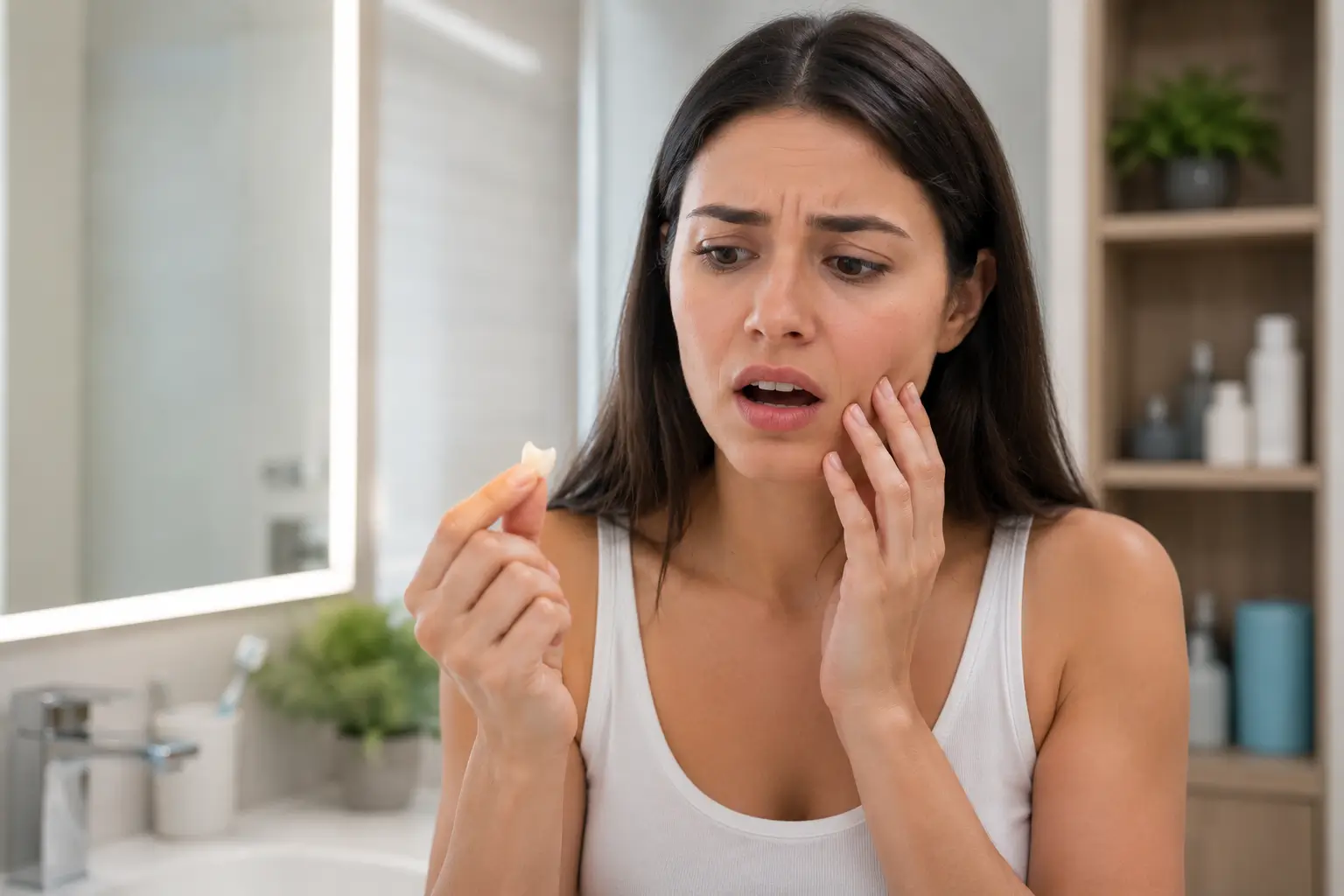
Let's cut to what matters. A veneer falling off is typically an urgent dental issue, not a trip-to-the-ER emergency. But there are exceptions. If you're dealing with heavy bleeding that won't stop, rapidly spreading facial or neck swelling, fever and chills, major trauma, or any difficulty breathing or swallowing—skip the dentist and head straight to an emergency room.
For everyone else, here's the plan: resist the urge to fix it yourself. Superglue, nail adhesive, craft glue, even aggressive cleaning with alcohol or peroxide—all of these contaminate the bonding surface and frequently force a full remake that could have been avoided. Your job right now is to gently rinse the veneer with plain water only, keep the inner surface untouched, and store it somewhere safe.
When you're ready to call a dentist, look for someone who will explain why the veneer failed and provide an itemized estimate with warranty terms in writing. That transparency matters more than geography.
A detached veneer can feel like a dental emergency, but the real danger is rushing into a "fix" that makes professional repair harder. Take a breath, then move through these steps deliberately.
Start with comfort. If the exposed tooth edge feels sharp or is cutting your lip, cover it with dental wax—or, in a pinch, a small piece of sugar-free gum as a very temporary shield. Avoid chewing on that side. For any bleeding, apply firm pressure with clean gauze for up to 10 minutes. Over-the-counter pain relievers like acetaminophen or ibuprofen can help with discomfort (follow package directions and avoid ibuprofen if you have stomach ulcers, kidney issues, or certain bleeding conditions). Never place aspirin directly on your tooth or gums—it can burn the tissue.
Document everything. Good lighting, multiple angles: take a straight-on photo of the exposed tooth, a side view, and clear shots of the veneer's front surface and inner bonding side. Write down the exact time it happened, what you were eating or doing, whether there was any impact or injury, and any symptoms like sensitivity, swelling, numbness, or a "high spot" when you bite. This information helps dental teams triage you faster—and becomes critical if you're traveling.
Reach out to a professional. When you call or message, say clearly that your veneer fell off and offer to send photos. That single step often gets you routed to the right person faster and helps determine whether you need to be seen today or can wait a day or two.
When stress hits, details slip away. The simplest solution is a brief checklist saved on your phone—in your notes app or medical ID section.
Your checklist should cover safety first: controlling any bleeding, covering sharp edges, and avoiding chewing on that side. Then capture your personal essentials: age, current medications, allergies, relevant medical conditions (like bleeding disorders), and an emergency contact. Add your dental and insurance basics: your dentist's name, insurance information, and any veneer warranty paperwork. Finally, include space for incident details—when it happened, what caused it, your symptoms, whether you recovered the veneer, and whether you might have swallowed anything.
When you head to your appointment, bring the veneer in a secure container, your photos, ID, and insurance card. If you have any past smile photos showing the veneer's original shape and color, those can help too.
The impulse to fix it yourself is completely understandable—especially if you have an important event coming up or the tooth looks noticeably different. But most home repairs make professional reattachment less predictable and more expensive.
Dentists see this pattern regularly: a veneer that "kind of stayed on" after someone used household adhesive, then requires extra time to clean, chips during removal, or no longer fits correctly. Even when rebonding remains possible, the outcome becomes less predictable. The safer approach is protecting the underlying tooth, rinsing the veneer with water only, and sharing photos with a dentist so they can advise on the best next step.
Most fallen veneers belong in the "urgent" category, not the "life-threatening" one. Understanding this distinction protects your health, your budget, and your chances of a simple repair.
Two things to remember: ERs can manage bleeding, swelling, trauma, and pain control, but they rarely perform cosmetic dentistry procedures like veneer rebonding. And urgency affects cost—after-hours and emergency settings typically charge more, while planned dental visits open up more options and fewer surprise fees. If you're dizzy, bleeding heavily, or have had facial trauma, don't drive yourself.
A good appointment after a veneer falls off involves both diagnosis and planning. You should leave knowing what happened, what's being done that day, and what the backup plan looks like if the first approach doesn't hold.
During intake, you'll share what happened, your symptom timeline, the photos you took, and the veneer itself. The dentist will examine the area and usually take X-rays, checking for decay, cracks, margin leakage, gum irritation, and bite problems. Imaging reveals issues that aren't visible to the eye.
From there, treatment typically takes one of three directions. Chairside rebonding means the veneer and tooth are both in good shape, and the dentist is confident bonding will hold—you could be done in a single visit. Temporary coverage means they want to protect the tooth while planning a stronger solution, buying time if there are questions about fit or underlying damage. Lab remake means the veneer is damaged, lost, doesn't seat properly, has compromised bonding surfaces, or the underlying tooth needs treatment first. In some situations, your dentist may also discuss alternatives like a crown, composite resin bonding, or other options depending on what's happening underneath.
The procedure itself typically involves dry isolation to control moisture, a careful trial fit, bonding or cementation, bite adjustment, and polishing. On the administrative side, expect an itemized estimate and a written treatment plan—ask for both before work begins.
A veneer usually debonds for a specific reason, and identifying that reason matters. If the underlying cause isn't addressed, rebonding may not last.
Here's the key insight: if you have bruxism (teeth grinding or clenching—often without realizing it), untreated decay, or persistent bite stress, simply "sticking it back on" may not be enough. A solid treatment plan often includes bite adjustment, gum or decay treatment, and sometimes a custom nightguard or mouthguard to protect the work going forward.
This decision isn't based on optimism—it's based on whether the veneer fits properly, the tooth is healthy, and the bonding surfaces are clean enough for a predictable outcome.
A simple rebond may be possible if the veneer is intact with no cracks or chips and seats correctly during a dry try-in, the internal surface hasn't been contaminated by household adhesives or harsh cleaning, and the underlying tooth is healthy with no new decay, fractures, or major position shifts.
A new veneer becomes more likely if the original is cracked, chipped, or lost, the inner bonding surface is contaminated or damaged, the underlying tooth shows decay, damage, or shape changes affecting fit, or your bite has shifted since the veneer was originally placed.
Listen for phrases like "the margins don't seal," "it doesn't seat fully," or "the bonding surface is compromised"—these signal practical reasons why a remake may be the safer long-term choice. Keep in mind that even a well-executed rebond isn't guaranteed to last as long as the original placement, especially if the underlying cause hasn't been fixed. Ask your dentist to document their reasoning in your chart—that written record is valuable for insurance claims, warranty coverage, and second opinions.
Veneers can serve you well for many years, but durability depends on case selection, bonding quality, bite forces, materials, and habits like clenching or nail-biting. Individual results vary considerably.
These findings come from studies with specific patient populations and clinical settings, so everyday results may differ. Risk factors that shorten how long veneers last include grinding or clenching (often helped by a custom night-guard, though effectiveness varies), edge-to-edge bite, poor gum health, smoking (which increases recession and margin exposure), inconsistent oral hygiene, and missed cleanings.
Both countries have excellent clinics—and both have poor-quality ones. The meaningful differences for patients come down to access, turnaround time, documentation quality, and how straightforward it is to coordinate follow-up care, especially if adjustments are needed later.
What reliable care typically looks like in the U.S.: You can verify a dentist through your state dental board's license lookup. Many practices follow established documentation standards, providing itemized estimates, informed consent, and detailed chart notes. Patients often look for additional credentials like membership in the American Academy of Cosmetic Dentistry (AACD) or specialty training with the American College of Prosthodontists.
What reliable care typically looks like in Mexico: Strong clinics provide clear written treatment plans, bilingual communication for international patients, and often faster lab turnaround in larger centers. You can request the dentist's cédula profesional and verify it through Mexico's Registro Nacional de Profesionistas—a practical step many cross-border patients skip. Organizations like the Asociación Dental Mexicana (ADM) are also recognized quality markers.
If you're comparing options for veneers, crowns, implants, or full-arch work, the Globalcare app lets you evaluate clinics side by side using consistent information: credentials, verified reviews, before-and-after photos, and transparent pricing.
These are typical ranges based on industry surveys and clinic network data; actual costs vary by location, clinic, materials, and complexity. When comparing quotes, line up the total cost (including temporaries and follow-ups), what's excluded, how many visits are required, after-hours support availability, and what documentation you'll receive. Keep everything in one folder—email PDFs, screenshots, receipts—so you can actually use your warranty if needed.
Vague pricing leads to surprises, particularly when you're trying to compare clinics quickly. Knowing what to ask for makes all the difference.
For your quote, request: "Please send a written, itemized estimate for veneer rebond vs. remake, including the exam, X-rays, bonding or cement, lab fees, a temporary if needed, anesthesia, and each follow-up visit. Please include procedure codes for insurance purposes."
For warranty terms, ask: "Please send your warranty details in writing: what's covered, what's excluded (grinding, trauma, travel limitations), duration, geographic restrictions, and your adjustment or remake policy if I'm out of the country."
When comparing two quotes, evaluate total cost including temporaries and follow-ups, exclusions, number of visits, after-hours support, and what documentation you'll receive (photos, materials list, receipts, consent forms).
It's uncommon, but sometimes a veneer failure reveals that the underlying tooth can't be predictably restored. If extraction becomes necessary, dental implants may enter the conversation. Below are current typical USD ranges—not guarantees—along with the factors that shift pricing.
These ranges are based on industry surveys and clinic network data. Price drivers in either country include imaging type (CBCT vs. basic X-rays), implant brand, whether grafting is needed, crown material, sedation requirements, and how many follow-up visits are included. Regional patterns patients often notice: Mexico City and Guadalajara offer broad clinic options; Cancún may price higher due to tourism overhead; border towns like Tijuana, Los Algodones, and Ciudad Juárez tend to be competitive because of high cross-border volume.
Patients comparing El Paso vs. Juárez, for example, frequently find the dental fee lower in Juárez—but the real decision depends on total cost (travel, lodging, time off work) and what the follow-up plan looks like once you're back home. If you're researching average dental implant costs in Mexico, treat any headline price as incomplete until you confirm what's included: imaging, abutment, crown, grafting, and follow-ups.
When you're calling around, you're not just buying a procedure—you're choosing a team that can diagnose correctly, communicate clearly, and manage follow-up if something needs adjustment.
On your first call or message, verify three practical realities: how quickly you can be seen, whether they can review photos before you arrive (so you don't waste a trip), and whether a same-day rebond is realistic or you'll need a solid temporary in the meantime. Also ask about administrative clarity—will you receive itemized estimates and written warranty terms?—and their plan if your bite feels off later that day.
If you're traveling for care, add logistics to your checklist: language support, clinic location relative to your lodging and transportation, and a named coordinator with direct phone or WhatsApp access. If a clinic can't provide basic written documentation, keep looking.
If cross-border care makes sense for your situation, a little preparation goes a long way.
Travel essentials: Bring your passport or visa if needed. Book flexible lodging and transport in case an extra visit is required. Consider travel insurance that covers medical or dental issues abroad. Establish a clear communication plan with a bilingual coordinator if needed, along with direct clinic contact information and a defined channel for pre-op and post-op questions.
Paperwork: Get everything organized before you go. That means a signed, itemized estimate; a written warranty with exclusions clearly stated; written aftercare instructions; and a copy of your treatment plan. For credential verification, request the dentist's license details—in Mexico, that's the cédula profesional, verifiable through the Registro Nacional de Profesionistas.
Follow-up planning: Identify a U.S. dentist who can see you after your trip before you leave, and pre-schedule that checkup if possible. This creates a safety net for any adjustments needed once you're home.
Once your veneer is back in place—or replaced—small daily habits make a significant difference in how long it serves you. With proper care, high-quality porcelain veneers can last many years.
If you grind or clench (and many people do this during sleep without knowing), ask about a custom nightguard. For many patients, it meaningfully reduces stress on veneers and bonding, minimizing wear and tear over time. Follow your dentist's short-term soft-food guidance after bonding, and for the long haul, avoid biting hard foods like ice, hard candy, or popcorn kernels with veneered teeth. Your teeth aren't tools—avoid opening packages with them.
For daily oral hygiene, use a soft brush and non-abrasive toothpaste, floss daily, and clean gently at the gumline where margins matter most. Proper flossing protects your oral health and prevents issues at the veneer margins. Stay current with regular cleanings and checkups, typically twice per year. If you notice any roughness, sensitivity, gum irritation, or bite changes between visits, don't wait—schedule a check sooner.
When urgent dental situations go sideways, the problem often isn't clinical skill—it's logistics: unclear paperwork, weak follow-up plans, and communication breakdowns. That's where a coordination platform adds real value.
Globalcare helps reduce those risks by providing access to a vetted network of clinics with documented outcomes and verified patient experiences, offering bilingual support and a single point of contact for logistics, structuring quote comparisons so you're evaluating like-for-like care instead of vague price claims, and supporting tele-triage and proactive follow-up planning—especially across borders.
The platform proves most useful when you need fast access, you're considering Mexico for cost savings, or you want predictable documentation: written plans, transparent pricing, and clear aftercare expectations.
To get started, create a case with your timing, symptoms, and brief dental history, then upload photos of the exposed tooth and the veneer. Request tele-triage to clarify urgency and likely next steps. You'll receive itemized quotes from multiple clinics with timelines and warranty terms included. Filter by availability, language support, lab turnaround, and warranty strength, then book with a written follow-up protocol and after-hours contact in place.
Ready to compare real options? Use the Globalcare app to explore pre-screened clinics and request quotes without starting from scratch.
Get in touch to get started!
Our team of experts will ensure your all-on-4 dental implants journey is safe and easy. We're dedicated to guiding you to your new smile every step of the way!
ConnectConcierge Services

Trusted Dentists

Safe Locations

Concierge Services
Trusted Dentists
Safe Locations

Disclaimer: Dental Cost Estimation Calculator
This Dental Cost Estimation Calculator is designed to provide users with estimates of potential savings when seeking dental treatments abroad compared to the cost of similar procedures in the United States. However, please be aware of the following important information before using this tool:
1. Estimations Based on Publicly Available Data:
The estimates provided in this calculator are derived from publicly available data sources, including average procedure costs, exchange rates, and other relevant information. These figures may not reflect the exact costs of your specific treatment or location. Estimations include non-dynamic assumptions for travel and lodging costs that may not reflect the actual costs at the time of your research.
2. Quantitative Model Assumptions:
The calculations are based on assumptions and data inputs that may not account for all factors influencing dental treatment costs. Variations in individual treatment needs, dentist fees, and other variables can significantly affect the final expenses.
3. No Substitute for Professional Advice:
This tool is not a substitute for professional dental advice. Before making any decisions about your dental treatment, it is crucial to consult with a qualified dental professional who can provide you with a personalized assessment of your needs and potential costs.
4. Currency Exchange Rates:
Estimates involving foreign treatment costs rely on currency exchange rates, which can fluctuate. The rates used in this calculator may not accurately represent the current market rates at the time of your treatment.
5. Geographic and Facility Variations:
Dental costs can vary significantly based on geographic location, dental facility, and the complexity of the procedure. The estimates provided are general in nature and may not reflect the specific conditions in your chosen destination or dental clinic.
6. Non-Inclusive Costs:
This calculator may not account for additional expenses such as per diem costs in destination or unforeseen complications during or after the procedure. These costs can substantially impact your overall expenses.
7. Liability Waiver:
By using this calculator, you acknowledge that the estimates provided are for informational purposes only, and Globalcare Network Inc or any of its representatives bear no responsibility for the accuracy of the estimates or any decisions made based on them.
8. Independent Research Recommended:
It is strongly recommended that you conduct independent research, obtain quotes from dental professionals, and consider all relevant factors when making decisions about dental treatment abroad.
In summary, while this Dental Cost Estimation Calculator aims to provide helpful information, it should not be the sole basis for your decision-making process. Your individual circumstances and dental needs may differ, and it is essential to seek professional advice and conduct thorough research before pursuing dental treatment abroad

