Best City in Mexico for Dental Work in 2026
April 27, 2026

Back to Blog
.png)
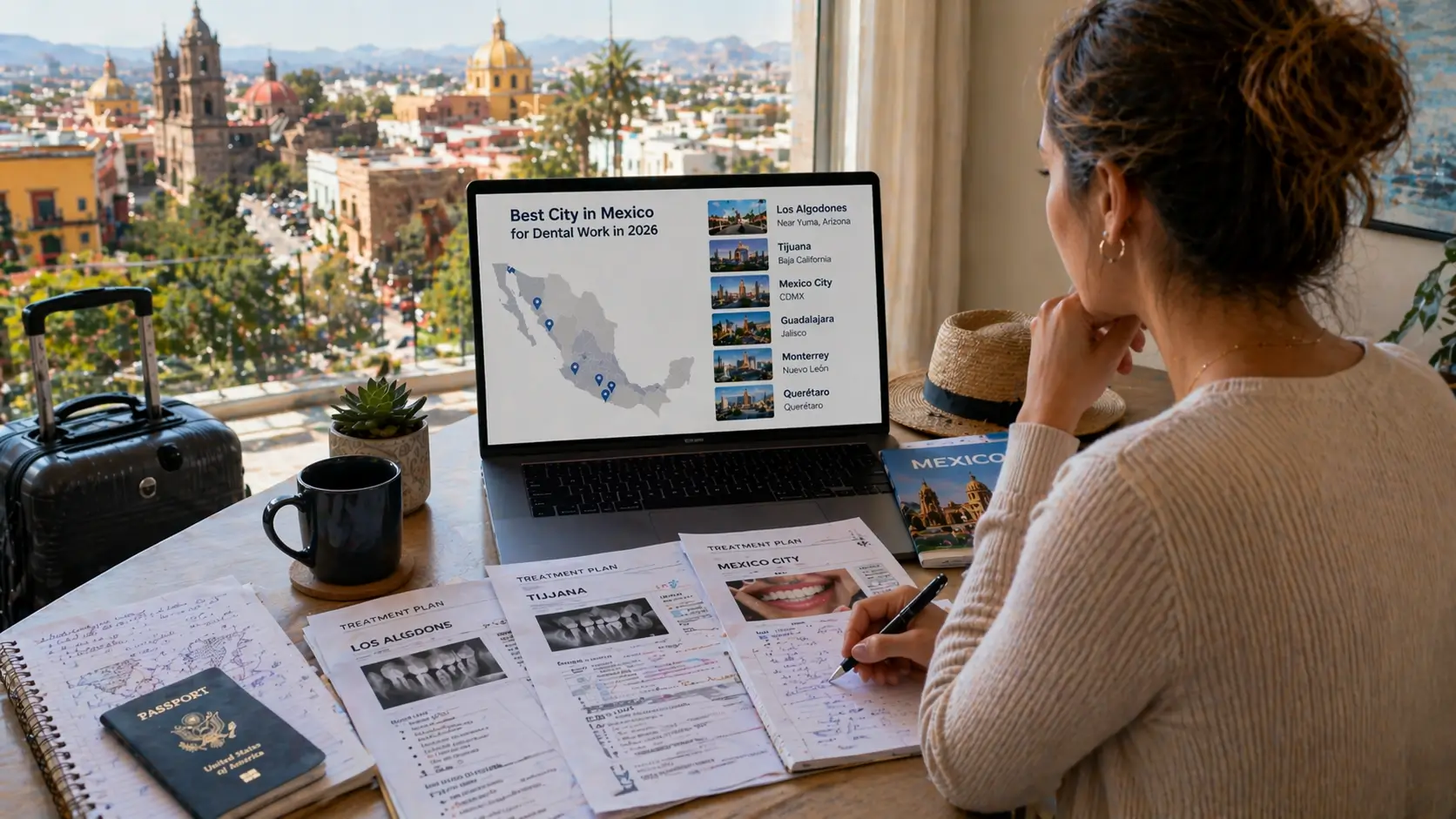
If you remember nothing else from this guide, keep these three principles.
First, choose your city based on how many times you'll need to return. Dental crowns and veneers can often wrap up in a single trip—though this depends on how many teeth are involved and whether any underlying issues need dental treatment first. Dental implants and full-arch work? They usually require multiple visits staged over months. When your treatment plan includes return trips, border access becomes critical. That's why Los Algodones (near Yuma, Arizona) and Tijuana (in Baja California, near San Diego) remain so popular—not just because fees are lower, but because you can pop back across without booking another expensive flight.
Second, treat "warranty" as a document, not a warm feeling. The clinic that earns your trust is the one willing to spell out in writing exactly what happens if your bite feels off, a crown needs remaking, or swelling changes your fit after you fly home. No written redo policy? No aftercare plan? No after-hours contact number? You're not buying protection. You're buying hope.
Third, match complexity to team depth. Bone grafting, gum surgery, multiple specialists working together, full-mouth restorations—these cases belong in larger cities. Mexico City, Guadalajara, Monterrey, and Querétaro have more specialists and better lab support. They may not be the cheapest option, but for complex cases, they're often the smartest one.
Affordability matters, but price alone rarely tells the whole story once you factor in hotel nights, return visits, warranty coverage, and travel logistics. The best city isn't the one with the lowest listed prices—it's the one that minimizes your total cost and total risk.
Start by identifying your top priority. If lowest total cost is the driver, border towns tend to win—especially for multi-visit dental care where you can drive instead of fly. Looking for strong aftercare protection? Focus on clinics that put follow-up plans and warranty terms in writing, then pick a city you can realistically get back to. When easy travel is your top concern, border access or direct flights matter a lot if you need an adjustment later. And if you're facing complex treatment that needs multiple specialists, major cities typically have the most options.
Once you've narrowed your city list, evaluate clinics within those cities simultaneously—comparing pricing, credentials, and aftercare terms side by side prevents choosing a destination only to find the clinic options don't fit. The Globalcare app lets you filter pre-screened clinics by city, procedure, and preferences in one place.
Most bad dental tourism stories come from the same three problems: quotes that change once you arrive (or left out key costs from the start), aftercare "promises" that were never written down and can't be enforced from back home, and clinics that respond fast before payment—then go silent after you leave.
The table below offers a quick reference for matching Mexico's top dental tourism destinations to treatment needs.
Los Algodones—often called Molar City—has built its entire identity around affordable dental care. This tiny border town near Yuma, Arizona, packs more dental offices per capita than almost anywhere else on the planet. Dozens of dental clinics cluster in a compact, walkable area just steps from the U.S. border crossing—meaning no flights, no expensive shuttles or taxis, and much lower total trip costs for patients coming from the American Southwest.
The town's affordability draws patients from across the United States and Canada seeking high-quality dental care at a fraction of the cost they'd pay at home. Canadian and American retirees, in particular, have made Los Algodones a top destination for dentures, dental crowns, and implant procedures.
This city works best if you're chasing competitive prices and can realistically return for staged care. Whether you're addressing missing teeth—a single tooth or a full arch—many implant cases require a second trip months later for the final crown or bridge—don't overlook that when planning. Before you commit, get your full treatment plan and aftercare terms in writing. Confirm the implant brand being used, and ask specifically how the clinic handles bite adjustments if swelling changes your fit once you're home.
Tijuana's proximity to San Diego makes it the default choice for patients who want to drive across, get dental treatment, and drive back—sometimes in the same day. Located in Baja California, this border town is especially practical for routine dentistry and multi-visit treatment plans: cleanings, fillings, dental crowns, and root canal plus crown combinations.
Bilingual staff and clinic density drive lower prices without sacrificing patient experience. For Southern California patients, it's effectively a local option.
If your case might get complicated—a root canal that needs to be redone, surgical extractions, gum problems, or implant issues—confirm that those specialists are available before you commit. Ask who would actually perform each procedure and whether that person is on staff or a referral.
Want to pair elective dentistry with beach time? Clinics in Cancún, Playa del Carmen, Puerto Vallarta, and Los Cabos are well-versed in medical tourism—priority scheduling, English-speaking staff, and familiarity with what North American patients expect.
These destinations work best when your treatment is straightforward—either a single visit (whitening, simple extractions) or carefully planned with enough time for the lab to make your restorations (veneers, certain crown cases). If you're considering a smile makeover—multiple veneers or cosmetic dentistry procedures—a dental vacation in Cancún can combine transformation with relaxation. The main caution? Resort cities are unforgiving if you need an unplanned redo. Build in extra time, avoid scheduling your dental trip on your last day, and get a written plan for what happens if something needs refinement after you fly home.
Mexico's large cities—Mexico City, Guadalajara, Monterrey, Querétaro—don't always market themselves as dental tourism hubs. But for complex cases, they deliver world-class dental care: a deep bench of specialists, advanced diagnostics, and robust lab support with quality materials.
If you're facing multi-phase treatment—All-on-4 implants, full-mouth rehabilitation, bone grafting, or gum surgery—larger cities are better set up to handle it. You'll find it easier to get multiple opinions in one city, and specialists are accustomed to collaborating on challenging cases. These cities also have modern hospitals and pharmacies nearby, which matters when you're recovering from complex procedures. Verify who's leading your case, how the surgical and restorative teams communicate, and what the realistic timeline looks like between phases—including a backup plan if healing takes longer than expected.
Regional cities can be excellent when you have a strong personal referral or have already identified a clinic with clear documentation and verifiable credentials. Pricing is often very competitive, with some dental procedures available at affordable prices that undercut even border town rates. The tradeoff? Fewer clinics in these areas means fewer backup options if you need fast, in-person aftercare.
Safe choices come from documentation, not optimism. The CARES framework gives you a consistent standard for evaluating any clinic in any city—making apples-to-apples comparisons actually possible.
For any dental clinic you're considering, request the treating provider's full legal name and cédula profesional (professional license number), then verify it in the official SEP registry. Ask who does what for your specific dental procedure—an oral surgeon might place implants while a prosthodontist designs and delivers the final teeth.
Dig into procedure-specific experience. How often does this provider perform your exact treatment? What's their typical workflow? If dental implants are involved, which brand and component system will you receive? (This matters for future maintenance anywhere in the world.) Also request basic safety documentation: at minimum, the clinic should clearly explain their sterilization process and demonstrate they operate as a legitimate medical facility.
English fluency and high ratings are nice, but they're not credentials. Any top-notch clinic answers these questions quickly and consistently.
To compare dental clinics fairly, you need quotes in the same format. Ask every clinic for a dated, itemized PDF quote that breaks down each procedure, specifies materials and brands (implant system, crown material, prosthesis type), notes whether imaging is included, lists temporaries and follow-up visits, and clearly states the currency. Also confirm whether payment method affects pricing.
Then build your "Total Cost to Go" by adding travel, lodging, local transportation, meals, and buffer days. This is the number that actually matters—the one that hits your bank account, not the one in the clinic's marketing.
Aftercare separates solid dental practices from dental "deals." Before you commit, secure written documentation covering post-op instructions (in English if you prefer), the follow-up schedule (what happens before you leave and any remote check-ins afterward), emergency contact information with hours and a real channel (phone, WhatsApp, or email), and the warranty or redo policy—including coverage, exclusions, and whether you must return in person.
When a clinic says "Don't worry, we'll take care of you" but won't put aftercare terms in writing, that's a warning sign—not reassurance.
Convenience isn't just about being close to the border or the beach. It's about whether you can complete treatment safely and return if needed without blowing up your schedule and savings. Map your total door-to-door time from home to the clinic, evaluate how close your lodging is (especially important post-surgery), understand border wait times or airport transfer realities, and confirm what support services exist—English-speaking coordinators, pickup options, written directions.
The same procedure can be straightforward for one patient and higher-risk for another. Disclose everything relevant: smoking (which significantly reduces implant success rates), diabetes (which can impair healing), medications like bisphosphonates (which carry specific risks for jaw surgery), prior implant failures, gum disease, sleep apnea, and bruxism (teeth grinding). Discuss your plans with your primary care provider or home dentist before traveling, especially for complex dental procedures.
Then ask how your health affects the plan (materials, staging, healing time), what success looks like and what would trigger a plan change, and who handles complications—in-house specialist or outside referral?
For a streamlined way to apply this framework—especially the pricing and aftercare verification steps—the Globalcare app organizes documentation from vetted clinics in one place, reducing the risk of costly oversights.
Mexico can deliver meaningful savings, but only when you calculate like a planner—not a bargain hunter. Your real equation is: treatment + travel + lodging + local transport + meals + buffers + possible follow-up = total cost.
Start by requesting a dated, itemized PDF quote from each clinic. Copy the quote date and currency into a simple tracker so you're not comparing a six-month-old estimate against a fresh one. Add travel costs and build in buffer days, especially for surgical procedures. Mark any exclusions clearly and follow up until they're resolved in writing.
Keep in mind: dental implant and full-arch prices vary dramatically based on implant brand, prosthetic material (acrylic vs. zirconia), imaging needs, surgical complexity, and whether grafting or extractions are required. Published ranges are starting points only—always insist on line-item quotes tailored to your specific situation.
For faster comparisons without building your own spreadsheet, the Globalcare app lets you request multiple quotes from vetted clinics and review pricing in a standardized format.
Instead of asking "Can they do this procedure?" ask: How many visits does it require, how long do I need to stay each time, and what's the recovery plan?
These timeframes are estimates; individual cases may require longer stays depending on healing, clinical findings, or lab schedules. Border towns like Los Algodones and Tijuana excel for repeat visits because return travel is simple. Resort cities work beautifully for planned cosmetic dental work—until you need an unplanned adjustment. Major metros tend to be best when specialist coordination matters more than convenience.
A warranty sounds great—until you're home with a bite problem and no idea what to do next. Before you commit, ask for warranty terms in writing. Make sure those terms answer these questions: What's covered (the implant post, abutment, crown, lab remakes, screws)? What's not covered (accidents, gum disease, grinding, missed follow-ups, smoking complications)? Where can you use it (that clinic only, or partner clinics)? Who pays for what (travel, shipping, replacement parts)? How do you file a claim (photos, X-rays, deadlines)?
A simple comparison table in your notes can help:
If a clinic can't provide clear written terms, treat their "warranty" as marketing, not protection.
When you're collecting multiple quotes, your goal is straightforward: turn scattered messages into a clean, comparable file for each clinic. For every option on your list, gather the treating provider's name, cédula, and specialty credentials; implant brand or system and proposed materials; a dated, itemized PDF quote with currency; written post-op instructions, warranty terms, and emergency contact information; and the number of visits required plus minimum stay.
Create a one-page checklist and keep one copy per clinic. If you're using the Globalcare app, it serves as that organizer—keeping clinic details, pricing, and messages in one place instead of scattered across email threads.
Here are templates you can copy and paste:
Initial request:
Hi [Clinic Name], I'm comparing a few dental clinics in Mexico for [procedure]. Could you please send: (1) a dated, itemized PDF quote with currency, (2) the treating dentist's full name and cédula number, (3) your written warranty/redo policy and aftercare instructions, and (4) the estimated timeline and number of visits. Thank you.
Follow-up for missing details:
Thanks. Can you confirm whether the quote includes CBCT/imaging, temporaries, anesthesia/sedation, follow-up visits, and any grafting or extractions? If anything is excluded, please list exclusions in writing.
Clinics that respond quickly with documents tend to stay responsive after treatment, too.
After dental work—especially surgical procedures—you want boring logistics. A few smart planning choices make that happen.
Map your complete door-to-door timing: home to airport or border crossing, to lodging, to clinic, and back. If it looks tight on paper, it will be worse in reality. Add recovery buffer days for any surgical procedure. Book flexible reservations when possible—changeable flights and hotels are often worth the premium. Line up your support: a translator or English-speaking coordinator, pickup options, and the easiest route back to your hotel after appointments.
Get safe-to-travel guidance in writing for your specific procedure. Some procedures—especially sinus lifts or recent extractions—may require a waiting period before flying, because cabin pressure can affect healing. Request post-op instructions in English (or your preferred language), including medications and warning signs to watch for.
Your consultation isn't about being sold to—it's about confirming the clinic can document what it claims. These questions help you get verifiable answers instead of vague promises:
Strong clinics answer with specifics and documents, not general reassurances.
Need to move fast without cutting corners? Match each concern to a single proof item. For quality, request the dentist's cédula plus the official lookup link, along with a few recent, procedure-specific before-and-after examples. For safety, ask for a brief overview of sterilization standards and how they handle medical history, allergies, and emergencies. For communication, request a sample consent form and the contact information for an English-speaking coordinator. For payment, confirm accepted methods and request a sample itemized invoice format. For aftercare, review written warranty terms, the follow-up schedule, and a named emergency contact.
You're looking for consistency: consistent answers, consistent documentation, and a plan that still makes sense if healing takes longer than expected.
Many issues that arise after dental work are manageable—but having a plan in place before treatment makes all the difference. Some complications—like implant failure, nerve problems, or significant bone loss—may need major follow-up treatment. Those aren't easy to fix from home.
Before treatment begins, make sure you have a written warranty or redo policy plus instructions for initiating a claim, a clear statement of who pays for remakes, additional visits, shipping, and travel, a named after-care contact with hours and a way to reach them, and a promise to provide your clinical records so a dentist at home can check on you if needed.
Take it step by step, and only move forward when documentation is complete.
Pick your best-fit city, then shortlist clinics and collect the evidence pack for each: verified credentials, dated itemized quotes, written aftercare and warranty terms, realistic timelines, and travel plans. Score each using the CARES framework so your decision rests on proof.
Run the math before you commit. Take the clinic's itemized quote and add flights or driving costs, lodging, meals, local transport, and buffer days. Then add a realistic follow-up allowance—especially for dental implants and full-arch work. This confirms whether Mexico remains the better option for you, not just in theory.
Once your checklist is complete—credentials verified, quote itemized, aftercare documented, timeline realistic—book your video consultation using the question script above. Or compare verified options inside the Globalcare app to request multiple quotes and choose with confidence.
Healthcare decisions deserve transparent sourcing. Here's how you can verify this guide:
Pick your best-fit city based on cost, convenience, or complexity. Shortlist dental clinics and verify credentials using the CARES framework. Request dated, itemized quotes and calculate your true total cost. Get written aftercare and warranty terms before paying a deposit. Book a video consultation only after documentation is complete.
The Globalcare app lets you explore pre-screened clinics filtered by treatment type, location, and preferences—with transparent pricing, direct clinic chat, and free quotes in one place.
Get in touch to get started!
Our team of experts will ensure your all-on-4 dental implants journey is safe and easy. We're dedicated to guiding you to your new smile every step of the way!
ConnectConcierge Services

Trusted Dentists

Safe Locations

Concierge Services
Trusted Dentists
Safe Locations

Disclaimer: Dental Cost Estimation Calculator
This Dental Cost Estimation Calculator is designed to provide users with estimates of potential savings when seeking dental treatments abroad compared to the cost of similar procedures in the United States. However, please be aware of the following important information before using this tool:
1. Estimations Based on Publicly Available Data:
The estimates provided in this calculator are derived from publicly available data sources, including average procedure costs, exchange rates, and other relevant information. These figures may not reflect the exact costs of your specific treatment or location. Estimations include non-dynamic assumptions for travel and lodging costs that may not reflect the actual costs at the time of your research.
2. Quantitative Model Assumptions:
The calculations are based on assumptions and data inputs that may not account for all factors influencing dental treatment costs. Variations in individual treatment needs, dentist fees, and other variables can significantly affect the final expenses.
3. No Substitute for Professional Advice:
This tool is not a substitute for professional dental advice. Before making any decisions about your dental treatment, it is crucial to consult with a qualified dental professional who can provide you with a personalized assessment of your needs and potential costs.
4. Currency Exchange Rates:
Estimates involving foreign treatment costs rely on currency exchange rates, which can fluctuate. The rates used in this calculator may not accurately represent the current market rates at the time of your treatment.
5. Geographic and Facility Variations:
Dental costs can vary significantly based on geographic location, dental facility, and the complexity of the procedure. The estimates provided are general in nature and may not reflect the specific conditions in your chosen destination or dental clinic.
6. Non-Inclusive Costs:
This calculator may not account for additional expenses such as per diem costs in destination or unforeseen complications during or after the procedure. These costs can substantially impact your overall expenses.
7. Liability Waiver:
By using this calculator, you acknowledge that the estimates provided are for informational purposes only, and Globalcare Network Inc or any of its representatives bear no responsibility for the accuracy of the estimates or any decisions made based on them.
8. Independent Research Recommended:
It is strongly recommended that you conduct independent research, obtain quotes from dental professionals, and consider all relevant factors when making decisions about dental treatment abroad.
In summary, while this Dental Cost Estimation Calculator aims to provide helpful information, it should not be the sole basis for your decision-making process. Your individual circumstances and dental needs may differ, and it is essential to seek professional advice and conduct thorough research before pursuing dental treatment abroad

