How Much Does a Crown Cost With Delta Dental?
February 16, 2026

Back to Blog
.png)
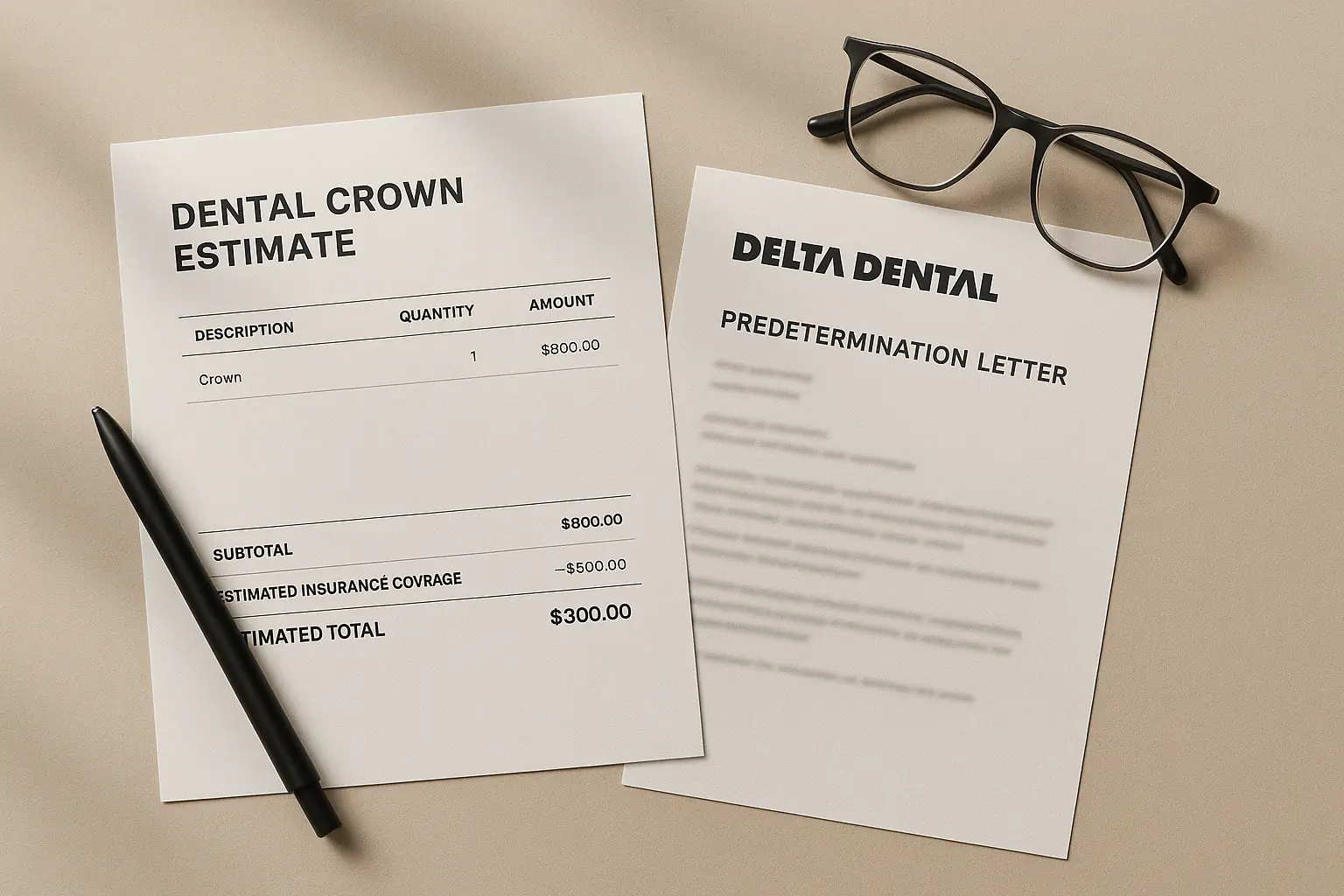
Before covering price ranges, here's what really determines your final out-of-pocket cost. Understanding these factors is what separates a predictable dental bill from an unwelcome surprise.
Your Delta Dental plan type matters—a lot. A Delta Dental PPO plan works completely differently than a DeltaCare USA (HMO) plan. With PPO coverage, your cost is based on Delta's "allowed amount" combined with your deductible and coinsurance percentage. With DeltaCare USA, you typically pay a fixed copay from a set fee schedule—but only if you see your assigned dentist and follow the plan rules precisely. Same Delta logo on your card, completely different math on your bill.
A dental crown is rarely just one charge. Many crown procedures require additional work: diagnostic X-rays to plan treatment, a core buildup to reconstruct tooth structure, and sometimes a post if you've had a root canal. These aren't optional upsells—they're often clinically necessary based on your tooth's condition. The catch? If you don't see them itemized with CDT codes upfront, you can't predict what Delta will cover versus what you'll pay yourself.
Your paperwork is your power. The only reliable way to know your true out-of-pocket cost is to get two documents in hand before any drilling starts: your dentist's itemized estimate (complete with CDT codes) and Delta's written predetermination. Together, these reveal waiting periods, frequency limits, annual maximum concerns, and potential balance-billing risks—all before you're committed to treatment.
Once you have both documents, you can make a calm, informed decision: move forward with in-network care, adjust your treatment timeline, stage the work across benefit years if clinically appropriate, or compare cash-pay options (including international clinics) without playing guessing games.
The most important step you can take: get a detailed, CDT-coded estimate from your dentist, then submit it to Delta for a written predetermination. This pre-treatment paperwork is the closest you'll get to knowing your actual cost before the procedure begins.
Before submitting, run through a few quick checks. First, confirm whether dental crowns are classified as a "major" service on your plan—most are. That major coverage classification typically means higher coinsurance, often around 50%[2] compared to the 20% common for basic work like fillings (though your specific percentages may vary). Check how much of your annual deductible you've already met and how much of your annual maximum remains. If your dental plan caps benefits at $1,500 and you've already used $1,200 on other dental work this year, you're covering most of this crown yourself regardless of your coverage percentage.
Network status deserves attention too. For PPO plans, verify your dentist is genuinely in-network—not just someone who "accepts" Delta Dental (those are different things). For DeltaCare USA, confirm the dentist is your assigned or selected provider. Seeing a different dentist without proper referral could mean zero coverage. Also check for frequency limits—many plans only cover crown replacements every five years or so per tooth—and whether you're still within a waiting period for major services (often 6 to 12 months on newer plans).
Submitting for predetermination accomplishes three things. First, it shows you exactly how Delta will apply your benefits—your deductibles, coinsurance, maximums, and any applicable limitations. Second, you catch potential problems while there's still time to address them, not after your tooth is already prepped. Third, it creates time and space to compare alternatives. If the estimate comes back higher than expected, you can request a private-pay quote or explore other options using those same CDT codes for a true apples-to-apples comparison.
One important caveat: a predetermination isn't a guarantee of payment. It's an estimate based on current information. Final payment depends on your eligibility at the time of service, the accuracy of submitted information, and Delta's review of the actual claim.
General price ranges help you set expectations, but the most useful comparison considers both crown material and your network status—these two variables create the biggest swings in what you pay. Keep in mind that actual costs vary significantly by geographic location, specific plan design, and individual provider fees.
*HMO copays vary by state, plan, and specific DeltaCare USA fee schedule[15]. Always confirm your exact copay with your assigned provider.
**Patient share estimates assume typical 50% coinsurance for major services after deductible. Your actual coinsurance percentage may differ—check your specific plan documents.
Before requesting a formal predetermination, you can do a rough sanity check. Start by identifying the crown code and Delta's allowed amount (for PPO) or your fixed copay (for HMO). Apply your coinsurance percentage, then add any remaining deductible. Don't forget likely add-ons like buildups, posts, or imaging if they appear on your estimate. For out-of-network care, factor in potential balance billing if your dentist charges more than Delta's allowed amount.
The PPO formula in plain terms: Your out-of-pocket equals the allowed amount times your coinsurance percentage, plus any remaining deductible, plus non-covered items, plus balance billing (if applicable).
Here's why "allowed amount" is critical: Delta calculates your benefits based on their allowed amount—not what your dentist actually charges. For out-of-network care, a dentist can charge more than Delta's allowed amount, and you're responsible for the difference unless the office agrees in writing to accept Delta's payment as payment in full.
One more thing to watch for: some plans include an "alternate benefit" or "least expensive alternative treatment" provision. This means Delta may base payment on a less costly option if one exists. Your predetermination will reveal whether this applies to your situation.
A crown bill rarely shows just one line item. Many procedures include diagnostics, tooth reconstruction, and lab work. Here's what you might see when that itemized estimate arrives:
To keep this process manageable, use this simple checklist. It works whether you're pursuing in-network care, going out-of-network, or comparing international options—the goal remains the same: make your out-of-pocket cost as predictable as possible.
Most crown cost surprises trace back to a handful of avoidable assumptions. Here's what trips people up—and how to sidestep each pitfall.
Accepting verbal estimates. When a receptionist says "it should be around $500," that means nothing when the actual bill arrives. Always request a written, CDT-coded, itemized estimate by email before you commit.
Assuming "covered" means "paid in full." Does Delta Dental cover crowns? Yes—but coverage typically means Delta pays a percentage, often 50% for major services, after your deductible, up to your annual maximum. Confirm your deductible, coinsurance, remaining maximum, and frequency limits in writing.
Not confirming network status upfront. Your dentist might "accept Delta," but that's not the same as being a contracted in-network provider. For PPO plans, verify in-network status directly. For HMO plans, confirm you've properly selected or been assigned to that provider.
Starting treatment during a waiting period. Many newer plans require 6 to 12 months of enrollment before covering major services like crowns. Ask Delta to confirm your waiting period status before scheduling anything.
Ignoring balance-billing rules for out-of-network care. Delta might pay $700 toward a crown, but if your dentist charges $1,200 and doesn't agree to accept Delta's payment as full, you owe the $500 difference. Get the office's balance-billing policy in writing before treatment.
Not confirming warranty or redo policy. If the crown doesn't fit properly or fails early, who covers the remake? Get the warranty and redo policy in writing before treatment starts, including timelines and whether lab fees apply again.
Here's exactly how to turn uncertainty into a predictable number:
If your predetermination reveals a steep out-of-pocket cost—or if you don't have dental insurance—dental tourism might be worth exploring. Mexico is a common destination because many clinics there specifically cater to U.S. patients.
Cash prices for dental crowns in Mexico often run lower than U.S. self-pay rates. But your total cost involves more than the clinic quote. Travel expenses, time away from work, follow-up logistics, and warranty terms all factor in. Quality varies significantly between providers, and complications—while uncommon—can be harder to address when your dentist is across the border. The challenge isn't finding a low price; it's thoroughly vetting quality, confirming credentials, and ensuring clear communication before you commit.
Before you book: Don't choose based on price alone. Confirm the exact crown material and ask where it's fabricated. Get the redo and aftercare policy in writing—ideally in English. Budget for travel, lodging, and the possibility of needing adjustments once you're home. Think through what recourse you'd have if something goes wrong, and whether you have a local dentist who could help with follow-up care.
For many patients, the deciding factor isn't "Is Mexico cheaper?" It's "Can I see enough proof of quality and get clear communication before I commit?" That's the gap a dental tourism facilitator aims to fill.
Globalcare connects patients with a network of clinics across Mexico, helping you compare options, organize written quotes, and coordinate logistics and aftercare planning. According to Globalcare, clinics in their network go through a vetting process focused on factors like equipment, English-speaking staff, pricing transparency, and documented aftercare policies.
Within the Globalcare app, you can filter clinics by treatment type and location, review clinic details and pricing information, message clinics directly with questions, and request multiple quotes using your CDT-coded estimate. This helps you compare options on a more consistent basis—same procedure codes, same materials, clear warranty terms.
Before using any facilitator, ask the important questions: How are clinics selected and what credentials are verified? What warranty or redo policy is provided in writing? How are complications or adjustments handled once you're back home? What role does the facilitator play if issues arise? Use facilitation to structure your comparison and gather information—not as a substitute for your own careful research and due diligence.
Staying organized is what transforms guesswork into a predictable number. Keep track of these details:
The bottom line: Crown costs with Delta Dental can be manageable—but only if you turn estimates into paperwork. A written, CDT-coded dental quote plus a written predetermination gives you the clearest view of what you'll likely owe, helps you compare providers fairly, and significantly reduces surprise bills after treatment.
If your paperwork shows the U.S. path is too expensive or unpredictable, the smart next step is expanding your comparison set while maintaining your standards. Explore the Globalcare app to compare dental clinics in Mexico side by side. You can review pricing information, clinic details, and message clinics directly to request quotes—all before you book anything. It's one way to evaluate your options more comprehensively, so you can make a confident choice about quality, cost, and convenience.
Get in touch to get started!
Our team of experts will ensure your all-on-4 dental implants journey is safe and easy. We're dedicated to guiding you to your new smile every step of the way!
ConnectConcierge Services

Trusted Dentists

Safe Locations

Concierge Services
Trusted Dentists
Safe Locations

Disclaimer: Dental Cost Estimation Calculator
This Dental Cost Estimation Calculator is designed to provide users with estimates of potential savings when seeking dental treatments abroad compared to the cost of similar procedures in the United States. However, please be aware of the following important information before using this tool:
1. Estimations Based on Publicly Available Data:
The estimates provided in this calculator are derived from publicly available data sources, including average procedure costs, exchange rates, and other relevant information. These figures may not reflect the exact costs of your specific treatment or location. Estimations include non-dynamic assumptions for travel and lodging costs that may not reflect the actual costs at the time of your research.
2. Quantitative Model Assumptions:
The calculations are based on assumptions and data inputs that may not account for all factors influencing dental treatment costs. Variations in individual treatment needs, dentist fees, and other variables can significantly affect the final expenses.
3. No Substitute for Professional Advice:
This tool is not a substitute for professional dental advice. Before making any decisions about your dental treatment, it is crucial to consult with a qualified dental professional who can provide you with a personalized assessment of your needs and potential costs.
4. Currency Exchange Rates:
Estimates involving foreign treatment costs rely on currency exchange rates, which can fluctuate. The rates used in this calculator may not accurately represent the current market rates at the time of your treatment.
5. Geographic and Facility Variations:
Dental costs can vary significantly based on geographic location, dental facility, and the complexity of the procedure. The estimates provided are general in nature and may not reflect the specific conditions in your chosen destination or dental clinic.
6. Non-Inclusive Costs:
This calculator may not account for additional expenses such as per diem costs in destination or unforeseen complications during or after the procedure. These costs can substantially impact your overall expenses.
7. Liability Waiver:
By using this calculator, you acknowledge that the estimates provided are for informational purposes only, and Globalcare Network Inc or any of its representatives bear no responsibility for the accuracy of the estimates or any decisions made based on them.
8. Independent Research Recommended:
It is strongly recommended that you conduct independent research, obtain quotes from dental professionals, and consider all relevant factors when making decisions about dental treatment abroad.
In summary, while this Dental Cost Estimation Calculator aims to provide helpful information, it should not be the sole basis for your decision-making process. Your individual circumstances and dental needs may differ, and it is essential to seek professional advice and conduct thorough research before pursuing dental treatment abroad

