Does Blue Cross Blue Shield Cover Dental Implants or Just Part of the Cost?

February 6, 2026

Arrow pointing to the left

Back to Blog

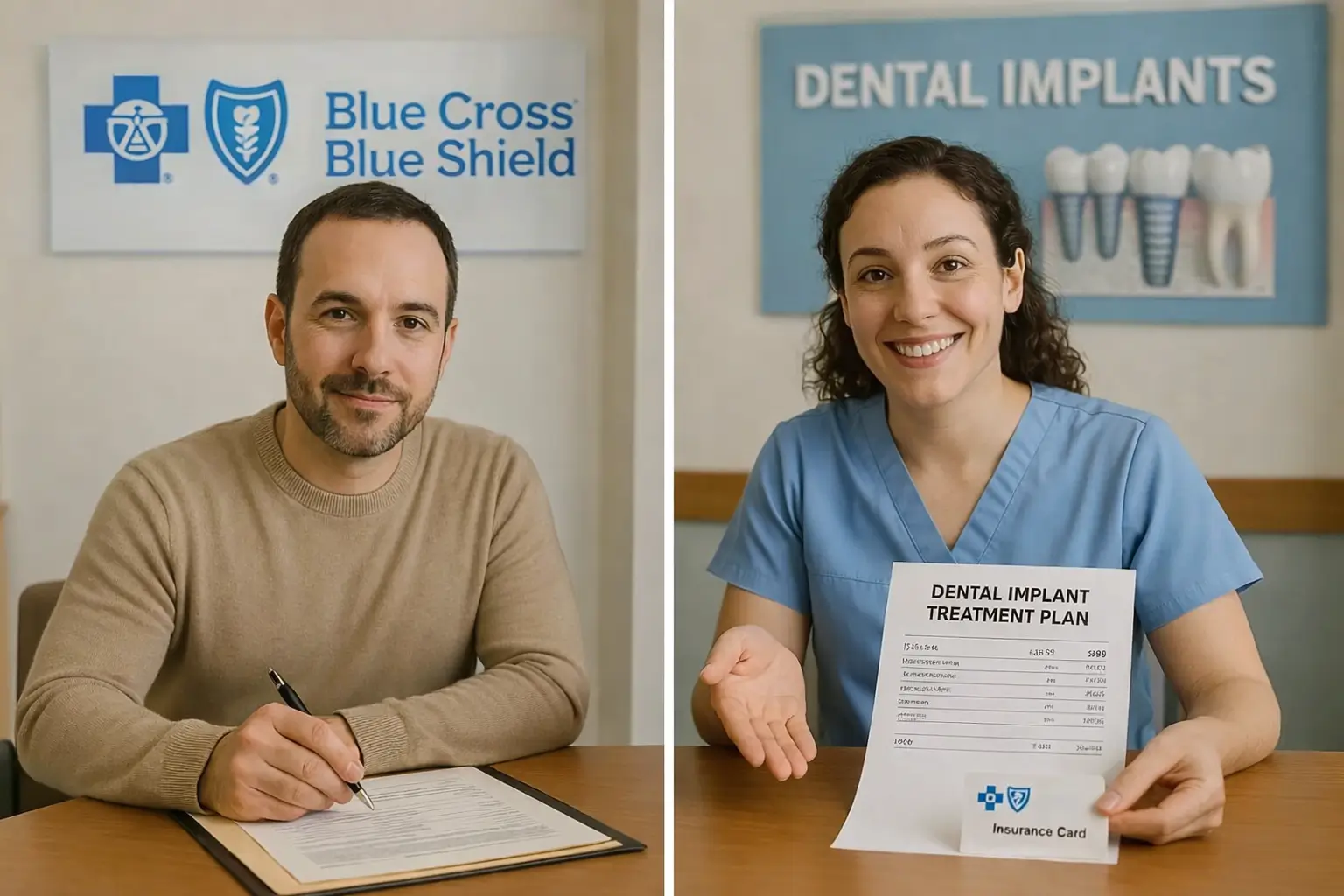
Man reviewing dental insurance options next to a dentist showing a treatment plan for dental implants covered by Blue Cross Blue Shield.

Most Blue Cross Blue Shield dental plans cap annual benefits at $1,000–$2,000, but major procedures like implants, crowns, and abutments often cost $10,000–$15,000 or more, meaning patients exhaust their coverage quickly and pay most of the expense out of pocket (Medicare plans face similar limits).

With a single implant running $3,000–$6,000 and that cap covering all dental care, not just implants, routine cleanings, and part of the surgery, can use up your allowance before restoration even begins. For an All-on-4, that means paying possibly $15,000–$30,000+ out of pocket.
Considering Mexico?

That's why many patients head to dental clinics in Cancun, Los Cabos, or Puerto Vallarta. Recover beachside, pay a fraction of the cost, and skip the insurance headaches.*

Globalcare helps you find vetted clinics with clear pricing and warranty terms upfront.

Find Vetted Clinics

Key Steps Before Committing to Implant Costs

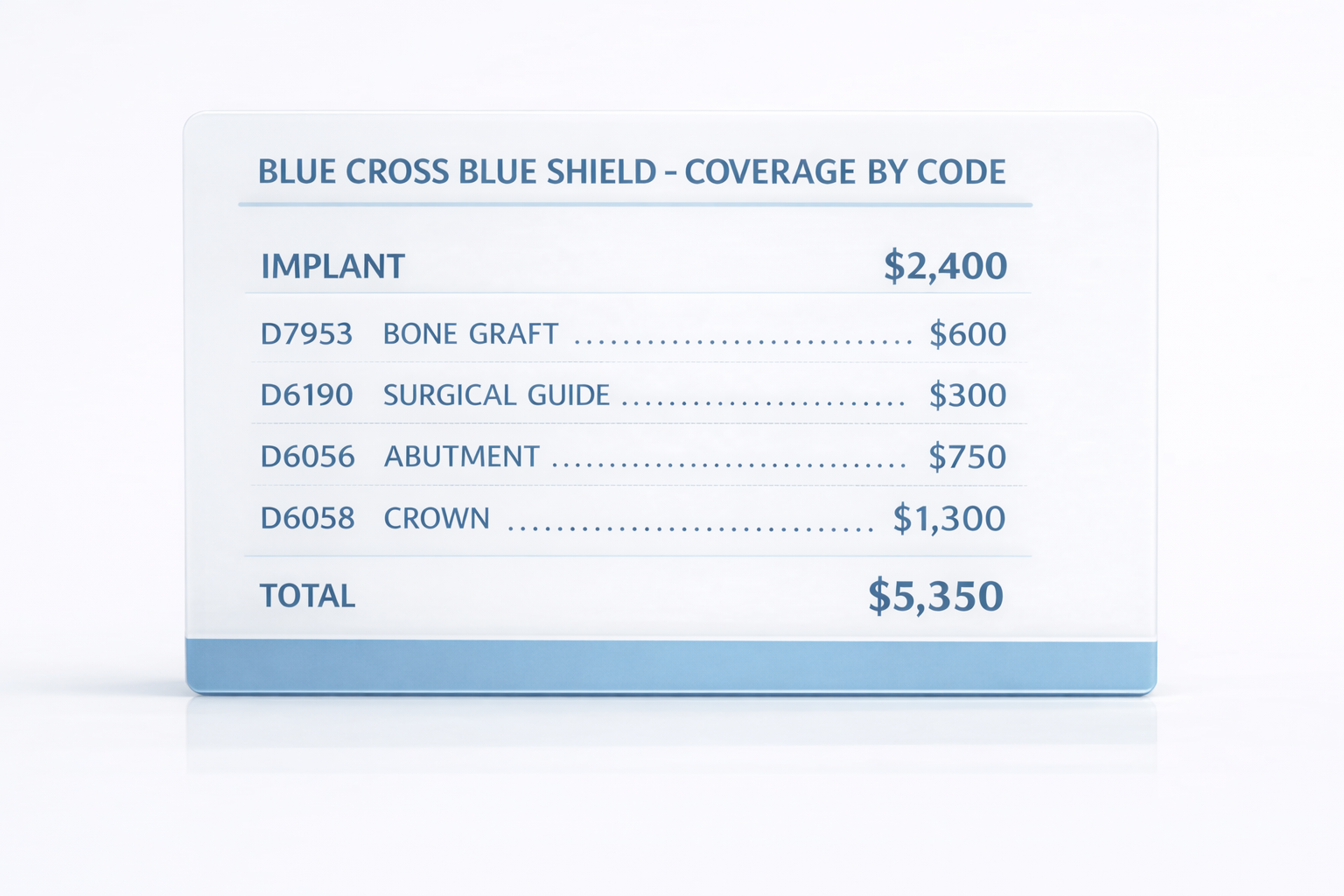
A dental billing breakdown chart for Blue Cross Blue Shield showing dental implant costs and procedure codes like bone graft and crown.

Implant decisions rarely go wrong because of the dentistry. They go wrong when the financial picture is unclear, claims get processed incorrectly, or patients mistake "covered" for "paid for."

Before you commit, understand these three basics so you're comparing real out-of-pocket numbers, not assumptions or vague "coverage" promises.

1. BCBS Is a Network, Not a Single Policy

Blue Cross Blue Shield is an association of 33 independent companies. That means implant benefits vary widely by plan, state, and employer.

Your coworker with Anthem Blue Cross Blue Shield (Elevance Health) might have completely different coverage than you do with Blue Cross Blue Shield of Texas, Florida Blue, Independence Blue Cross, or Blue Shield of California. Start by identifying your exact plan: Is it a PPO or an HMO? Employer-sponsored or marketplace? FEP BlueDental? Then figure out whether your claim goes through dental benefits, medical benefits, or both.

2. Your Implant Is Billed as Multiple Parts

An implant isn't billed as one charge. It's submitted as several parts: imaging, surgical placement of the post, possible bone grafting, and the final tooth (abutment and crown).

Insurance reviews each part separately, so approval for one part doesn't carry over to the others. What people call "implant coverage" is really a collection of separate decisions about what they'll pay.

In practice, if insurance contributes at all, it tends to pay more toward the surgical portion than the restoration. On top of that, most dental plans have an annual maximum (often $1,000–$1,500) that caps the plan's total annual payment. That limit often runs out before the final tooth is completed, which is why many patients face a large out-of-pocket balance even when something is technically "covered."

3. Confirm the Numbers in Writing

What clinics or insurers say on the phone isn't binding. The only reliable way to know what's actually covered is to check your treatment against specific billing codes:

  • Get a dated, itemized treatment plan with ADA/CDT codes from your dental office.
  • Submit those codes to BCBS for a written benefits estimate.
  • Get written confirmation (predetermination or preauthorization, if required) before committing to anything.

With that paperwork in hand, you can calculate your real out-of-pocket cost and compare it directly against a bundled private quote that clearly spells out what's included, what's not, warranty terms, and aftercare.

Understanding BCBS Dental Implant Coverage and What to Expect

A dental billing breakdown chart for Blue Cross Blue Shield showing dental implant costs and procedure codes like bone graft and crown.

Implant treatment is broken into multiple parts, and BCBS looks at each one under different rules. As a result, coverage often seems inconsistent across plans and even within the same treatment.

  • The surgical phase (placing the implant post) may be covered under your dental plan, often at a percentage after you meet your deductible. In limited situations, it might qualify under medical benefits, but this usually happens only when tooth loss results from trauma, significant disease, or a documented reconstructive need, and you've provided all the required clinical paperwork.
  • The restorative phase (abutment, crown, and lab work) is where coverage commonly drops off or disappears entirely. Even plans that say they "cover implants" often have annual maximums around $1,000 to $1,500, and those caps can run out before the final tooth is placed, sometimes before the surgery even happens, if you've already used benefits earlier in the year.

The table below shows how this typically plays out and what you should verify before relying on any estimate.
Pro Tip

Get written confirmation of what BCBS will pay for each part (with code-specific confirmation) after deductibles, coinsurance, and annual maximums, as well as written confirmation from the clinic of exactly what's included, excluded, warranty terms, and aftercare.

How BCBS Dental Plans Typically Pay for Implants

BCBS Dental Implant Coverage - Plan types, payment details, limitations, and verification steps
Your BCBS Plan Type What Usually Gets Paid What's Commonly Limited or Denied Exactly What to Ask and Verify
BCBS Dental PPO Plans Partial payment for implant placement (CDT D6010) after deductibles and waiting periods. Abutment (D6057), crown (D2740), lab fees, and annual maximums ($1K–$2K typical) often cap total payment. Request a written predetermination for D6010, D6057, and D2740. Confirm your remaining annual maximum and whether lab fees are billed separately.
BCBS Dental HMO / Managed Care Very limited implant coverage. Some exceptions only under strict medical necessity rules. Most elective implants, fixed crowns, and upgrades. Alternate benefit may apply (they pay bridge/denture pricing instead of implant pricing). Ask if implants are covered at all, what counts as medical necessity, and whether an alternate benefit applies. Get it in writing.
BCBS Federal Employee Dental (FEP / FEDVIP) Some plan tiers allow partial implant coverage with strict documentation and preauthorization. High Option offers unlimited annual maximum. Standard Option has a $1,500 annual maximum. Denials from missing imaging, incomplete notes, cosmetic upgrades, and annual caps. Review your FEP plan brochure and submit a pretreatment estimate with full documentation before scheduling.
BCBS Optional Riders / Enhancements May expand restorative coverage or increase annual caps depending on the rider. Waiting periods, lifetime caps, and limited covered codes are common. Confirm rider effective date, waiting period, covered CDT codes, and caps in writing.

How to Verify Your Implant Coverage

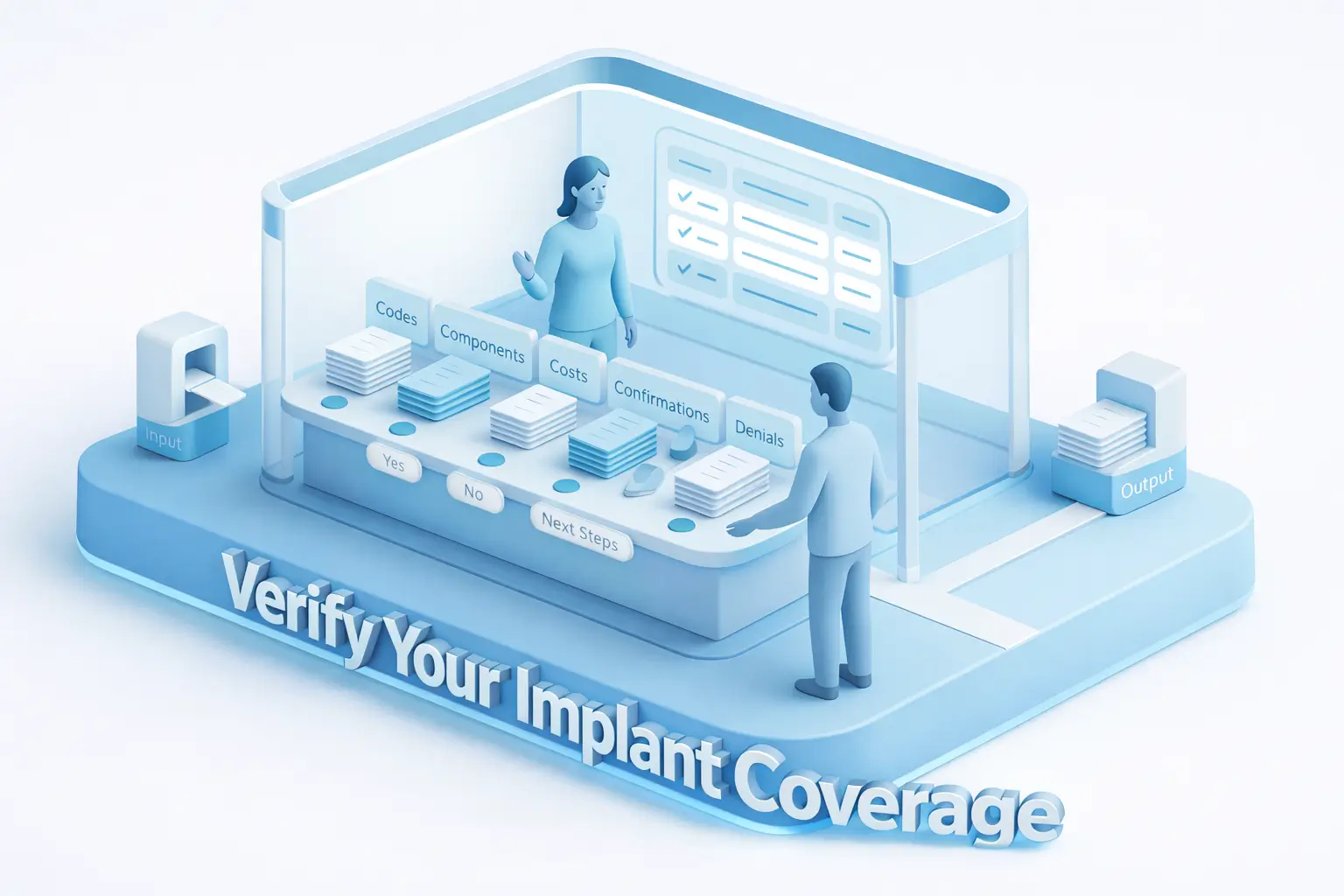
3D isometric illustration showing the step-by-step process to verify Blue Cross Blue Shield dental implant coverage, including checking procedure codes, costs, and confirmations.

Implant coverage is one of the easiest areas for miscommunication because everything depends on codes, documentation, and timing. That's why we created the COVER framework: to give you a clear, step-by-step way to verify benefits, line up your documentation, and make decisions based on real numbers rather than guesses.

C — Which Implant Components Does Your Plan Cover?

Confirm coverage for each part separately:

  • Implant Fixture or post placement (often D6010)
  • Abutment (often D6057)
  • Crown (often D6065)
  • Lab-related charges (may be included in crown or abutment fees, or listed separately)

Common add-ons:

  • Imaging / CBCT (D0367)
  • Bone grafting (D7953)
  • Extractions (D7210 surgical, D7140 simple)
  • Anesthesia or sedation (D9215 local, D9223 deep, D9243 IV moderate)
  • Surgical guides (D6190)
  • Temporary teeth (D6085 provisional crown, D5810/D5811 interim dentures)

What to request first:

  • From your dental office: ask for a dated, itemized treatment plan listing all relevant ADA/CDT codes. If the office thinks any portion might qualify for medical insurance coverage, ask for CPT and ICD-10 codes as well.
  • From BCBS: a code-by-code answer for each line item, including whether it will be processed under dental benefits, medical benefits, or if it's not covered at all.

Important: If your plan uses an "alternate benefit," Blue Cross Blue Shield might pay as if you chose a bridge or denture, even if you receive an implant. That can be the difference between "covered" and "still expensive," so ask about it directly, and get the answer in writing.

O — Estimating Out-of-Pocket Costs

To calculate what you'll actually spend, consider:

  • Your deductible, and whether it applies to implant-related services
  • Your coinsurance percentage by category (major services vs. basic, etc.)
  • Your annual maximum (and how much you've already used this calendar year)
  • Waiting periods and frequency limits that might delay or exclude certain procedures
  • Any alternate benefit calculations or explicit plan exclusions

Make the comparison fair by placing your confirmed insurance costs next to a bundled clinic quote covering the same scope of work, including surgery, abutment, crown, imaging, and grafting, if clinically needed.

If the difference in your out-of-pocket cost is close to the bundled price difference, the decision usually comes down to predictability, warranty coverage, and aftercare support, not just the headline price.

V — Confirm Coverage Before Treatment Begins

Many implant billing problems happen because people skip the one step that prevents denials: getting written confirmation before treatment begins.

  • Ask BCBS whether you need predetermination (pretreatment estimate) or preauthorization for any implant-related codes.
  • Submit the required documents (treatment plan, clinical notes, imaging) before you commit.
  • Keep the insurer's response letter, reference number, and any conditions in a single folder. You'll need this if there's a dispute later.

Use this script when you call BCBS:

Script

Hi, I have a treatment plan with these implant codes: D6010, D6057, and D6065. I'd like to confirm what my plan covers for each one. Can you tell me the percentage covered, whether the deductible applies, if there are any waiting periods, and whether I need predetermination or preauthorization?

E — Steps to Take if Coverage Is Denied

If you're denied, move quickly and build a clean evidence package. Denials often come down to missing steps, missing documentation, or claims processed under the wrong benefit category.

Build your appeals folder with:

  • The denial letter (and denial reason codes)
  • The exact plan language cited (save screenshots or PDF pages)
  • Your itemized, dated treatment plan with all billing codes
  • Clinical notes from your dentist explaining why the implant is medically necessary (examples: trauma history, infection, failed prior treatment that makes alternatives unworkable)
  • Imaging or photos (as applicable)
  • A simple timeline documenting dates of service, dates you submitted paperwork, who you spoke with, and call reference numbers.

R — Comparing Other Reliable Options and Warranties

If your coverage is limited, or if the approval timeline feels uncertain, it makes sense to compare other options side by side:

  • Local cash pricing (some dentists offer packages, even domestically)
  • Bundled packages that clearly include surgery, abutment, crown, and follow-ups
  • Cross-border care (commonly in Mexico or Costa Rica), if you're comfortable with travel

What matters most when evaluating bundles isn't just price, but warranty terms (what's covered, for how long), who handles repairs once you're home, and whether you can get local follow-up if an adjustment is needed.

What You’ll Really Pay: BCBS Insurance vs Bundled Clinic Pricing

A comparison table showing Option A versus Option B for dental insurance coverage, illustrating the difference between Blue Cross Blue Shield insurance rates and clinic bundle pricing.

What You'll Actually Pay: BCBS vs. Bundled Clinic Pricing

To make a fair comparison, focus on what you will actually pay out of pocket. Add every expected cost, including clinic fees, the implant, abutment, crown, lab work, imaging, grafting, anesthesia or sedation, temporaries, follow-up visits, and potential repairs.

If you're traveling for care, also include flights, lodging, local transportation, and time off work.

The table below breaks down what you'll typically pay out of pocket with BCBS versus what's usually included in a bundled clinic price, and how to verify each line item before you commit.

BCBS Dental Implant Cost Comparison - Insurance coverage vs bundled clinic pricing breakdown
What You're Paying For What You'll Typically Pay With BCBS What's Usually Included in a Bundled Clinic Price Exactly How to Compare and Verify
Implant Placement (Surgical Post – CDT D6010) Most BCBS dental PPO plans reimburse roughly 50% of major services, limited by deductibles and annual maximums (commonly $1,000–$2,000 per year). Typical U.S. fees run $1,500–$2,000 per implant, leaving many patients paying $1,000–$2,500 out-of-pocket even when "covered." Surgical placement is typically included in the bundle at a fixed price with no separate billing. Ask BCBS: "What is my allowed amount and my patient responsibility for CDT D6010?" Get it in writing. Compare that dollar amount against the surgical portion of the bundle (if itemized). Ignore percentages. Compare actual cash.
Abutment + Final Crown (Restoration – CDT D6057 + D2740) Frequently reimbursed at a lower rate or excluded under many BCBS dental plans. Lab fees may be billed separately. Typical U.S. fees run $1,500–$3,000 per tooth, with most of that often falling out-of-pocket. Usually included in the bundled price as part of the final tooth. Ask BCBS whether D6057 and D2740 are covered, at what percentage, and whether lab fees are separate. Add all uncovered portions into your total. Look at the finished tooth, not one code.
Imaging, Bone Grafting, Sedation, and Surgical Add-Ons (D0367, D7953, D9215) CBCT scans ($150–$750), bone grafts ($500–$3,000+), IV sedation ($400–$1,000), and surgical guides are often partially covered or excluded under BCBS dental policies. These items commonly drive surprise out-of-pocket costs. Many bundles include CBCT imaging, surgical guides, temporary teeth, and basic grafting, or clearly list fixed upgrade pricing. Request a written treatment plan listing each CDT code (D0367, D7953, D9215). Confirm whether each item is included or extra in the bundle. If it's not written, assume it's billable.
Annual Maximum Limits (Benefit Cap) Most BCBS dental plans cap annual benefits at $1,000–$2,000 (occasionally up to $3,000). Prior dental care often consumes part or all of that limit before implant treatment is finished. No annual cap. Pricing is fixed regardless of treatment timing. Log into your BCBS portal and check your Remaining Annual Maximum. Subtract it from expected reimbursements to calculate true out-of-pocket exposure.
Full-Arch Cases (All-on-4 / All-on-X) BCBS typically contributes only a small portion (often $1,000–$3,000 total) due to caps and exclusions, even when total treatment runs $20,000–$35,000+. Bundles usually include surgery, temporary fixed teeth, final prosthetic bridge, and defined follow-up visits. Starting at $8,110 per arch at Sani Dental Group. Request a written estimate covering every implant and prosthetic code. Compare your full BCBS out-of-pocket against the bundled total—including follow-ups and warranty coverage.
Warranty, Repairs, Adjustments, and Long-Term Care Adjustments, repairs, or replacements often trigger new claims, new deductibles, and new caps under BCBS dental policies. Bundles usually define warranty length (commonly 3–5 years on implants, 1–3 years on prosthetics) and included adjustments upfront. Ask what happens if something loosens, chips, or needs adjustment in 12–24 months—and what's covered without extra cost. Get it in writing.
Travel, Lodging, Time Off Work (if traveling) BCBS does not cover flights, hotels, meals, or lost income. Travel is paid separately when receiving bundled care abroad. Add airfare, lodging, transport, meals, and missed work into your total comparison. Cheap care becomes expensive if logistics are ignored.

Pro Tip

If your implant treatment spans two calendar years (surgery in December, crown in January), you may be able to use two separate annual maximums instead of one. Ask your clinic if staging is clinically appropriate. It can effectively double your available benefits.

Use Case: What This Looks Like in Real Life

Let's say your predetermination shows that your insurance will pay part of the surgical placement, while the abutment and crown are excluded or reimbursed at a much lower rate. At the same time, part of your annual maximum has already been used earlier in the year. The result is that more of the final cost shifts back to you than you expected.

To make this concrete, write down exactly what your insurance confirmed in writing.

1. Your Insurance Plan (Fill Once)

  • Insurance company: ______________________________
  • Plan name: ______________________________
  • Plan type (PPO / HMO / FEP / Rider): ______________________________
  • Member ID: ______________________________
  • Annual maximum: $__________________
  • Remaining annual maximum: $__________________
  • Deductible remaining: $__________________

2. What Your Clinic Says You Need (From Treatment Plan)

Check all that apply and write the billing codes shown on your plan:

  • ☐ Implant placement — Code: __________
  • ☐ Abutment — Code: __________
  • ☐ Crown — Code: __________
  • ☐ Bone graft — Code: __________
  • ☐ Imaging (CBCT / X-ray) — Code: __________
  • ☐ Sedation / anesthesia — Code: __________
  • ☐ Temporary tooth / provisional — Code: __________

3. What Insurance Confirmed (Write What They Said in Writing)

For each code, ask: allowed amount, what they pay, what you pay.

Insurance Coverage Worksheet - Track procedure codes, coverage, and out-of-pocket costs
Code Procedure Insurance Pays ($ or %) Your Share ($) Covered? (Y/N) Notes


Also capture:

  • Prior authorization required? ☐ Yes ☐ No
  • Waiting period applies? ☐ Yes ☐ No
  • Reference number or document name: ______________________________

4. Your Estimated Insurance Out-of-Pocket

Add only what you pay, not what insurance pays.

  • Implant surgery out-of-pocket: $________________
  • Abutment out-of-pocket: $________________
  • Crown out-of-pocket: $________________
  • Imaging / grafting / add-ons: $________________
  • Deductible still owed: $________________
  • Estimated insurance total: $________________

5. Your Bundled Clinic Option

  • Bundled clinic price (surgery + final tooth + follow-ups): $________________
  • What's included: ____________________________________________
  • Warranty length and coverage: ______________________________

If travel is required:

  • Flights: $________________
  • Lodging: $________________
  • Local transportation: $________________
  • Meals / incidentals: $________________
  • Time off work: $________________
  • Total travel cost: $________________
  • Bundled total (care + travel): $________________

6. Risk Buffer (Plan for Real Life)

Set aside a buffer for adjustments, repairs, or unexpected follow-ups over the next 6–24 months.

  • Repair / adjustment buffer: $________________

7. Final Side-by-Side Comparison

  • Insurance total (from Section 4): $________________
  • Bundled total + travel + buffer: $________________
  • Difference between options: $________________

8. Your Document Folder

Create one folder on your phone or computer and save:

  • Treatment plan with billing codes
  • Predetermination or written insurance confirmation
  • Benefits booklet or Evidence of Coverage
  • Call reference screenshots or emails
  • Clinic quotes and warranty documents

Name files with dates so nothing gets lost later.

Bottom Line: Write things down. Keep them organized. Compare real numbers instead of guesses. That's how you stay in control, rather than letting the system surprise you later.
Why Mexico Is a Practical Alternative When BCBS Coverage Falls Short

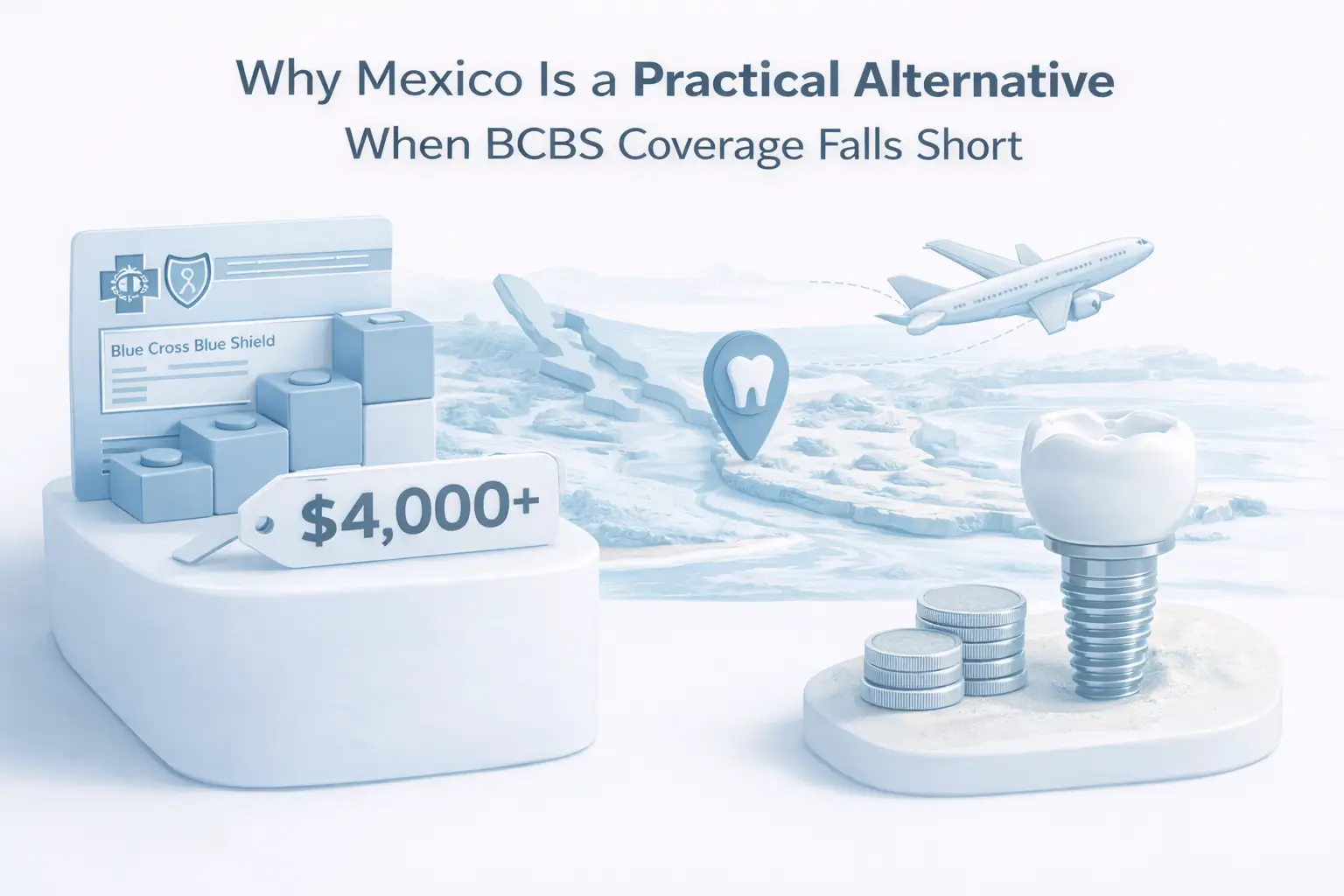
3D infographic illustrating Mexico as an affordable dental implant alternative when Blue Cross Blue Shield coverage is insufficient, showing potential cost savings.

Mexico is a popular destination for many U.S. patients because getting there and receiving treatment is simple. Flights are short, schedules are easy to line up, and recovery stays are easy to plan.

Most patients take a short flight, stay several days for surgery and early recovery, and return home with the implant placed and a clear plan for the next phase of treatment. There's no long travel, no unfamiliar systems to figure out, and no complicated coordination.

Even after flights and lodging, total costs often land 50–70% below typical U.S. out-of-pocket pricing. You get a written, itemized quote upfront that shows exactly what's included. There are no predeterminations, no approval delays, and no post-treatment denials. Costs stay predictable, and decisions stay grounded in real numbers.

Choosing the Right Destination for Your Situation

The right location depends on where you live, how much time you can take off, and how much flexibility you want for travel and recovery.

Some patients want the shortest possible trip. Others prefer a more comfortable recovery setting or easier access to specialists. There's no single "best" location. Only what fits your schedule, budget, and case.
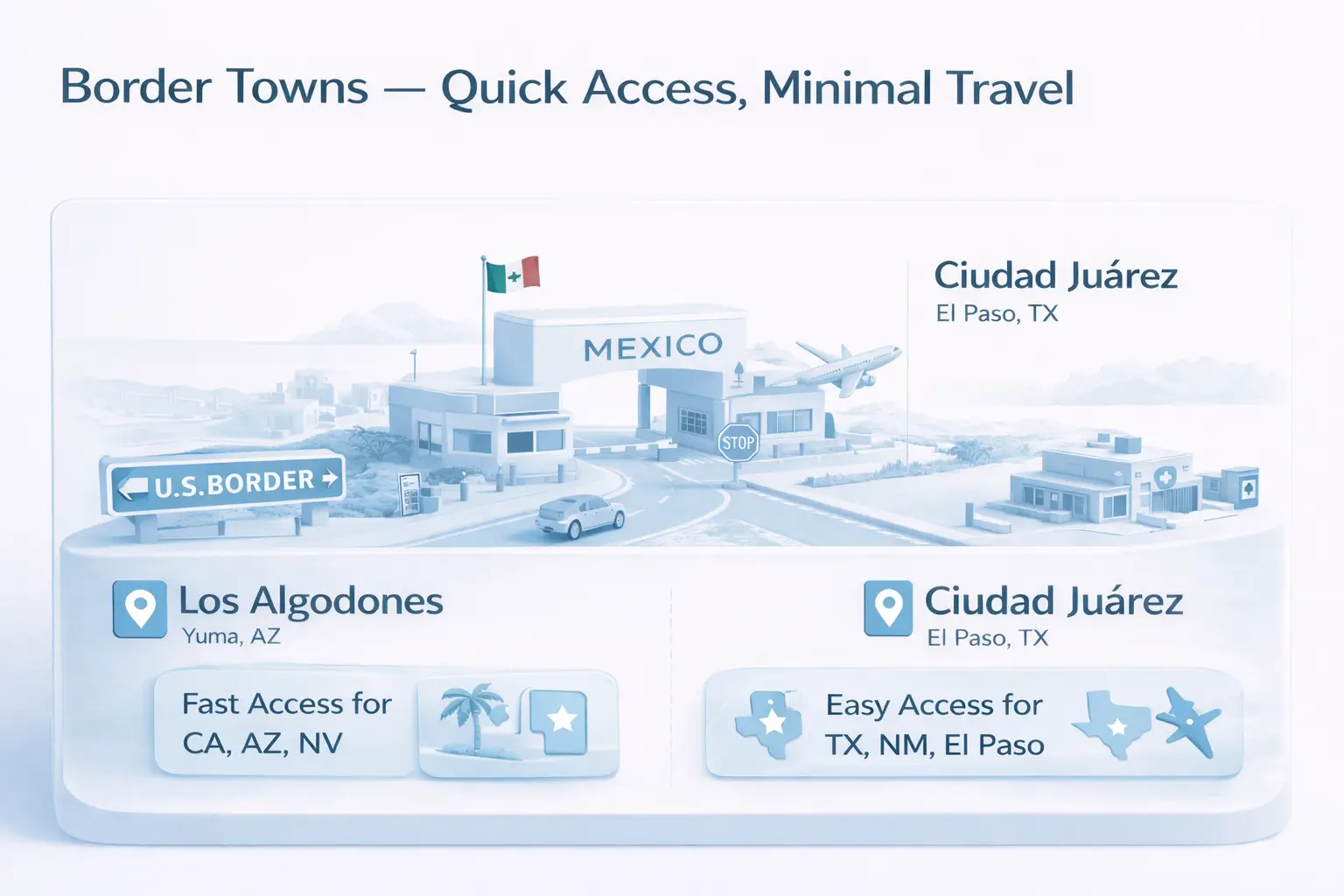
Border Towns: Quick Access, Minimal Travel

3D infographic showing travel proximity to Mexican border towns like Los Algodones and Ciudad Juarez for dental care, highlighting quick access for patients from California, Arizona, Nevada, and Texas.

If you live in the Southwest or want to keep travel as short as possible, border clinics can be a practical option. Travel time is minimal, and logistics are straightforward.

  • Los Algodones: Just south of Yuma, Arizona. Often called "Molar City," it has one of the highest concentrations of dental clinics in the world. Many patients stay nearby for a short surgical visit and return home quickly. Popular with patients from Southern California, Arizona, and Nevada.
  • Ciudad Juarez: Directly across from El Paso, Texas. Easy access for patients in Texas and New Mexico, as well as for anyone flying into El Paso. Short ground transfers and simple border access.

Best fit if you want the shortest travel time and don't need resort-style accommodations.
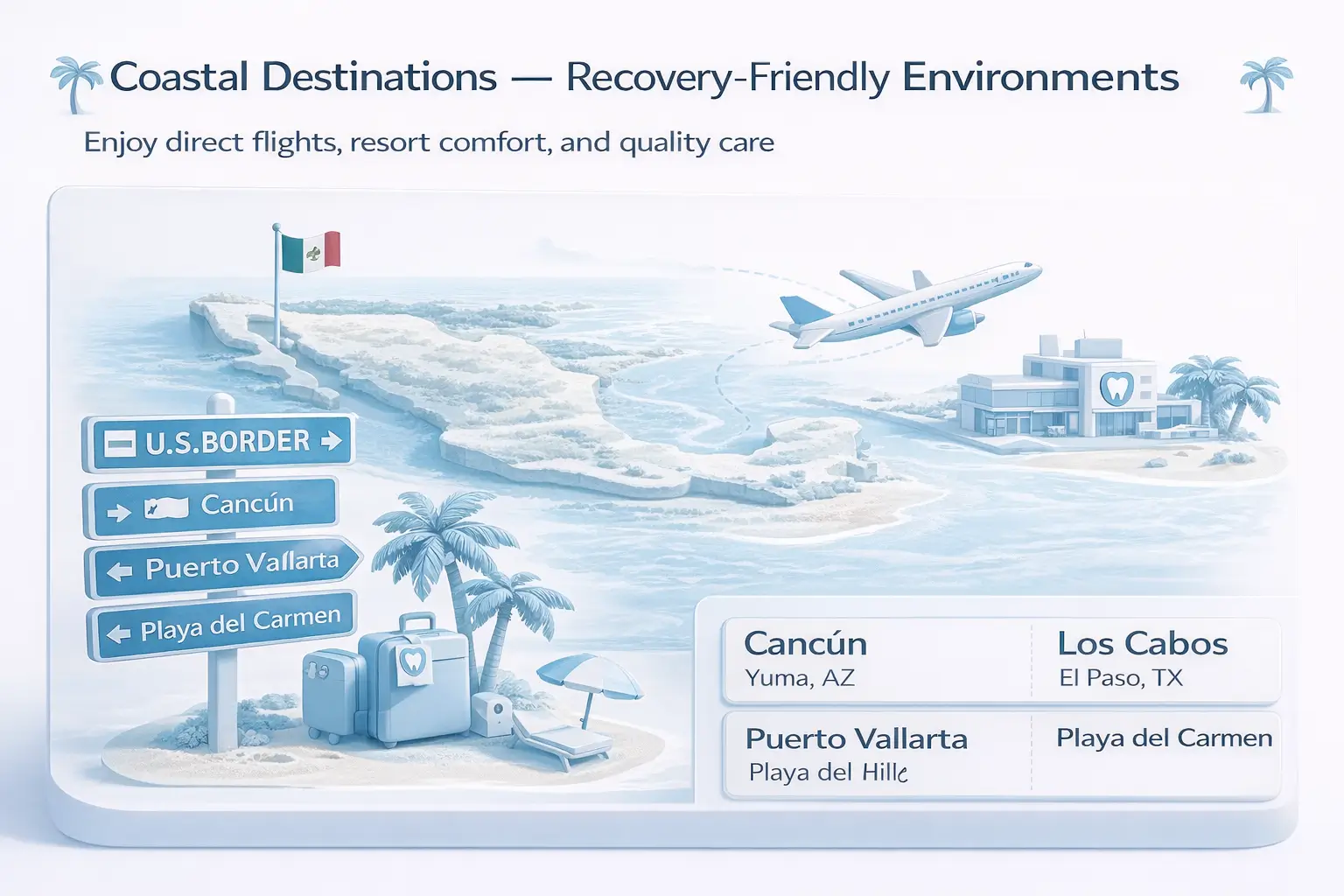
Coastal Destinations — Recovery-Friendly Environments

Infographic showing coastal dental tourism destinations in Mexico like Cancun, Los Cabos, and Puerto Vallarta for recovery-friendly dental implant care.

If you can take a few extra days and want a more comfortable recovery environment, Mexico's coastal cities offer direct flights from most major U.S. hubs and well-established medical tourism infrastructure.

  • Cancun: Nonstop flights from many U.S. cities, modern clinics, and a wide range of hotels. A common choice for patients who want convenience and reliable coordination.
  • Los Cabos: Direct flights from the West Coast, Phoenix, Dallas, and Denver. Quieter than Cancún, with more upscale accommodations and a dry climate that some patients find more comfortable during recovery.
  • Puerto Vallarta: Good flight connectivity from the West Coast and Midwest. Relaxed pace, solid healthcare access, and a wide range of lodging options.
  • Playa del Carmen: Smaller than Cancún and less crowded, while still offering resort access and proximity to major clinics.

Best fit if comfort during recovery matters and you're comfortable staying a few days locally.
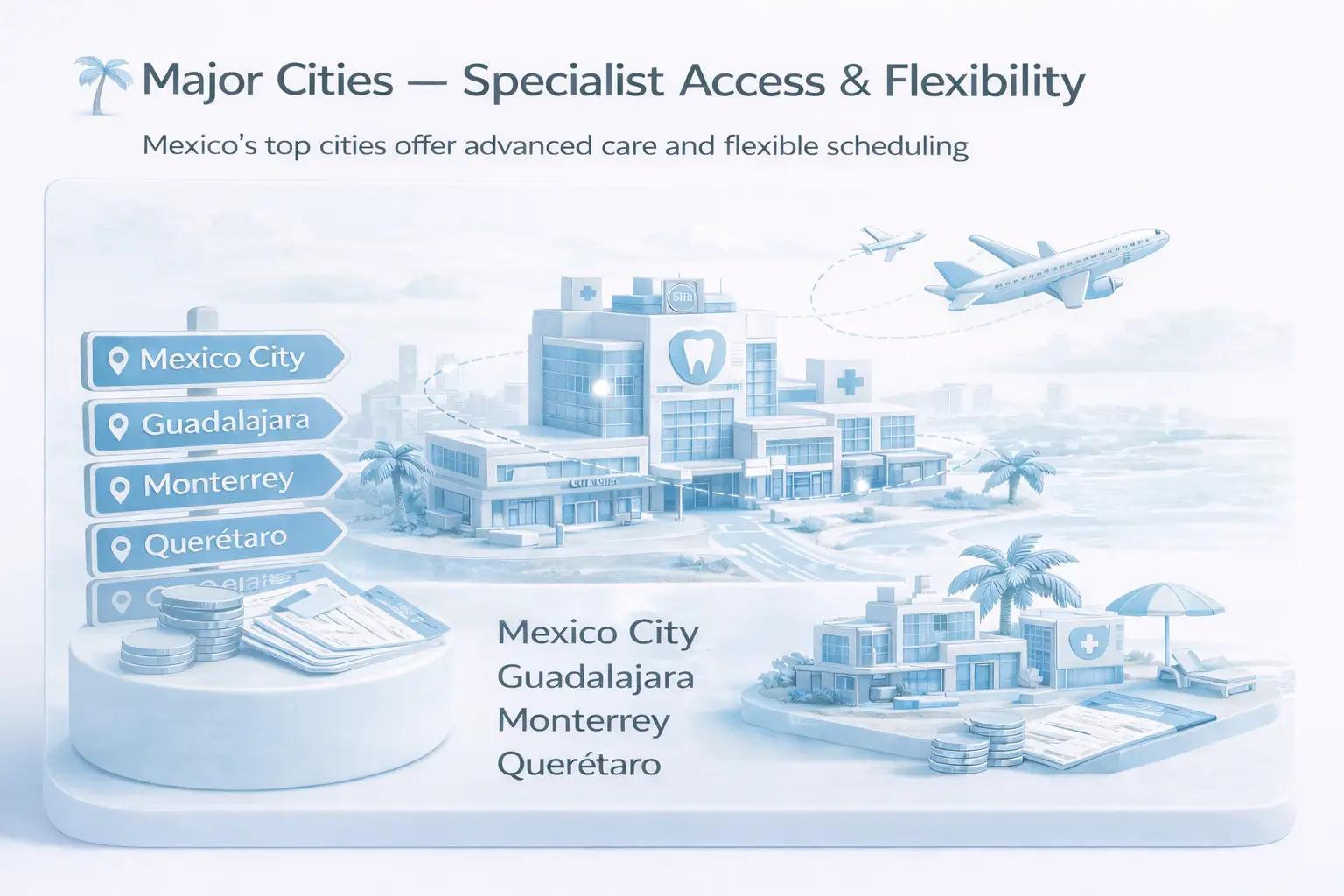
Major Cities — Specialist Access and Flexibility

Infographic listing major Mexican cities for dental implant specialist access, including Mexico City, Guadalajara, Monterrey, and Querétaro with direct flight routes.

For complex cases or patients who prefer a large urban medical environment, major cities offer deeper specialist access and more scheduling flexibility.

  • Mexico City: The largest medical hub in the country, with advanced imaging, surgical centers, and broad specialist availability. Often chosen for complex full-arch cases or second opinions.
  • Guadalajara: Strong private healthcare infrastructure, good flight connectivity, and a growing international patient base.
  • Monterrey: Close to the Texas border with a well-developed private hospital system and frequent direct flights from major Texas cities.
  • Queretaro: Smaller and quieter than Mexico City, with lower density and clinics serving both local and international patients.

Best fit if your case is complex or you want access to a broader specialist network.

What to Expect: Timing, Trips, and Recovery

Most implant treatments require two trips. The first visit covers implant placement and any extractions or grafting. After a healing period of roughly three to six months, the second visit completes the final crown, bridge, or full-arch restoration.

Plan two to four days onsite for a straightforward implant visit, and longer for full-arch cases that require multiple fittings and bite adjustments. Always build in at least one buffer day before flying home to allow for swelling, medication adjustments, or an unexpected follow-up check.

Compared to navigating insurance approvals, the clinical timeline is often similar, but there's less paperwork. There's no waiting weeks for predeterminations, no mid-treatment denials, and no uncertainty about what will be paid after the fact.

Once the quote is confirmed, you schedule and move forward with clear expectations.

Pro Tip

Book your return flight for the afternoon or evening. Never early morning after a surgical day. This gives you buffer time for a quick post-op check, bite adjustment, or prescription refill without scrambling to catch a plane while swollen.

How to Make Confident Decisions About Your Care Options

Focus on the full path, not just the initial price. Cost, timeline, follow-up care, and warranty protection matter more than any single line item.

  • If the treatment is urgent or medically necessary: prioritize timely local care, especially if delaying risks infection, bone loss, or functional problems. Still, confirm coverage in writing before treatment begins.
  • If the treatment is elective or coverage is limited: when your insurance out-of-pocket cost approaches the price of a reputable bundled option (including warranty value), bundled care often wins on simplicity and predictability.
  • If the case is complex (multiple implants or full-arch): prioritize the pathway with the clearest long-term maintenance plan and written warranty coverage. Adjustments and repairs are more likely over time, and how those are handled matters.

How Globalcare Supports Safe Dental Care Abroad

3D infographic for safe dental care abroad, featuring a medical travel kit with dental implants, boarding passes, and an airplane to represent international dental tourism.

When insurance coverage is limited, or you want a clearer all-in number, considering cross-border dental care in Mexico can make sense, as bundled pricing often reduces billing surprises. The opportunity is real, and popular destinations like Los Algodones are considered safe for dental tourism, but so are the risks if clinics, pricing, and aftercare aren't properly vetted.

Globalcare is built for patients who want structure, transparency, and clear documentation before committing.

What Globalcare does differently:

  • Clinic verification: Clinics in the Globalcare network go through credential checks, facility standards reviews, and ongoing quality monitoring. The same homework you'd do when choosing the best dentist on your own, but handled for you.
  • Clear bundled pricing: Quotes clearly state what is included (surgery, restoration, imaging, temporaries, follow-ups) and what is not (certain grafting, advanced sedation, unexpected findings).
  • Payment clarity and safeguards: Staged payments and written terms reduce confusion around deposits, scope changes, and cancellations.
  • Warranty and aftercare in writing: Warranty scope and post-treatment responsibilities are documented upfront.

This tends to fit best if:

  • You're priced out locally, and your BCBS annual maximum barely makes a dent.
  • You want to compare multiple clinics without endless calls.
  • You want clarity before committing.

Globalcare supports treatment in: Cancun, Los Cabos, Los Algodones, Puerto Vallarta, Playa del Carmen, Guadalajara, Mexico City, Queretaro, Monterrey, Ciudad Juarez, and Merida. The best location depends on your schedule, treatment complexity, comfort level, and budget.

Common Questions About Dental Implant Insurance and Aftercare

Does BCBS Cover the Crown for Implants?

In most BCBS dental plans, the implant crown and abutment are limited or excluded unless you have a higher-tier plan or a specific implant rider. Even when the surgical placement is partially covered, the restorative phase is usually paid largely out of pocket.

Always confirm crown coverage by billing code, for example: D6065 for an implant-supported porcelain or ceramic crown, and request written confirmation whenever possible. What you're told on the phone isn't binding and often leads to misunderstandings once claims are submitted.

Common Reasons Dental Implant Claims Are Denied

Most implant claim denials happen for paperwork or process reasons, not because the treatment itself was inappropriate:

  • Predetermination or preauthorization was required, but never submitted.
  • Clinical documentation didn't meet the plan's requirements.
  • The billing code didn't match what the plan covers, or was processed under the wrong benefit.
  • Annual maximums were already used earlier in the year.
  • An alternate benefit was applied, paying as if a bridge or denture had been chosen.

Nearly all of these issues can be avoided by confirming coverage by code in advance and keeping written confirmation.

Pro Tip

If your claim is denied, request the specific plan language BCBS used to justify the denial. Denials often cite vague "not medically necessary" reasons, but the actual policy text may reveal a documentation gap you can fix and resubmit within 30–60 days.

Planning Aftercare for Dental Implants Received Abroad

Aftercare should be planned before you travel, not figured out after you're home. Look for written terms that clearly spell out:

  • Who handles adjustments, repairs, or complications once you return
  • What is covered versus excluded, and for how long
  • How to contact the clinic after treatment and expected response times
  • Whether local follow-up care is available for routine maintenance or urgent issues

If you don't have this in writing, with current contact info and a clear plan for what happens if something needs fixing, assume you'll be handling follow-up care back home and paying for it yourself. If something does go wrong, Mexico has official channels for filing dental complaints, but working with a vetted clinic network such as Globalcare lowers the odds you'll ever need them.

Tips for Avoiding Unexpected Implant Costs

BCBS implant coverage varies widely by plan and is rarely all-in. The most reliable way to reduce surprise costs is to follow a simple discipline:

  1. Get a dated, itemized treatment plan.
  2. Verify coverage by billing code.
  3. Get written confirmation through predetermination or preauthorization.
  4. Compare your true out-of-pocket cost against bundled alternatives, domestic or cross-border.
  5. Confirm warranty and aftercare terms in writing.

When each step is documented in advance, financial risk drops sharply.

Compare Providers and Treatment Plans With Clear Pricing

If you've confirmed your codes and your out-of-pocket cost is still high, the next step is an apples-to-apples comparison of reputable clinics and complete treatment plans.

On Globalcare, clinics are vetted before joining the network. You can:

  • Filter by treatment type, location, and preferences
  • Compare pricing and clinic details side-by-side.
  • Message clinics directly to request written quotes covering inclusions, exclusions, timelines, warranty, and aftercare.
  • Move forward only once the scope and total cost are clearly defined.

This shortens the distance between insurance uncertainty and a concrete, documented decision.

About the Editorial Team and Review Process

Editorial note: This article is for general education and does not provide individualized insurance, medical, or legal advice. Coverage and eligibility depend on your specific BCBS or FEP plan, clinical documentation, and compliance with plan requirements (such as waiting periods, predetermination, and preauthorization).

While we strive for accuracy, this content may contain errors, outdated information, or unintentional inconsistencies. Always verify details directly with BCBS, your plan administrator, and your treating clinician before making decisions about your care.

  • Created by: Globalcare editorial team (patient decision support)
  • Disclosures: This article references Globalcare and may be used in connection with Globalcare’s services. Readers should still compare options and verify coverage independently.
  • Last updated: January 2026

Get in touch to get started!

Our team of experts will ensure your all-on-4 dental implants journey is safe and easy. We're dedicated to guiding you to your new smile every step of the way!

Connect

Concierge Services

a ilustration of a person receiving a patient for transport

Trusted Dentists

A doctor waving through a phone

Safe Locations

A ilustration of a person under a beach umbrella

Concierge Services

a ilustration of a person receiving a patient for transport

Trusted Dentists

A doctor waving through a phone

Safe Locations

A ilustration of a person under a beach umbrella

Ready to get Started?